




That perception is heightened by the fact that several lucky figures accused of corruption have been pardoned. Last August, President Prabowo forgave former trade minister Thomas Lembong and senior politician Hasto Kristiyanto, merely days after the two had been convicted in separate cases of corruption. Last November, he issued a decree granting full rehabilitation to three former executives of state-owned ferry operator ASDP Indonesia Ferry who had been convicted of corruption, including former CEO Ira Puspawati. But not everyone is that lucky. They lie outside the purview of the benevolent Garuda state.
Wealthy Indonesians are increasingly feeling the prosecutorial wrath of the Garuda economy. They are wondering about what has gone wrong and how they may make amends. A clearer indication of the flight path of the Garuda state is necessary, both for the wealthy and equally for Indonesia’s overall credibility as a globalising economy that welcomes migratory capital. After all, if local business is suspect, so must be foreign business, indeed, doubly so. That is how it was before economic realism overtook economic nativism.
According to law scholars Royhan Akbar and Sulistiowati, “this drive by the Indonesian government has been raising concerns on the misuse of legal instruments” to capture public attention through populist means or to “retaliate against political adversaries, without clear accountability”.
The same note of concern is struck by the Indonesian political observer Rocky Gerung, who has framed the relationship between the government and business leaders as representing an “oligarchic” interplay. In that interplay, businessmen are finally at the receiving end of this “political” persecution.
See also: Indonesia tightens FX rules, supports rupiah with hawkish hold
A number of organisations (including CIVICUS, Amnesty International and Human Rights Watch) and commentators (such as Joshua Kurlantzick and scholars writing for the East Asia Forum) have decried the current government’s increasing use of legal processes and the criminal code to consolidate political power and to intimidate rivals and suppress dissent. The gravely heightened risk of selective law enforcement rather than neutral adjudication and the substantially weakened prospects for impartial justice in politically sensitive cases have often been highlighted. The repressive use of laws to silence government critics also threatens civic space and freedom of expression.
The Garuda state
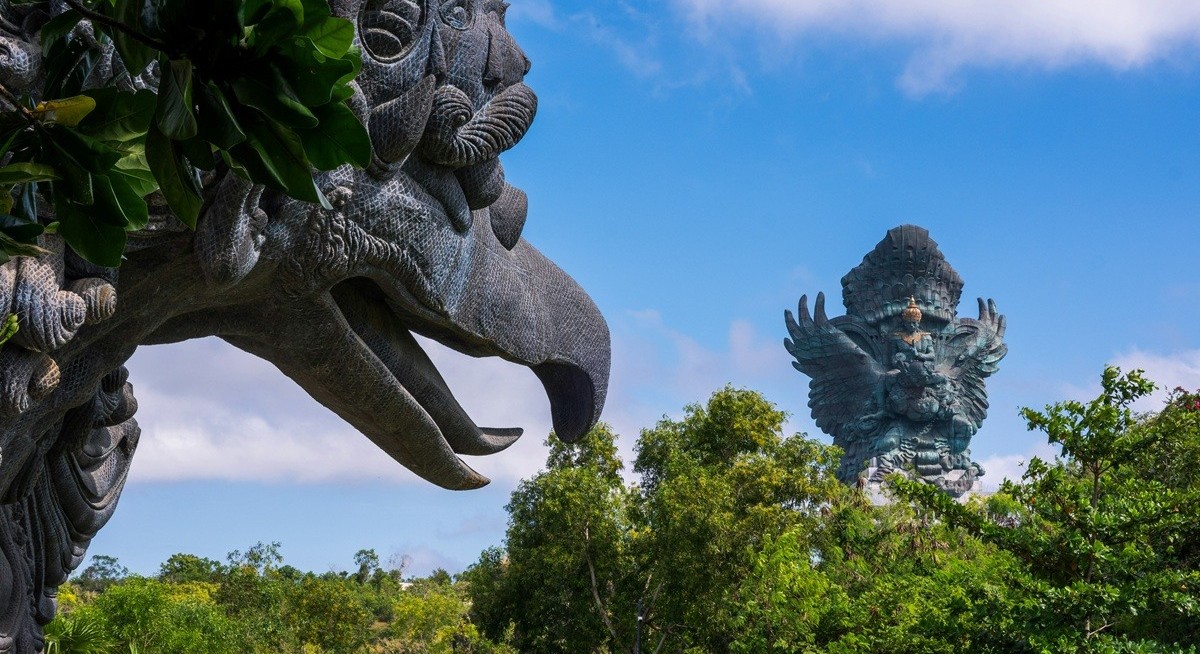
Let me introduce the Garuda, the motif of this article. The Internet is awash with information about him. Here is an overview: “Garuda is a divine, eagle-like figure in Hindu, Buddhist, and Jain mythology, serving as the mount (vahana) of Lord Vishnu. Known as the king of birds, he symbolises speed, immense strength, and martial prowess. Son of Sage Kashyapa and Vinata, he is famed for stealing amrita (nectar of immortality) to free his mother from slavery, representing the triumph of light over darkness and knowledge over ignorance.”
That is an apt description of contemporary Indonesia as well. Speed, strength and the warrior spirit mark the collective character of a people who resisted the brutalities of Dutch colonialism through one repulsed revolt after another — until, on the historic day of Aug 17, 1945, they broke free of the talons of an imposed past in a sensation of independence that lasts to this time. Indonesians gained freedom, sovereignty and renewed their strength as a people that no foreign power would rule over again. The Garuda had prevailed across a vast archipelago that gave its wings space to soar across the skies.
See also: Defiant Prabowo spars with Indonesia tycoons and market sceptics
The Garuda story has an important angle. The national bird is the eternal enemy of the Nagas (serpents), a mythological rivalry that stems from a bet between the Garuda’s mother, Vinata, and her co-wife, Kadru, the mother of the serpents. The mythology makes rational sense: birds and serpents do not get along biologically. The forest does not belong equally to all its species: It belongs to the species most of whose members have survived the Darwinian struggle for existence.
Hence, independent Indonesia, symbolised by the Garuda, had to decide who the Nagas were. Indonesians had disposed of the colonial Dutch and the imperial Japanese in the aftermath of World War II. They were indeed Nagas.
But other enemies of the state remained, this time partly real and partly imagined. They were the presumed descendants of the mythological Nagas. They were businessmen, particularly of Chinese ethnicity, who were seen as an economic fifth column operating within the pribumi — or indigenous — contours of pristine Indonesia. Indonesia’s first President, Sukarno, nationalised swathes of the economy. Many thousands of Dutch residents were expelled, and their businesses seized, businesses that included plantations, banks and trading companies.
Then, targeting the Chinese community, a regulation banned foreign retailers from operating in rural areas, thus forcing many to move to urban areas or close their shops. Also, in what came to be known as the “Sukarno Method”, trade unions would take over foreign-owned companies, after which the government would seize their management. The Garuda flies over all humankind: Sukarno clept the wings of the Garuda state so that it would flap only over the economically contracting contours of nationalist Indonesia.
Sukarno had acted under the influence of domestic communists who had been inspired and supported by foreign communist countries. The anti-communist coup of 1965 that brought President Suharto to power took care of the communist Nagas, perhaps forever. But what about the presumed Nagas of capitalism?
Suharto had a way of dealing with them. In a departure from the flamboyant leftist adventurism of the Sukarno years, which undermined Indonesia’s economy perilously, the conservative Suharto returned the country to a golden era of financial realism and economic success
Although his New Order era of three decades is accused of having inaugurated a phase of crony capitalism, wherein the presidential family accumulated massive wealth through symbiotic relationships with a closed circle of the rich, often ethnic Chinese business leaders known as cukong, the truth was less dramatic. The entrepreneurial energy of market leaders, Chinese or otherwise, became a rising tide that lifted the boats of the pribumi economy.
Sink your teeth into in-depth insights from our contributors, and dive into financial and economic trends
Business was not the enemy of humans: the waters of the sea were not the enemy of the boats that carried travellers to their destinations. They could never be, because, otherwise, there would be no boats and no travellers.
When Suharto fell at the end of the last century, it was because of the Asian Financial Crisis and not because of intrinsic faults with the Suharto Model. The Nagas were not Indonesian businessmen: They were unseen and uncontrollable foreign market forces that had slithered their way into the Garuda’s Indonesia from the hidden recesses of the Asian and indeed the global economy. The problem with treating successful businessmen today as the latest Nagas, as the reincarnation of Sukarno’s serpents, is that it would do little to resolve underlying economic problems, although Indonesia has moved far beyond the stage of the post-Independence economy. Indonesia’s prosecutorial agencies are powerful guardians of economic sovereignty, as they should be, but going after the domestic wealthy is no way of attracting the foreign wealthy to invest in the country.
Instead, to reiterate a point made earlier, foreign investors cannot help but look askance at a country which, they might come to believe, is making scapegoats out of its most economically successful for invisible political reasons. Indonesia is a considerable player on the global stage as Southeast Asia’s largest economy, a position that makes it eligible for a place at the Group of 20 table of the world’s major advanced and emerging economies.
As an international player, Indonesia needs to treat its wealth-generators with an eye to its global reputation. It does Jakarta no good if its actions against businessmen are tied up with the less-than-desirable aspects of its human-rights record. Images, true or not, create perceptions that become a working reality.
The new nationalism
The Indonesian administration is avowedly nationalistic. President Prabowo wants to return economic power to the people by taking it away from entrenched and parasitic elites. This desire is not only natural but welcome. He ascended to the presidency on the promise of a new social contract with the Indonesian people. His robust, indeed muscular, nationalism heralds a return to the Sukarnoist days of Indonesia’s political prominence as an Asian leader of the Non-Aligned Movement, combined with the Suhartoist era of Indonesia’s rise in a globalising economy. Prabowo wants the best of both worlds — a desire which pays tribute to his self-confidence as a legatee of the Garuda’s power.
However, the increasingly determined pursuit of businessmen carried out by parts of his Administration and prosecutorial agencies detracts from that goal. Consider the way in which private businessmen were apparently pressured into participating in the state-owned investment vehicle, Daya Anagata Nusantara (Danantara), through a “Patriot” bond initiative aimed at financing national strategic projects. The move was seen as “a blend of state-business partnership and forced contribution”, in one account.
Now, it is true that Jakarta has to raise funds somewhere and somehow for transformative projects, which include the Free Nutritious Meals scheme that aims to provide free meals to tens of millions of schoolchildren and pregnant women in order to prevent stunting and consequently affect learning in children.
How can that programme not be welcome? Children are Indonesia’s future: Their capacity to create a worthwhile future has to be built up here and now. The meals scheme could well become President Prabowo’s signature legacy to his successors. Take it away, and they will be answerable to a population empowered by food for children. That is what the leaders of nations exist to do: fill the mouths of children.
However, the Danantara bonds are issued with a 2% interest rate, which is well below the market rate for Indonesian government bonds. Claims that the purchases were voluntary contributions to national development are belied by the low yield, which becomes negative when considering inflation. Now, while even the richest of Indonesian businessmen, whether they are pribumi or Chinese or Arab, would not wish to take food out of the mouths of innocent children, they have a right to ask why they should be forced into participating in what is essentially a charity drive. Charity is voluntary by definition.
President Prabowo’s agenda for Indonesia’s renewal is not being helped by treating market warriors as Nagas. They are not lurking serpents. Instead, they belong to the extensive family of the Garuda. Those who are manifestly not so deserve to be treated as serpentine intruders and treated likewise. But the business families that have tried to raise the Garuda state to new economic heights should be treated as compatriots.
The Garuda state cannot lift its wings without the winds of its economy beneath them. The Garuda has seen it all.
The writer is the founder and CEO of Pereira International, a Singapore-based political and strategic consultancy. An award-winning journalist and a graduate alumnus of both the London School of Economics and Political Science and the Kennedy School of Government at Harvard University, he is also a member of the Board of International Councilors at the Center for Strategic and International Studies in Washington DC. This article reflects the writer’s personal views.




