





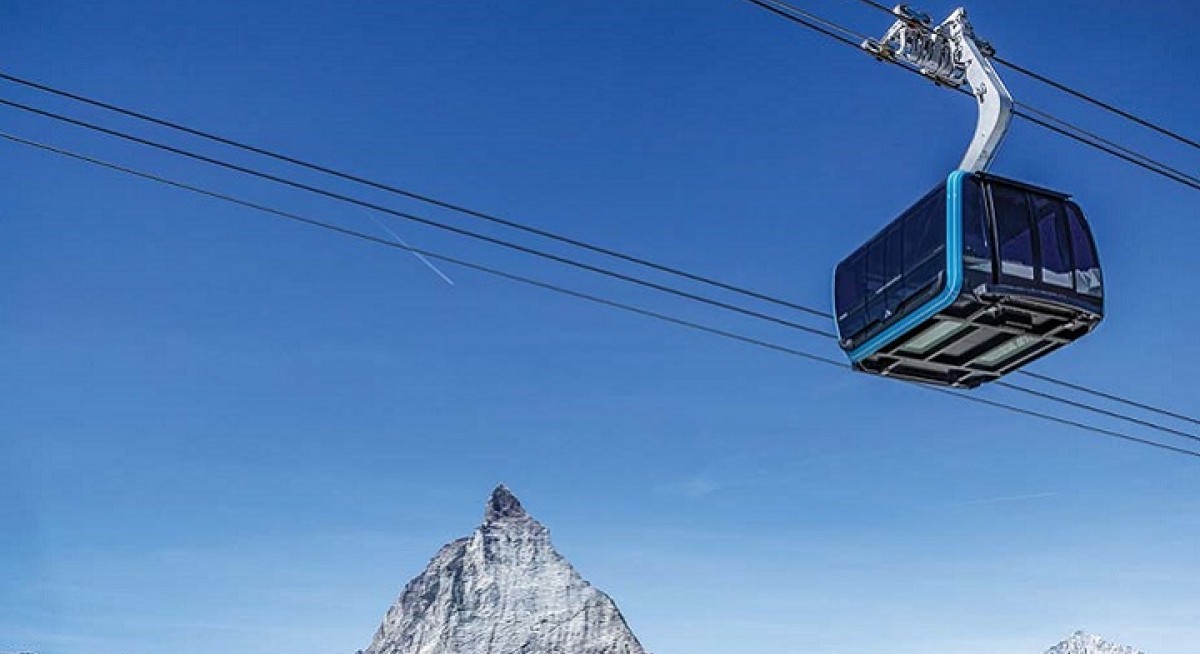


 Four “Crystal Cabins,” marked by blingy Swarovski exteriors, come with an extra perk: matte glass floors that turn transparent once the lift hits 560ft, offering a spectacular view of the glacier that wraps around Matterhorn’s base.
 A gondola pulls into the station
For Zermatt regulars, it is a very welcome upgrade. The previous system was not just 40 years old; in high season, it could see wait times of 1.5 hours. Now there is triple the capacity.
It is also pretty plush, considering that passengers slide in with their snow- and mud-covered boots. In all 25 cabins, you will find heated leather and faux suede seats designed by Pininfarina and emblazoned with the mountain’s logo (in Swarovski crystals). “The design of the cabin is pure, harmonic, and dynamic — a perfect display of the best Pininfarina design,” company chairman Paolo Pininfarina tells Bloomberg.
All this comes at a steep cost to Zermatt Bergbahnen: At US$60 million, the gondola is an investment eclipsed in Europe only by Austria’s US$72 million Stubai Glacier Ride, which also has Pininfarina seats. Here, the cost is not just increased by luxury materials; besides all the crystals, the cost was due to ambitious engineering feats that included distance (the longest cable spans 1.6 miles between two towers, a record in Europe), wind-and fog-related weather constraints and the challenges of working at such high altitude (for two and a half years, this was the highest construction site on the continent).
Those same challenges make the investment more likely to pay off. With an altitude of nearly 13,120ft, Zermatt’s Glacier Paradise is exempt from the so-called climate-change danger zone, designated to resorts with top stations below 2,000m (6,560ft). And whereas ski conglomerates such as Vail Resorts are trying to compensate for unpredictable winter business by building summer programming from scratch, Zermatt has always benefited from running year-round — in 2017, there were nine summer visitors for every 11 winter skiers at the destination, driven by a growing Asian market. Specific “Crystal Ride” tickets come in just under US$10 per person.
“We expect [the new gondola to drive] an increase in the number of guests, especially in the field of excursion tourism,” says Mathias Imoberdorf, communications manager at Zermatt Bergbahnen, about the investment. Already, the Klein Matterhorn has snow tubing, a cinema lounge, a subterranean glacier palace, and the top station’s tri-country viewing platform to keep non-skiers entertained.
A gondola pulls into the station
For Zermatt regulars, it is a very welcome upgrade. The previous system was not just 40 years old; in high season, it could see wait times of 1.5 hours. Now there is triple the capacity.
It is also pretty plush, considering that passengers slide in with their snow- and mud-covered boots. In all 25 cabins, you will find heated leather and faux suede seats designed by Pininfarina and emblazoned with the mountain’s logo (in Swarovski crystals). “The design of the cabin is pure, harmonic, and dynamic — a perfect display of the best Pininfarina design,” company chairman Paolo Pininfarina tells Bloomberg.
All this comes at a steep cost to Zermatt Bergbahnen: At US$60 million, the gondola is an investment eclipsed in Europe only by Austria’s US$72 million Stubai Glacier Ride, which also has Pininfarina seats. Here, the cost is not just increased by luxury materials; besides all the crystals, the cost was due to ambitious engineering feats that included distance (the longest cable spans 1.6 miles between two towers, a record in Europe), wind-and fog-related weather constraints and the challenges of working at such high altitude (for two and a half years, this was the highest construction site on the continent).
Those same challenges make the investment more likely to pay off. With an altitude of nearly 13,120ft, Zermatt’s Glacier Paradise is exempt from the so-called climate-change danger zone, designated to resorts with top stations below 2,000m (6,560ft). And whereas ski conglomerates such as Vail Resorts are trying to compensate for unpredictable winter business by building summer programming from scratch, Zermatt has always benefited from running year-round — in 2017, there were nine summer visitors for every 11 winter skiers at the destination, driven by a growing Asian market. Specific “Crystal Ride” tickets come in just under US$10 per person.
“We expect [the new gondola to drive] an increase in the number of guests, especially in the field of excursion tourism,” says Mathias Imoberdorf, communications manager at Zermatt Bergbahnen, about the investment. Already, the Klein Matterhorn has snow tubing, a cinema lounge, a subterranean glacier palace, and the top station’s tri-country viewing platform to keep non-skiers entertained.