


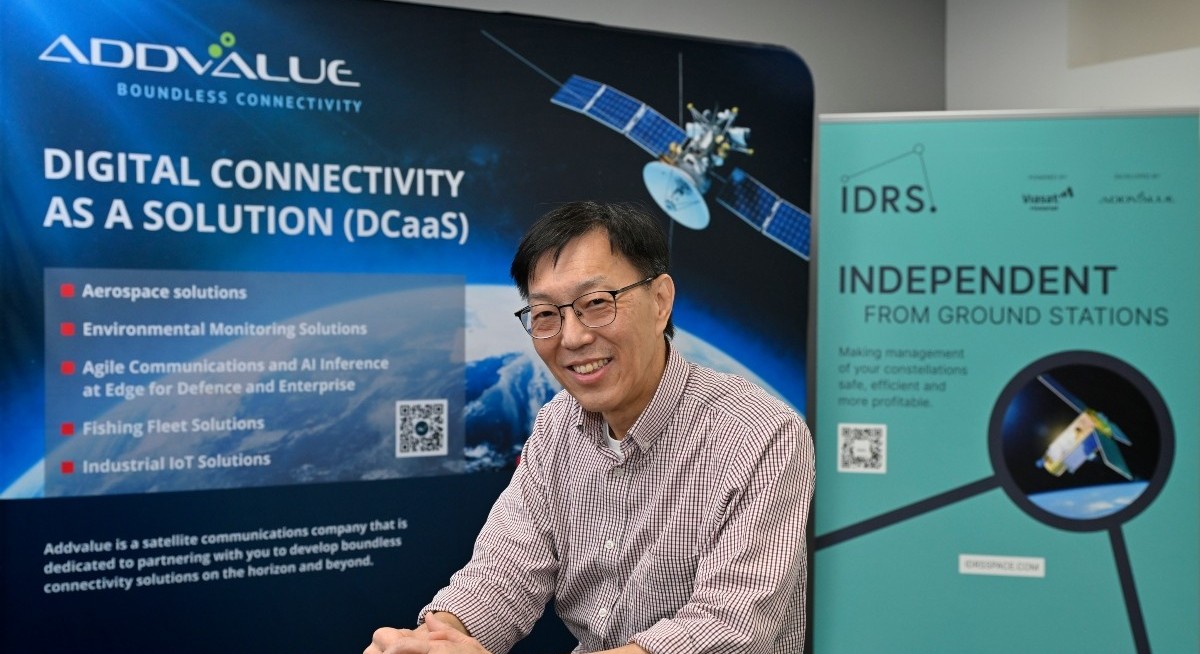


Addvalue Technologies has seen a steady pick-up in orders amid rising global interest in the space economy. Over the past year, its share price has enjoyed a gain of some 1,450% and at the June 24 closing price of 13.7 cents, its market cap is above $500 million. Its shares are often among the most actively traded counters on the Singapore Exchange (SGX), where it has been listed since June 2000.
The improved trading performance is backed by better results. For its FY2026 ended March 31, earnings surged 147.5% y-o-y to US$4.8 million ($6.2 million), on the back of 59.9% increase in revenue to US$24.8 million. The gains were driven by what CEO Tan Khai Pang calls “good traction” with both of Addvalue’s key business segments: space connectivity (SPC) and advanced digital radio (ADR).
On June 8, the company announced another new batch of orders worth US$5.1 million, thereby lifting the orderbook to US$23.35 million, which gives Tan a “good indication” of better days ahead. “Never in our history have we started our financial year — at this early stage —with a book order of over US$20 million. We are expecting more orders to come in,” says Tan in an interview with The Edge Singapore.
This is a marked change in the company’s fortunes. Just last year, Addvalue was on SGX’s now-defunct watch-list. At one point, its share price was down to 0.8 cents, which valued the company at less than $40 million.
Thanks to steady improvements, Addvalue was able to exit the watch-list, just as the mechanism was removed. Today, it is included in two indices — the FTSE ST All-Share Index, since December 2025, and the MSCI Global Micro Cap Index – Singapore, since February this year. “[It’s been] pretty remarkable to think about where we came from about 12 months ago,” says Tan, who co-founded the company in 1994.
Previously the company’s COO and CTO, Tan has “high credibility” among stakeholders and the marketplace, says Abel Ang, CEO of Economic Development Innovations Singapore, who invested in Addvalue. “If you have ever seen him in action, when he talks [about] space tech with the Americans, the Americans take notes. So, this guy is elite and distinguished in his own right,” Ang tells The Edge Singapore.
Nasdaq spin-off
Within its broader portfolio, one of Addvalue’s key growth platforms is the Inter-Satellite Delay Relay System (IDRS), the space connectivity business it is preparing to spin off for a separate Nasdaq listing.
IDRS uses a compact terminal, roughly twice the size of a Rubik’s Cube, to address a practical bottleneck in space operations: Satellites in low earth orbit (LEO) move rapidly and are typically limited to short, scheduled contact windows with ground stations. Addvalue’s data relay technology allows satellite operators to communicate with their spacecraft more flexibly, including through ad hoc sessions, and to sustain those links beyond the visibility limits of ground stations.
What makes the IDRS business strategically different from a conventional hardware supplier is that each terminal placed on a satellite can create a long operating relationship, supported by recurring airtime and service revenues over the satellite’s life in orbit. As more satellites are launched by commercial, government and defence users, the value shifts from simply putting assets into space to keeping them reliably connected.
Tan says the spin-off was first floated about a year ago, when its US customers were growing rapidly; close to half of its IDRS customers are based in the US. The timing of this move is equally strategic. Legacy systems such as Nasa’s Tracking and Data Relay Satellite System (TDRSS), which have supported space missions for decades, are winding down as Nasa announced transiting new near-Earth missions to commercial solutions.
A spin-off would position IDRS as a pure-play global space infrastructure company, rather than one business line within a broader Singapore-listed technology group. A Nasdaq listing would place the business closer to the world’s deepest pool of space and technology investors, many of whom are more familiar with valuing companies based on platform potential, installed base, recurring revenues and strategic relevance to the space economy.
Listing the IDRS business in the US will give it the “right attention”, Tan shares. “The investors [there] are more discerning… [and] are savvier with the space industry, the space economy. We will be able to get better valuation multiples,” says Tan, adding that Addvalue will maintain a controlling stake in the Nasdaq-listed entity.
For Addvalue, the structure is designed to unlock value without severing the business it has built. The parent company is expected to retain a controlling stake, while continuing to support IDRS through manufacturing, engineering and technology development from Singapore. To meet rising demand, Addvalue is increasing production capacity at its existing premises for this year and beyond.
The strategic significance is clear: IDRS could gain the capital and market profile to compete globally, while Addvalue remains anchored in the value chain and benefits from the growth of the listed entity. If executed well, the spin-off could transform IDRS from a promising product line into a recognised space connectivity platform — and give Addvalue shareholders exposure to that growth.
The spin-off means Addvalue can raise more funds without diluting its current shareholder base. The move is derived from previous lessons when the company had to raise funds through several rounds of rights issues, which tested the patience of some shareholders.
As of June 18, over 40 satellites in orbit carry Addvalue’s products, from more than 20 customers. Around 100 terminals are already in customers’ hands, awaiting launch. Tan’s target is to have around 100 satellites in orbit by this time next year. Addvalue makes money from the recurring airtime fees from these units, which continue for as long as they stay in orbit.
Pillars of growth
Beyond its satellite communications business, Addvalue’s ADR pillar represents a strategically important growth platform built around software-defined radio (SDR) technologies. ADR sits at the convergence of several structurally expanding markets — counter-drone systems, signal intelligence, smart radio networks, defence electronics, and next-generation wireless infrastructure. As the spectrum becomes more congested, threats become more software-defined, and edge intelligence becomes mission-critical, the ability to capture, process, adapt and act on radiofrequency (RF) signals in real time is becoming a core capability in both defence and commercial applications.
Addvalue’s ADRS1000 module provides a reconfigurable digital radio building block that enables customers to accelerate the development and deployment of complex wireless systems. Rather than serving as a single-purpose hardware component, it gives system integrators, defence firms, technology companies and electronics manufacturers a flexible platform that can be embedded into their solutions. This makes ADR relevant not only to today’s drone and anti-drone ecosystem, but also to a broader set of emerging use cases where wireless systems must be adaptive, secure, intelligent and rapidly deployable.
ADR has the potential to evolve into a mission-critical, AI-enabled RF intelligence platform. Addvalue’s SDR modules are already designed for demanding operating environments where reliability, configurability and technical know-how matter. Over time, as more intelligence shifts to the edge, ADR can move up the value chain — from module supply, to embedded platform intellectual property (IP), to software-linked features, upgrades, analytics and lifecycle support. This creates the pathway for a more scalable and repeatable revenue model, with stronger customer stickiness and higher strategic value than conventional hardware sales alone.
Through its “one-stop shop” design and development services, Addvalue can enter high-value SDR application programmes at an early stage, work closely with customers on mission-specific requirements, and then systematically extract reusable platform IP, follow-on production revenue and software-enabled lifecycle value. In this sense, the design services business functions as an incubation engine for future ADR products, customer programmes and recurring platform economics.
Taken together, ADR strengthens Addvalue’s overall business proposition by demonstrating that the company is not dependent on a single growth vector. It adds a second, technology-rich platform with exposure to defence modernisation, autonomous systems, RF intelligence and AI-at-the-edge. While IDRS positions Addvalue in space-based data relay, ADR positions the group in the intelligence layer of advanced radio systems — a complementary growth engine that can broaden the company’s addressable market, deepen customer relevance, and support a more resilient long-term valuation narrative.
For now, Addvalue’s more immediate challenge is operational, which is to ensure supply can keep pace with demand. The company uses licensed intelligence software to monitor the availability of components such as semiconductor chips and categorising these parts by lead time and supply availability to decide how much to offer. Single-sourced components with long procurement lead times get the deepest stock cover; readily available parts get less. While less talked about, these aspects are key as a company has to be able to fulfil its orders in a timely manner when it gets them.
While the company reported more than US$7.2 million in cash, up from US$1.5 million in the previous financial year, Tan points out that not all of it should be viewed as profit, as part of the balance reflects customer prepayments. He says maintaining a healthy cash reserve remains a deliberate priority, not only to support the company’s next phase of growth, but also to give it the resilience to navigate sudden shocks in an increasingly fragmented and unpredictable global environment.
As Addvalue pursues further growth in the space sector, geopolitical considerations have become a more important part of its commercial strategy. Tan says the company is keeping a close watch on shifting global dynamics and has taken steps to address potential concerns among US customers and government-related end-users.
At the same time, Tan sees opportunity emerging from the new geopolitical environment. As more countries seek greater national sovereignty and self-reliance through their own satellite constellations, the total number of satellites in orbit is likely to expand further. Addvalue is therefore preserving the financial flexibility to withstand uncertainty, while preparing to capture a larger share of the opportunities that may arise. “Because of national sovereignty and self-resilience, every country wants that capability,” Tan says.
Broker’s call: Room for upside
Addvalue’s moves are attracting attention from the market. While Maybank Securities’ Jarick Seet was the first and so far, the only one, to initiate coverage on the stock, other reports may be released “soon”, says CEO Tan.
With the better-than-expected FY2026 earnings and prospects of the Nasdaq spin-off listing, Seet has applied 30 times FY2027 sales valuation to value the company at 34 cents, which is an upside of 148.2% to the June 24 closing price of 13.7 cents. Even at this valuation multiple, Addvalue would still be at a 65% discount to global peers, according to the analyst.
“With US valuations far higher than in Singapore, we estimate a potential market cap in the US$180 million to US$250 million range and the potential to return some cash to shareholders if the IDRS division is successfully listed on the Nasdaq,” writes Seet in his June 8 report.
Besides better exposure to US-based customers, the listing can also help lead to potential M&A opportunities. Presumably with a higher valuation from Nasdaq, Addvalue’s valuation here in Singapore could improve further, reasons Seet.
“Besides AI, Addvalue is benefiting from two of the most exciting and highest growth themes in the investment world: drones and space. We expect a rapid growth phase in the next few years after Addvalue’s turnaround in FY2025,” says Seet, who ranks this company as one of Maybank Securities’ top picks in the small-cap tech space.
Management Access
Every month, we dive deep into the companies seeking to unlock value. If you have any questions that has not been touched on, scan the QR code or click here to submit them to Addvalue’s management team. Responses to selected questions will be published in four weeks’ time.




