


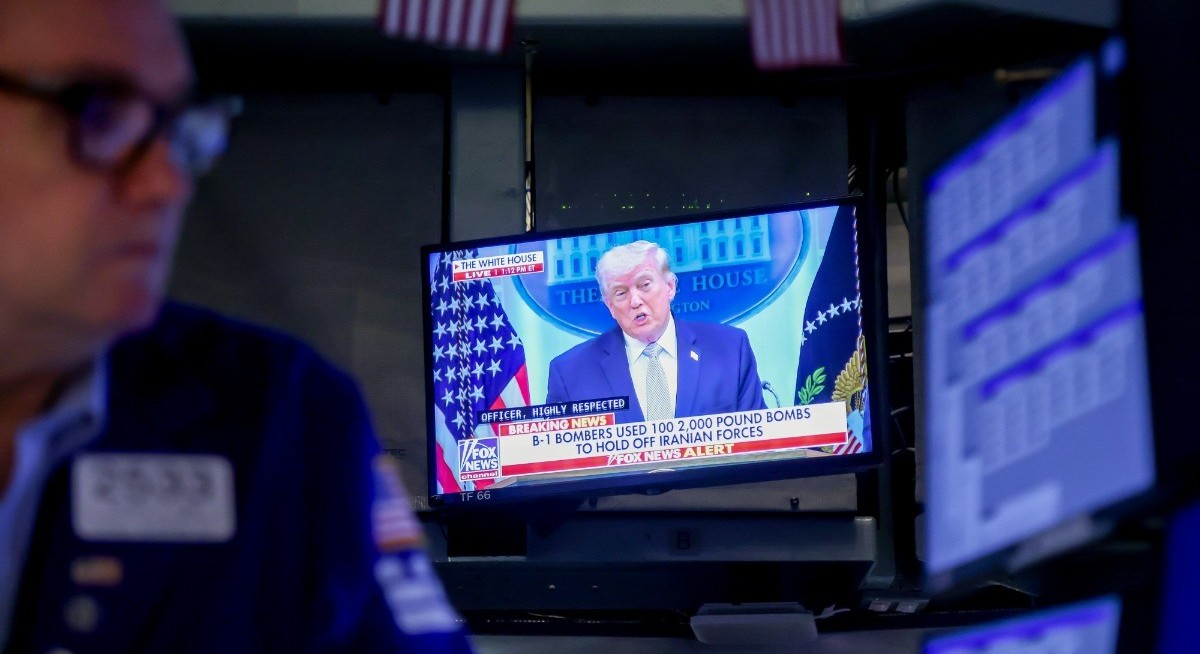


(April 15): It’s been two months since the war in Iran began, with no clear end in sight. But after some initial turbulence, Wall Street seems to be blocking out the noise.
The S&P 500 Index has climbed almost 10% since March 27, heading for a third consecutive week of gains. Over the same period, the Nasdaq 100 Index has advanced roughly 12%, rattling off 10-straight sessions in the green — its longest winning streak since 2021.
After US and Israeli military strikes on Iran set off a five-week-long drawdown, traders are now shrugging off negative developments in the Middle East, opting to continue piling into stocks.
“It just doesn’t seem that the equity market, or really financial markets in general, are all that concerned about the Strait of Hormuz,” said Doug Peta, the chief US investment strategist at BCA Research.
While stocks have started to move in tandem again as macroeconomic risks grow, a new earnings season means company fundamentals are more likely to move shares than headlines from Iran.
To Mark Hackett, the chief market strategist at Nationwide, institutional investors are behind the stock market recovery. After aggressive selling, attention has shifted back to fundamentals, which he says are supportive.
See also: US stocks climb on cooler wholesale price growth, lower oil prices
Meanwhile, the recent uptick in stock correlations driven by the rapid rebound and institutions’ use of index-tracking vehicles is poised to cool. A gauge of realized one-month correlation in the index’s members is hovering near the highest level since May, suggesting stocks have been trading more on macroeconomic headlines and less on company-specific issues.
“As the market settles, I expect that we return to a similar trend to where we started the year, with significant differentiation between winners and losers, with strength in international, small caps and value,” Hackett said.
Monday’s trading session demonstrated that anxiety around the war is easing. The S&P 500 was treading water at the start of trading after the US and Iran failed to reach a breakthrough in peace negotiations over the weekend. But by the end of the session stocks were 1% higher. The US stocks gauge also erased its war-driven losses in the process. The index jumped 1.2% on Tuesday.
See also: Citi logs best returns in five years as revamp begins to bear fruit
Veteran strategist Ed Yardeni has seen this setup before. Similar to the conflict between Russia and Ukraine, financial markets are learning to live with the Iran war, he told investors in a note Sunday. Yardeni stands by his call that the S&P 500 reached its bottom on March 30.
With the US and Iran now “haggling over technical conditions” in relation to the Islamic Republic’s nuclear programme, BCA Research’s Peta expects that the two sides will make swift progress toward a de-escalation. And with peace talks advancing much of the risk premium applied to equities and bonds during the conflict will be priced out of financial markets.
Still, the lack of clarity about what lies ahead and the ripple effects from the conflict elevate the risk of a “growth-scare drawdown” according to RBC Capital Markets’ Lori Calvasina.
While the S&P 500 was no longer expensive at March’s low, stocks have yet fall to levels that would be considered a reason to buy the market on its own, in Calvasina’s view.
“This is important because if the fundamental narrative around the war or its impacts changes, there is room from a valuation perspective for stocks to fall again, perhaps even more than they did before,” Calvasina wrote in a note to clients on Sunday.
Nationwide’s Hackett, meanwhile, is doubtful that the S&P 500 will return to its all-time highs until the picture around the conflict becomes clearer.
“I am skeptical that we can definitively break out to record highs until there is some demonstrative progress on a deal,” said Hackett. “But there is a coiled spring from conservative positioning, strong fundamentals, and reset expectations when that day comes.”
Uploaded by Isabelle Francis




