


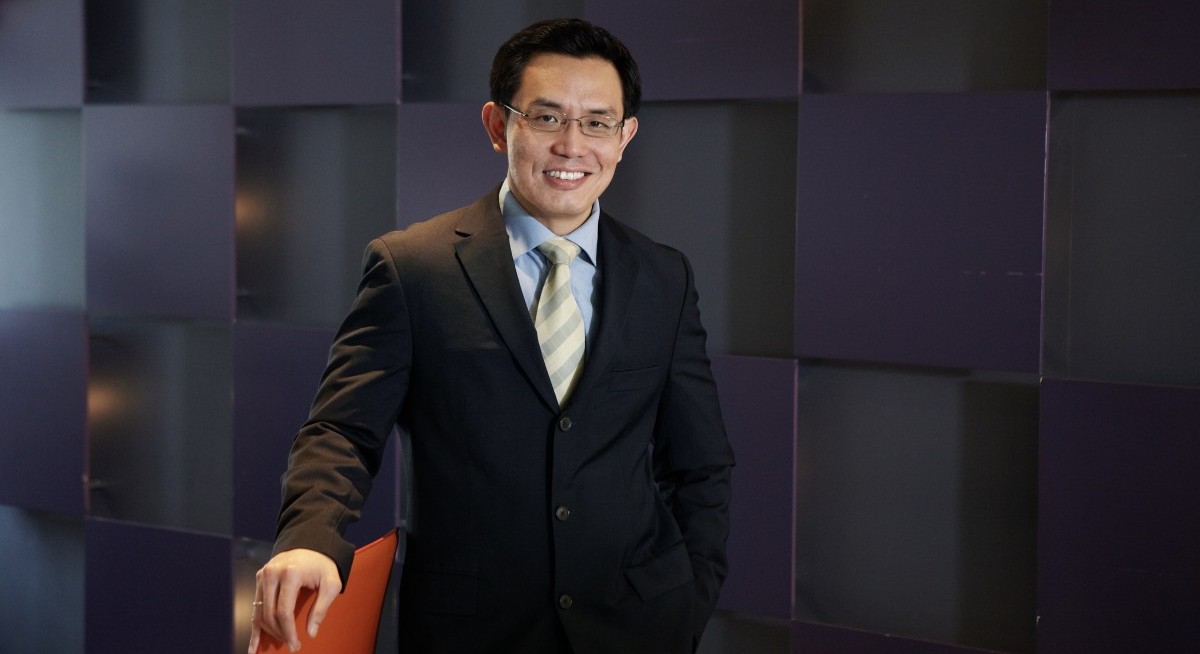


“Actually, I came to communications studies because I had failed to get into medicine at NUS (National University of Singapore). At that time, there was only one medical school in Singapore,” Ang told The Edge Singapore, adding that he ended up settling for communications studies because there were fewer classes and more girls enrolled.
“That was my absolutely degenerate way of looking at the world,” Ang joked.
But studying communications did not sever Ang’s early interest in science and medicine. If anything, it led him to join Singapore’s Economic Development Board (EDB), the city-state’s leading investment promotion agency. Ang’s career at EDB saw him take on different portfolios, first in communications and media, where he dealt with Internet companies at the height of the dot-com boom, before going on to head EDB’s global medical and biotechnology industry groups. Along the way, he earned a master’s degree in computational biology from Rutgers University on an EDB scholarship.
Ang credits his successful career to his mentor and former boss at the EDB, Philip Yeo. Yeo was EDB’s chairman from 1986 to 2006 and was known for taking an active interest in the careers of young officers, such as Ang.
See also: Google loses EU top court fight over €4.1 bil Android fine
“By some freak of nature, he took an interest in my career,” Ang says of Yeo. “I joined EDB in 1997. Next year will be 30 years already. So, it’s kind of like 30 years under the shadow of someone who has always taken an interest.”
“Many of the roads connect back to him,” Ang says, adding that Yeo was the one who landed him his first job in the private sector when he joined Hill-Rom, a medical devices company, in 2006.
“Mr Yeo was the one who called me to his office and said, ‘Hey, I got you a job in this company in the US and if you take this job, you will have to move there in the next three weeks. Do you want to do this?’ At that time, I didn’t know any better, so I said, ‘Sure, I will do it.’ Then he said, ‘If you don’t like it, don’t worry, I have already arranged for you to come back to the EDB after two years if you don’t like the job.’ After two years there, I actually enjoyed it, so I never came back.”
See also: SoftBank plans AI cloud services in US to tap surging demand
Leaving the public sector did not mark the end of Ang’s relationship with Yeo. The pair would reunite when Yeo embarked on his second act in 2013. This time, Yeo was the one who was leaping into the private sector when he started his own investment and advisory firm, Economic Development Innovations Singapore (EDIS).
“In a sense, I continue my expertise and, surprisingly, there’s quite a lot of demand. You know that old TV series Have Gun – Will Travel? That’s me now, I’m a mercenary in ED,” Yeo says in his 2016 biography Neither Civil nor Servant.
“Economic development, not erectile dysfunction,” Yeo quipped.
For Ang, working at EDIS is not unlike working at EDB. Yeo helms EDIS as its chairman. Ang reports to Yeo as the executive director. For a while, Ang worked for Yeo while also serving as the founding group CEO and president of Advanced MedTech from 2014 to 2024.
During its early years, EDIS was more focused on its advisory and economic development services for foreign countries, serving clients in Brazil, Colombia, Kazakhstan, Malaysia, Mexico, and the Middle East. Later, EDIS would branch into real estate investments and start hiring quantity surveyors, architects and urban planners. That sprawling focus eventually prompted a rethink from Ang.
“I went to Mr Yeo and said, ‘Actually, this is a chore.’ I have no business being in real estate. For economic development advisory, I spent almost 10 years at EDB, which at least gives me some credibility. But I think real estate was a little bit alien for me, but we did it because there was a lot of demand.”
In the end, Ang and Yeo arrived at the current iteration of EDIS: a deep-tech investment holding company. Ang says investing in deep tech companies falls perfectly within their zone of expertise and experience. Plus, they could now operate with a much leaner structure since they no longer needed to tap into a multi-disciplinary team, as they had when investing in real estate. Today, EDIS is run by a small team of fewer than 10 people, most of whom come from finance and investing backgrounds.
To stay ahead of Singapore and the region’s corporate and economic trends, click here for Latest Section
Investing is storytelling
That’s not to say that what Ang learned in communications school was for nought. The public servant-turned-businessman has a knack for delivering sharp pitches for his portfolio companies. That’s on top of the actual writing he’s been doing on the side, penning columns for The Straits Times about his travels, his views on parenting and his thoughts on the job market.
Having a penchant for storytelling is actually a good fit for investing. New York University finance professor Aswath Damodaran, better known as the “Dean of Valuation”, believes that investing and valuation are not just spreadsheet exercises. Rather, the best investments are those that blend a compelling story that teases a company’s future with hard numbers and metrics. Ang’s ability to tie complex scientific innovations to commercial sensibilities has proven invaluable for identifying potential investments for EDIS.
EDIS manages three funds. The first fund comprises the firm’s private equity and venture capital-related investments. Ang says one notable investment made by the fund was into Oodles Learning, a mathematics enrichment provider, in 2018. EDIS helped grow the company’s sales from about $3 million to $8 million before the company sold its controlling stake in Oodles Learning to the private equity firm Tower Capital. EDIS continues to retain a minority stake in the business.
The second fund is a dividend growth fund that is largely invested in Singapore equities. Ang says the fund’s returns are used to provide a steady source of income to fund EDIS’s operating expenses.
The third fund is a public markets fund that focuses on what Ang calls asymmetric opportunities. That fund is behind EDIS’s headline-grabbing investments in small- and mid-cap technology companies, such as satellite services provider Addvalue Technologies and marine engineering company Mencast.
Although it has been years since Ang and Yeo left EDB, Ang says EDIS shares the same mission as their former employer.
“EDB has always been about creating good jobs for Singaporeans. That ethos continues even till today because look at what we are trying to do now with our deep tech investments,” Ang says. “If we do what we do well, we will not just protect the livelihoods of Singaporeans, we will create new jobs in new sectors for Singaporeans.”
“Obviously, we have to generate a return. Anyone who manages money has to generate returns. However, the return can be generated by doing the right thing for the country and for the technologies developed here. I don’t think there’s a dichotomy. You don’t choose between returns and creating good jobs. You can do returns and create good jobs. It can be done.”
Adding value to Addvalue
One portfolio company that Ang is particularly proud of is Addvalue Technologies (SGX:A31 ) . Interestingly, the beleaguered company only came to EDIS’s attention because of a cold call Yeo had received about the company.
“Somebody wrote a random letter appealing to Mr Yeo to support this local company because they were going to go out of business within weeks,” Ang recounts. “We get a lot of such cold calls and we do screen most of them. Most of them are not investable businesses.”
In the end, what drew Yeo and Ang to Addvalue Technologies was its world-beating technology, its potential for global sales and the broader promise of the space technology market. Ang says the company is highly attractive because it is not making money on its hardware business but on its platform business as well.
Unlike geostationary satellites, which rotate at the same speed as the Earth, low Earth orbit satellites move much faster and are thus out of sight of Earth-based base stations. That’s where Addvalue Technologies’ products come in.
“What we do is we sell the handset to connect these low Earth orbit satellites to the Earth stations by channelling the signals through a geostationary object,” Ang says. “It works just like a handphone. SingTel or M1 sells you the handphone. They make a bit of money when they sell you a handphone, but the real money is made when they sell you minutes. We have the same business model.”
That potential was not obvious to the market back in 2021 when EDIS decided to invest $5 million in capital. Investing was the easy part. Ang says EDIS worked hard to rejuvenate and transform Addvalue Technologies by pushing for changes to its leadership and board.
“Their credibility in the marketplace was not good,” Ang says of the company’s reputation at that time. “It was bad. The reputation was so broken because everything that they said they would do, they didn’t do.”
To turn things around, EDIS pushed for the company’s then-CTO, Tan Khai Pang, to take over as CEO. “He’s a tech guy. He’s got high credibility in the marketplace, high credibility with the stakeholders,” Ang says of Tan. “If you have ever seen him in action, when he talks space tech with the Americans, the Americans take notes. So, this guy is elite and distinguished in his own right.”
Next, EDIS drove board renewal by bringing in people with the necessary expertise. To shore up the company’s financial capabilities, EDIS brought in Goh Liang Choo, an accountant and former finance executive from Shell, to chair its audit committee. In November 2025, Goh stepped down after serving on the board for three years.
That bet has paid off handsomely for EDIS. On Oct 29, Addvalue Technologies announced its exit from the now-defunct Singapore Exchange (SGX) Watchlist. The company was placed on the SGX Watchlist in December 2023 after posting three consecutive years of losses and a market value below the $40 million threshold. By the end of 2025, the company had become the top performer on the SGX, with its stock recording a total return of over 518%.
On April 27, news of a potential Nasdaq spin-off of Addvalue Technologies’ space connectivity business sent its shares surging past 15 cents, a new 52-week high. Jarick Seet, Maybank Securities’ research head for small- and mid-cap stocks, raised his target price for Addvalue Technologies to 31 cents from 12 cents on the same day. “Addvalue is one of the rare Asian space/drones plays in a rapid growth mode,” Seet says.
Betting on Mencast
The successful turnaround of Addvalue Technologies has given EDIS both the confidence and the resources to bet on other deep tech companies in Singapore. In fact, EDIS has already taken its next bet by pouring capital into local marine engineering firm Mencast (SGX:5NF) .
On April 17, EDIS announced it would raise its stake in Mencast through a $3 million convertible bond deal. The bonds have a three-year tenure and an annual interest rate of 4.75%. As part of the deal, EDIS can convert its bonds into 21.43 million shares at 14 cents per share.
Some of that capital came from EDIS’s partial sale of its Addvalue Technologies stake. EDIS netted $5.17 million after selling 55 million shares at 9.4 cents apiece. The transaction saw EDIS reduce its stake in Addvalue Technologies to 4.95% from 6.45%.
Mencast isn’t in the same position that Addvalue Technologies was in 2021. For one, Mencast is in a much stronger financial position. In FY2025, Mencast recorded over $46 million in revenue and the group held nearly $8 million in cash and cash equivalents on its balance sheet. In fact, Ang says the company could significantly increase its cash pile if it embraced an asset-light strategy and offloaded its properties.
Ang says he first came across Mencast when he was serving on the scientific advisory board for one of the research institutes under the Agency for Science, Technology and Research (A*Star). By working with A*Star, Mencast developed marine propellers using additive manufacturing rather than the traditional method of grinding hunks of steel. More importantly, Mencast’s new propellers had obtained the necessary regulatory approvals for use in open seas.
By tapping into decades’ worth of data, Mencast uses AI to develop propellers optimised for the vessels they serve. This isn’t just a design gimmick; it means the propellers can yield significant fuel efficiency because they are not over- or undersized for the ships they power, Ang says.
“What Mencast is doing now is actually what I call a holistic reimagination of the marine propeller business,” Ang says. “Now, when I make a propeller, I have to ship it and it is heavy. But if it is 3D printing, I just send my 3D printing crew to the place and they can print it there. There are no more logistics. You print when you need it.”
EDIS’s investment has already started to uplift the company, suggesting that investors are optimistic about another Addvalue-style success story. Mencast’s shares have risen by more than 30%, closing at 10 cents on April 27, up from 7.6 cents on April 17.
“I don’t know why the share price went up. I’m not a big fan of the 30% increase in the share price because it is driven by an announcement. In my mind, I am very comfortable if the share price falls,” Ang says.
“In fact, I hope the share price falls because I would rather that the share price goes up because of the actual value that the company has created and not because some joker has shown up and decided to invest some money in the company. That’s not sustainable.”
Scaling up businesses
Addvalue Technologies and Mencast are just some of the names EDIS has backed over the years. EDIS was one of the investors behind semiconductor optics company MetaOptics’ initial public offering. MetaOptics went public on Sep 9 at an offer price of 20 cents. At its peak, the company’s share price rose to $1.49 on Dec 5 but has since come down, closing at 88.5 cents on April 27.
“They actually had a pretty difficult IPO. So they needed people to come in and support them, to get them across the finish line. We supported getting them across the finish line,” Ang says of EDIS’s investment in MetaOptics.
“Why did we get them over the hump? Singapore needs to fund pre-revenue technologies to come to the marketplace. If pre-revenue technologies cannot come to the marketplace, then a lot of next-generation technologies will never see the light of day, because funding is a critical issue in the journey of technology,” Ang says, adding that EDIS has since fully exited from its investments into MetaOptics.
More recently, on March 26, EDIS subsidiary Fusionopolis Ventures said it had joined global food giant ADM as a joint venture partner and investor of ScaleUp Bio, Singapore’s first and largest precision fermentation contract development and manufacturing organisation. That deal had emerged from Yeo’s longstanding ties to Singapore’s biomedical industry.
In a nutshell, ScaleUp Bio is using the same technology used to make pharmaceutical products, such as monoclonal antibodies, to produce bio-based materials, such as probiotics.
“With ScaleUp Bio, the technology is world-class,” Ang says. “Why? Today I’m making bio-based ingredients, but if tomorrow suddenly we have a shortage of pharmaceutical manufacturing, you can make pharmaceutical products there too.”
It’s easy to look at the wide range of industries in which EDIS has invested and wonder whether it has a central focus. After all, this is the same investment firm whose capital is tied up in space technology, marine engineering, biomanufacturing, healthcare, fertility, and senior living. For Ang, the unifying theme across all of EDIS’s investments has been to bet on companies developing world-class, scalable technology.
Deep tech’s a long game
Incidentally, that’s the same focus of the Singapore government. According to the National Research Foundation, the city-state’s deep tech start-ups have attracted US$1 billion ($1.28 billion) or more in venture capital funding annually over the past five years. Singapore itself has invested over $125 billion to grow its research and development capabilities since 1991.
Those eye-watering numbers, however, have not really led to a commensurate number of local technology companies taking flight. While detractors will question whether those investments were worth making in the first place, Ang argues the naysayers need to recognise that deep tech is a long game that requires both public and private sector involvement.
“Private enterprise should not be doing the government’s job. When the technology is in the early phases, the people working on it should be at universities or A*Star, because that’s the government’s job. When it comes to the [later stages], that’s when the private sector should step up,” Ang says. “That’s what we intend to do at EDIS. We want to basically show that it can be done and show that we can make money.”




