


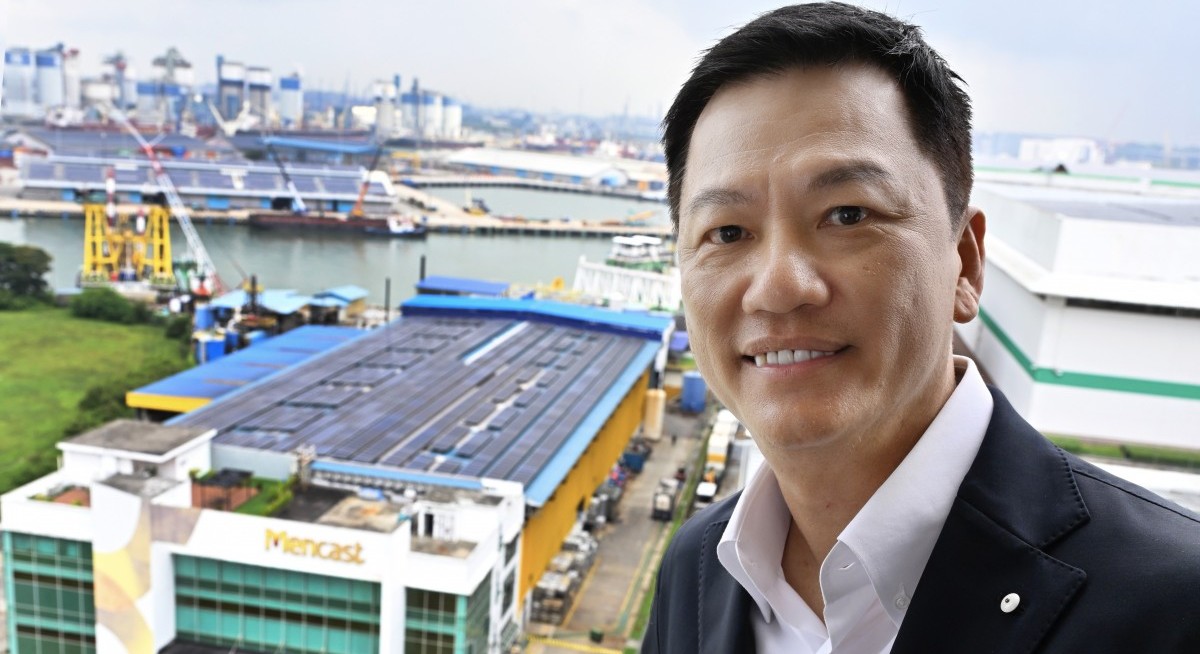


“He did not receive much education, so he’s a very hard worker who focuses on the production processes,” Glenndle Sim, the group’s executive chairman and CEO, says of his late father. “He sees, and then he improves.”
Established in 1981, Mencast manufactures and repairs ship propellers and stern gear equipment. Through its subsidiaries, the company has ventured into other areas, including waste management, energy solutions, and building materials. Today, the group serves major shipyards, shipowners, owners of small vessels such as tugboats and barges, and regional navies.
In 2009, Glenndle took over the reins of the company from his father, who would pass away in 2011. At that point, Glenndle realised that his father’s era, which prizes mastery and human craftsmanship, would not stand the test of time as the sector grew more competitive and volatile. The close relationship between the oil and shipping industries meant that marine engineering companies like Mencast were subject to the ups and downs of the shipping cycle, which in turn depended on oil prices.
It didn’t help that in the early 2010s, Mencast was still competing on price. Like most marine engineering companies, Mencast was making propellers from design blueprints its clients had handed over. This meant they couldn’t add value beyond competing on price alone.
See also: Penguin delivers composite superstructure to Singapore navy
“In my father’s time, they focused on product quality excellence,” Glenndle says. “So, we will always build based on other people’s blueprints. If we did it correctly, we would feel happy. But at the end of the day, you are trying to earn a margin. It depends on whoever can get a lower price. There’s no loyalty from the customer.”
All these problems would combine into a perfect storm between 2014 and 2016, when oil prices collapsed due to weakening demand and a supply glut. The price of Brent crude fell by over 70%, dropping from $112 in June 2014 to $31 in January 2016. With business slowing down to a crawl, Glenndle says the company was forced to downsize.
Mencast went from about 1,200 employees to about 300 today. The drastic cut was a painful decision for Glenndle, who noted how disruptive the job cuts were to his employees and their families.
See also: Marco Polo Marine to spin off shipyards via $139 mil RTO deal with Fuji Offset Plates Manufacturing
“They are like family because they have been working for us for so many years,” says Glenndle. “But if you don’t do it, you won’t be able to survive. We have to cut costs. If you fall, you won’t be able to get up again. We had to survive first. That’s basic business logic. You have to find a way to survive.”
At the time, Mencast was still heavily indebted, with around $200 million in bank loans. The trying times sent Glenndle into deep reflection as he began thinking of ways to free the company from the vagaries of the oil and shipping cycles.
“We know that what we are lacking is design,” Glenndle says. “Once we design our own propeller, we can manufacture rather than compete with all the other manufacturers for a common design. In this business, if you cannot set the rules, you cannot claim to provide a critical service. You have no edge at all. You are always a subcontractor. It’s not sustainable because people will move to China to do, move to Vietnam to do. Why should I let you Singaporeans do it?”
From carbon to silicon

Glenndle says Mencast currently manufactures its own robots as an original equipment manufacturer. Photo: Albert Chua/The Edge Singapore
For Mencast, the seeds of its second act were found in the very constraints that Glenndle had been wrestling with. In 2014, the group hired Chia Boon Tat as the chief technology officer of its subsidiary, Mencast Marine.
To stay ahead of Singapore and the region’s corporate and economic trends, click here for Latest Section
Chia was Keppel Telecommunications & Transportation’s executive vice president of technology and strategy from 1997 to 2002 and managing director for Nexwave Technologies, a subsidiary of Telechoice International, from 2003 to 2006. Before joining Mencast Marine, Chia was CEO of Interactive Microorganisms Laboratories, a company which he founded from 2007 to 2013.
“He was there to see how we could improve our production and do [our own] propeller designs,” Glenndle says of Chia’s role when he was first hired. “We started with robotics first because foreign labour is always an issue.”
The desire to break free from a manpower-intensive business model spurred the company to explore alternative manufacturing methods. Eventually, Glenndle and Chia came across 3D printing technology and began exploring ways to apply it to propeller manufacturing. The journey, however, was not straightforward.
“The first two years were quite difficult because we didn’t have the expertise locally,” Glenndle says. “People who have [the expertise are] from the institutes of higher learning, but they don’t have the skills to take things up to the commercial level.”
In fact, one local university even told Glenndle that it was not possible to 3D-print copper structures. But the naysayers did not dampen Glenndle and Chia’s belief in the technology. After tinkering with the technology, Mencast developed its own prototype. “That’s been proven wrong, right? If we had taken what they said, then things wouldn’t have moved,” says Glenndle.
While the prototype was a far cry from propellers made by traditional methods, it gave the team confidence that this technology had potential. In 2019, Mencast partnered with the Agency for Science, Technology and Research’s (A*Star) National Additive Manufacturing Innovation Cluster to further develop the technology. Through its partnership with A*Star, Mencast was able to produce and pilot Singapore’s first 3D-printed propeller in a small-boat sea trial.
After some early success, Glenndle deepened the company’s partnership with A*Star by establishing a joint lab. In addition to continuing their work on additive manufacturing of marine propellers, the joint lab began using AI and data to design and run simulations of various propeller configurations. Using AI enabled the company to develop propeller designs that could produce greater thrust, thereby generating fuel savings for ship operators. Mencast’s propellers are the world’s first fully additively manufactured propellers to be certified by world-class maritime classification societies Lloyd’s Register and the American Bureau of Shipping.
“Essentially, we are moving [away] from the carbon economy that is foundry works, where you use diesel or electricity to melt the ingots in the furnace and pour them into the sand mould. It’s very laborious,” Glenndle says. “Now, just one propeller can be done by a welding arm, a robotic arm, and a laser welding machine. So, a big bulk is taken away.”
Using AI and 3D printing to design and propellers doesn’t just save time. Glenndle says the new technology is upending and transforming Mencast’s business model entirely. “If you look at the financial model, it is essentially a one-off capex (capital expenditure).”
Mencast currently manufactures its own robots as an original equipment manufacturer (OEM), helping to keep costs low. Glenndle says the savings are even greater once you factor in all the capital outlay required to start and run a foundry. This means Mencast will be able to expand and scale its business much faster across the region.
“If you were to build five foundries right across the region, it would take two to three years to get a license,” Glenndle says. “But if I want to have 10 printing labs in five countries, I think you will only take three months. It’s just robots going there, so you don’t need a lot of permits. You are just printing right? So, time-scale is all mapped up in a very different way.”
“This is the silicon way. What does it mean? It is essentially about integrating AI silicon chips into robotics and automation. It is about engineering tomorrow’s marine intelligence, from chips to ships.”

Mencast Marine’s CTO, Dr Chia Boon Tat says it would not be easy for rivals to emulate their technology. Photo: Albert Chua/The Edge Singapore
When asked about the risk of rivals copying Mencast’s additive manufacturing technology and eroding their lead, Glenndle and Chia say it will not be easy to replicate their work. The significant time and capital invested in fine-tuning the process aren’t something competitors can replicate with off-the-shelf robots and software on the market, Chia says.
“Firstly, the cost is very high. Secondly, for the propeller blades that we print. Let’s say we need 100 to 200 layers. They probably can print the first 50. No problem. But beyond the first 50, they will struggle. We know many people have also tried to copy. After the first 50 layers, it starts to distort. That one has got some skills involved.”
Philip Yeo bets on Mencast
Mencast’s newfound success has won it the confidence of investors, including, most notably, the former chairman of Singapore’s Economic Development Board, Philip Yeo. Yeo’s investment holding company, Economic Development Innovations Singapore, announced on April 17 that it would invest in Mencast through a $3 million convertible bond deal. The bonds have a three-year tenure and offer an annual interest rate of 4.75%.
As part of the deal, EDIS can convert its bonds into 21.43 million shares at a conversion price of 14 cents per share. The price represents an 84% premium to Mencast’s volume weighted average price of 7.6 cents on April 15, before a trading halt was called ahead of EDIS’s announcement.
EDIS’s executive director and former group CEO of Temasek-owned Advanced MedTech, Abel Ang, told The Edge Singapore that he first heard about Mencast while serving on the scientific advisory board of one of A*Star’s research institutes.
“What Mencast is doing now is actually what I call a holistic reimagination of the marine propeller business,” Ang says. “There’s no more logistics. You print when you need it.”
Ang first pitched Glenndle on EDIS investing in Mencast during a dinner they had together. Glenndle was initially resistant because he did not want to issue new shares based on the company’s current stock price. Ang would eventually reconsider after EDIS acquired 2.04% of Mencast’s shares on the open market.
“After our meeting, they went to the market to buy [our shares] to show their interest and confidence. Subsequently, they came back and said, ‘Look, we are very sincere.’ I told them, ‘Not this price. It has to be a premium.’ We didn’t sell them at a discount,” Glenndle says. “They gave the market a good projection [and to show] that they had confidence, they paid a premium of 84% for the price then.”
“This sends a very strong signal to the market. Philip Yeo does not make investments casually. His reputation is more than the money itself.”
The technology is the business
For Glenndle, these new technologies are not just tools to support Mencast’s business. They are new businesses in their own right. His long-term vision is for the company to lease out their robots and manufacturing machines to clients across Southeast Asia.
This will reshape Mencast’s business entirely while complementing its push to become asset-light. Mencast has already been paring down its debt and real estate footprint. In March, the company agreed to sell one of its leasehold industrial properties at Penjuru Road to a buyer for $21 million.
“We are moving away from being a propeller company into a tech company,” Glenndle says. “Eventually, I won’t make propellers. I will lease the robots. I am going to build a platform business. I will help you do the designing, but when it comes to production, my clients will produce it in their home countries themselves.”
“I cut down on logistic time, logistic costs. The locals will do their own marketing. I don’t have to do the marketing. I don’t violate any rules. I don’t have to entice people to buy. Last but not least, I don’t have to clear the import tariff.”
In the long run, Glenndle envisions Mencast doing to the maritime sector what Grab did to the taxi industry. “Grab doesn’t own the cars, it doesn’t own the drivers. But their valuation is better than ComfortDelGro. Why? Because it’s a platform business. In a platform business, you burn a lot of cash upfront, but when you want to scale, it’s easier.”
In fact, Glenndle’s vision goes beyond just revolutionising the marine engineering industry, but manufacturing itself. Mencast’s additive manufacturing technology can be applied to other areas, such as the aerospace industry, he adds.
“Elon Musk’s Tesla is bigger than all the automotive companies combined. How come Nissan and Toyota cannot match his valuation? Why? It’s because he sets the rules. If you want to make an electric car, you have to follow the battery standard.”
Learning on the job
Interestingly, Glenndle says he did not harbour any aspirations to take over the family business when he was growing up. For one, he did not major in engineering at university. Instead, both his undergraduate and graduate degrees were in business administration. However, he later completed a certificate in foundry technology at the AFS Institute, the educational arm of the American Foundry Society, based in the US.
“I’m a marketing man and I like to meet people. I don’t like to do mundane things like engineering work,” he says, adding that he did not enjoy working at the foundry during his school holiday breaks in secondary school.
His desire to gain greater exposure to the world drove him to pursue an MBA at the University of Delaware right after completing his BBA at the National University of Singapore. Eventually, he came back home to learn the ropes from his father out of a sense of duty as the family’s eldest son.
Glenndle’s lack of a formal technical background made it hard for him to adjust when he returned to the company after his studies. “When I first came back to join, all the workers bullied me,” Glenndle recalls.
Over time, Glenndle learned the trade through on-the-job training. As he gained more experience, he found he could apply what he learned in business school. For instance, he realised that Mencast’s core business was in casting, rather than machining. “You need to protect your core business. You have to be better in your core,” he says of his early decision to build up Mencast’s competitive advantage.
Today marks 30 years since Glenndle first started working at Mencast in 1996. The company’s foray into smart manufacturing has been a shot in the arm for him after he pulled through the oil shock a decade ago. He remains bullish on the sector and its critical importance to Singapore’s economy.
“We have been leveraging our maritime sector. Our ports. Transshipment. Entrepot trade. Jurong Island. Our space. This is all created by maritime. We should continue to leverage this.”




