




Distribution per unit (DPU) growth is an important element in CLINT’s investment rationale. Since CLINT’s inception, the Indian rupee (INR) has depreciated around 57% against the Singapore dollar (SGD). The strategy is to outgrow the annual depreciation. For instance, assuming an annual depreciation of around 3%, distribution per unit (DPU) growth should be around 3.5% to 4%.
As a case in point, in 2H2024, DPU grew by 3% y-o-y to 3.2 cents. FY2024 DPU grew by 6% to 6.84 cents. In 2025, 2H DPU grew by 22% to 3.9 cents, and FY2025 DPU grew by 15% to 7.87 cents. Of course, in some years, including during the Covid-19 pandemic in FY2021, DPU dipped.
In a results briefing in January, CLINT’s management explained that the trust has outgrown the reasons for taking on cheap SGD debt and for swapping SGD for INR, as there are now tax benefits to having onshore INR debt in the capital structure.
At IPO and in the initial years following CLINT’s listing as Ascendas India Trust in 2006, the trust took on SGD debt, which was swapped into INR. This was because the cost of SGD debt was much lower than that of INR debt, which was in the high single digits.
Following the Federal Reserve’s interest rate hike cycle from 2022 to 2024, Sora surged but fell in 2025 as a flood of liquidity flowed into Singapore, making the SGD a haven currency. Despite the decline in Sora last year, the impact on DPU from the average weighted cost of debt derived from offshore debt in Singapore, compared with more onshore INR debt, has narrowed.
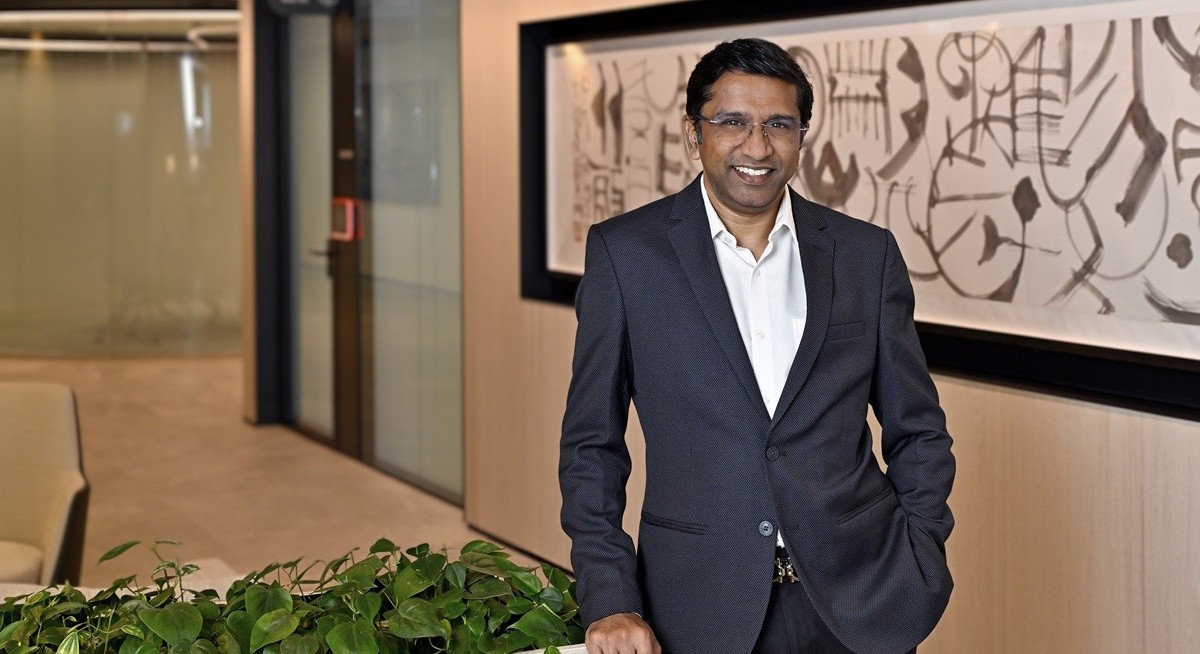
Gauri Shankar Nagabhushanam, CEO of CLINT’s trustee-manager, says it is DPU accretive to use onshore INR debt.
Why higher onshore INR debt makes sense
“India’s interest rates started coming down significantly while SGD interest rates actually crept up in the same time frame, so the gap that existed collapsed,” Nagabushanam says. Currently, the cost of onshore INR debt is around 7.5%. Although SGD debt is lower, at around 3.5% or thereabouts, when it is swapped into INR, the cost rises to more than 7%.
See also: Singapore REITs: Governance by design, or governance by hope?
“Once you hedge and convert the SGD into INR, [the total cost] is at best, 7.5%. INR depreciates every year. When bankers quote a price, they factor in depreciation and then add a few more basis points for unknown factors. So when you hedge the SGD INR, the hedging cost is around 4.6 percentage points,” says Nagabhushanam.
In FY2025, 53% of CLINT’s loans were in INR, and the rest in SGD, with 16% of total debt onshore. The interest cost for the 53% in INR, whether hedged or in an onshore INR loan, is around 7.5%. The 43% SGD tranche costs around 3%. Hence, the weighted average cost of these two tranches is about 5.6%.
CLINT’s target is for 40%–50% of the loan book to be in onshore INR debt, up from around 22% following the issuance of an INR9.15 billion onshore bond on Jan 2. “We have borrowed 78% of our entire loan book in Singapore and 22% of the loan book is in India. We would want to make it about 50:50, with 50% of our loans to be [onshore] in India and 50% in Singapore in the course of the next three years,” Nagabhushanam says.
The rationale for using higher-cost onshore INR debt is the tax deductibility of interest expense on that debt. Although the weighted cost of debt is likely to rise from the current 5.6% due to more onshore INR debt, distributable income will increase.
“We don’t just look at that 5.6% on a standalone basis. When I borrow at 7.25% in India, I don’t need to pay withholding taxes, which is a 15% saving if the entity that borrows is income-producing,” adds Nagabhushanam. The interest expense is deducted from the tax expense and CLINT pays taxes on the balance, resulting in a 15% savings.
Following the issuance of the three-year onshore INR9.15 billion bond at 7.25% per annum, annual tax savings from a 15% withholding tax work out to $2 million, while annual savings from tax disallowance are a further $2.5 million. Together, this amounts to around $4 million in addition to distributions, or a 3.8% DPU impact at a 90% payout. In India, certain expenses are not eligible for tax deductions, and this is termed a tax disallowance. With offshore debt, interest deductibility was capped at 30% of Ebitda. With onshore debt, there is full tax deductibility.

To stay ahead of Singapore and the region’s corporate and economic trends, click here for Latest Section
Identifying capable developers
Forward purchases refer to agreements with reputable developers in India to fund property development during the development phase and to take ownership upon completion, before leasing it to tenants.
“Forward purchases speak to our need to outrun the market and work harder to ensure that, despite a depreciation in the currency, we can provide, for example, in 2H2025, a 22% increase in DPU,” Nagabhushanam says.
Most REITs acquire stabilised assets at or near market prices for relatively modest yields. Unless the REIT’s sponsor owns the property, there could be competition for assets. In India, because of liquidity and growth, capitalisation rates and property yields have been falling.
Around 10–12 years ago, cap rates were 11%–12%. Today they are sub-8%. Some of the most attractive assets can go as low as 7.5% for business parks. With all the other operating costs and fees, etc, at cap rates of 7.5%, it would be challenging for CLINT to provide the DPU yields required of it. As at March 11, CLINT’s DPU yield is around 7.5%. Giving a yield of 6.5% to 7% in SGD would be a tall order, as there is no spread to cover the risk.
“What we did was identify developers who have good land with some reasonable development experience. We said we will help you build a state-of-the-art business park. We will tell you how to design it. We’ll help you construct it. We’ll fund the construction. We will help you lease the property. But when you sell it to us, you’ll have to sell it to us at a discount to market price, because we are doing these services for pretty much no economic interest. When my competitors buy a similar asset for 8% yield, I am buying the property at 10% yield,” says Nagabhushanam.
CLINT funds the construction cost at a specific interest rate in the low teens and then, when ready, leases the property. CapitaLand has access to network customers in Asia and beyond who require a presence in India. These include tenants such as AT&T, Bristol Myers Squibb, EY, London Stock Exchange and Warner Bros. “That is a major reason we can still keep clocking these high returns despite a depreciating currency,” Nagabhushanam adds.
On Feb 24, CLINT launched a private placement to raise gross proceeds of $150 million to fund two forward purchase development projects, Building 1 of Ebisu and MAIA, located in Bangalore’s Outer Ring Road micro-market. Ebisu is likely to be acquired in 2027 and MAIA in 2028.
“We view this positively, as it reinforces CLINT’s growth-oriented forward purchase strategy, delivering pro forma FY2025 DPU accretion of +5.1%, while reducing gearing to 36.8% on a stabilised basis. While we have already incorporated construction financing and forward purchases for both properties in our estimates, we have yet to include an equity placement in our estimates. The advanced distribution of 1.44 cents (for the 63 days from Jan 1 to Mar 4) annualises to 8.34 cents, which is tracking in line with Bloomberg consensus of 8.30 cents,” JP Morgan says in an update.
Sometimes, challenges emerge. In Pune, the occupancy of the International Tech Park (ITP) Pune-Hinjawadi and aVance II, Pune, was 88% and 57%, respectively, in 2025, while ITP Chennai occupancy as of end-Dec 2025 was 85%.
The area near Hinjawadi has become residential, and transport infrastructure is being developed. “If you need to build a metro rail, two lanes of a six-lane highway need to be blocked. What was six becomes four for a period of three to four years. That way, traffic worsens during infrastructure upgrades. Hinjawadi was caught in that,” Nagabhushanam says.
The upside is that the infrastructure disruption is likely to be over by the end of this year, when the metro goes live. CLINT is likely to see better occupancies in Pune and ITP Chennai, according to Nagabhushanam. aVance is likely to attain CLINT’s internal target of 70% occupancy this year and ITPC is likely to rise to the low 90%. These higher occupancies are likely to boost DPU this year.
Divestments to recycle capital
In September 2025, CLINT divested CyberVale in Chennai and CyberPearl in Hyderabad to an unrelated third party for INR11,031 million, or $161.7 million.
On Dec 31, 2025, CLINT announced the divestment of a 20.2% stake in three data centre assets under development to CapitaLand India Data Centre Fund (CIDCF) for an estimated total purchase consideration of INR7.02 billion, based on a total enterprise value of INR 51.97 billion. The enterprise value is at a premium to the independent valuation of INR45.70 billion. The divestment was completed on Feb 27. The divestment raised $99.7 million, which should be sufficient to finance the three data centres that are under development.
Of the three, CapitaLand DC Navi Mumbai Tower 1 has been operational since 3Q2025 and leased to a hyperscaler. CapitaLand DC Navi Mumbai Tower 2 will be completed in 4Q2026 and leased to the same hyperscaler as Tower 1. CapitaLand DC ITPH will be completed in 2Q2026 and CapitaLand DC Chennai will be completed in 3Q2026. “We have come out of the tunnel in terms of where the capex for data centres is coming from. It is now the homestretch for us. We just need to execute our plans. Capital is not a constraint for our data centre strategy anymore,” says Nagabhushanam.
JP Morgan has an end-2026 price target of $1.35, implying a forecast DPU yield of 6.3%, or a DPU of 8.5 cents. “We believe that CLINT is trading below its mean yield, considering its growth in DPU and value unlocking from monetisation of its data centre developments. “Beyond its core IT business park exposure, we are also excited by CLINT’s planned expansion into the warehouse and data centre segments, which should allow it to tap into the burgeoning e-commerce sector and growth in data storage,” JP Morgan says.




