


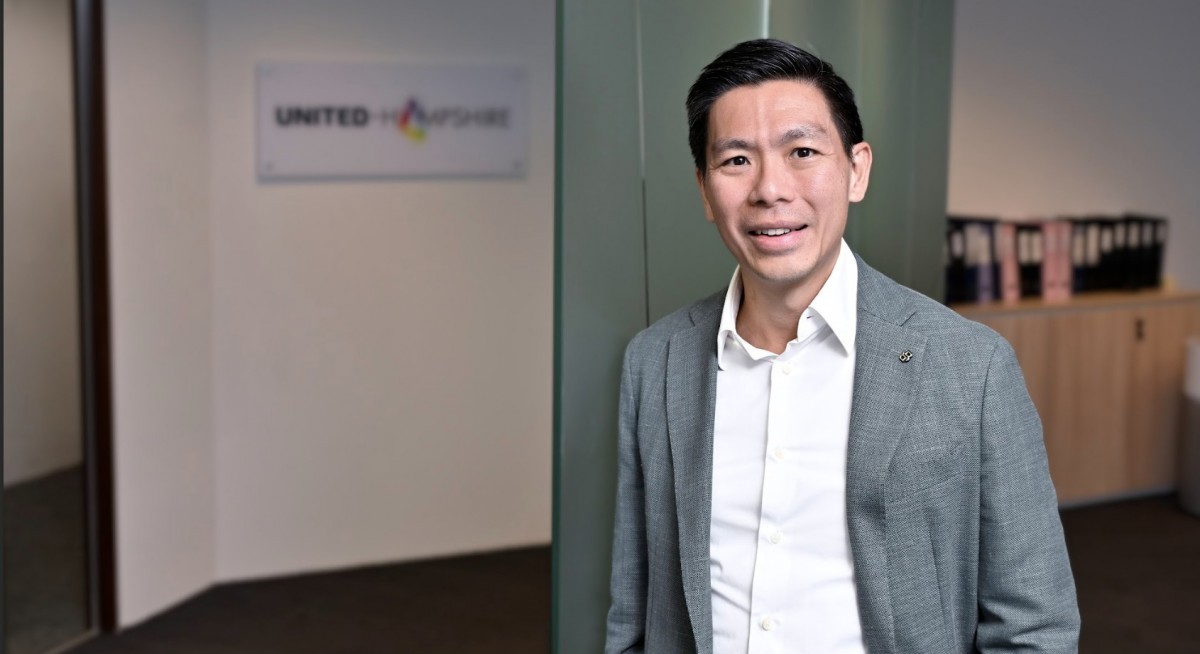


“REIT prices were quite badly impacted,” notes Gerard Yuen, CEO of UHU REIT’s manager, referring to the interest rate cycle. REITs’ unit prices are based on a spread between distributions per unit (DPU) yield and risk-free rates. The higher the risk-free rates, the lower the unit prices.
“With high interest costs, it results in your DPU declining just because you pay more interest. But at the same time, if your unit price is lower, it’s not easy to grow your DPU through DPU accretive acquisitions. When your unit price is lower, your yields are higher, so it’s not easy to achieve DPU accretive growth,” Yuen acknowledges.
Despite these challenges, Yuen has managed to divest assets at levels above their latest valuations and acquire assets at levels below them. This is one of the REIT’s strategies to raise DPU and its net asset value (NAV). On Jan 16, UHU REIT announced the acquisition of Wallingford Fair, a 115,223 sq ft retail property in Wallingford, Connecticut, for US$21.4 million ($27.5 million), at a discount of about 8.2% to CBRE’s valuation of US$23.3 million.
Proceeds from the divestment of Albany Supermarket in New York in January 2025 for US$23.8 million, at 4.2% above its purchase price, were recycled to the Connecticut property, as well as Dover Marketplace in Pennsylvania, acquired in 2025 for US$16.4 million.
See also: Elite UK REIT maps out growth path via diversification into living sector
According to an announcement on SGXnet, Wallingford Fair is 100% occupied by three tenants with a weighted average lease expiry (WALE) of 12.8 years based on base rental income from September 2025. The anchor tenant is ShopRite, a well-known supermarket cooperative in New Jersey, New York and other parts of the northeast US. The other two tenants are Petco and Wallingford Fair Self-Storage, which owns a self-storage facility operated by Extra Space Self Storage.
Grocery store as anchor
Yuen says the typical strip centre usually has a grocery store as the anchor, along with a few supporting tenants for non-discretionary items. “Our types of properties are especially suited to a large single tenant, such as home improvement entities like Lowe’s. These are attractive because they give you stable cash flows. But on the other hand, once we have put in place the tenant, and once we’ve extended or signed a new long-term lease with them, there isn’t much additional growth,” he admits.
See also: Should we be worried about the high LTVs of Japanese assets?
For the grocery stores, the long-term lease comprises a fixed rent for approximately 10 years, with moderate escalations every few years. Most leases are on a triple net basis, where the tenant pays for utilities and services. This model requires less capex than the US-based office S-REITs, where tenant incentives are a lot more generous.
On the flip side, once UHU REIT has signed on an anchor for 10 years, the asset is easy to divest should the REIT need the money. “If you sign a 10-year lease, there isn’t too much more you can do with the property. But, interestingly, that’s also when the market value of that property is the highest, because you have buyers who are looking for a very strong tenant with a very long lease,” Yuen explains.
The long leases also account for UHU REIT’s ability to divest its assets at a premium. In 2024, the REIT divested Hudson Valley Plaza at 9% above valuation and 17.5% above the purchase price. The property was anchored by Lowe’s and Sam’s Club.
In 2023, Bed Bath & Beyond filed for Chapter 11. It was a tenant at a couple of UHU REIT’s properties as junior anchors with around 20,000 sq ft. To replace Bed Bath and Beyond, UHU REIT was able to clinch Trader Joe’s as a tenant at its Lynncroft Center in 2024.
“If a tenant moves out, it’s an unfortunate event. But, because the market was so strong, the replacement tenant was Trader Joe’s,” Yuen says, referring to a supermarket chain popular with Singapore consumers who travel.
Following its successful development of a build-to-suit 63,000 sq ft Academy Sports Store as part of the expansion in its Port St Lucie, Florida property, UHU REIT is constructing a new 5,000 sq ft store, which has been pre-leased to Florida Blues at the same Port St Lucie site.
Decline in DPU could be over
To stay ahead of Singapore and the region’s corporate and economic trends, click here for Latest Section
Since its IPO in March 2020, UHU REIT’s net property income (NPI) and distributable income (DI) margins have been steadily declining (see table). In addition to the impact of interest rates, another reason for the decline in DI in the past couple of years is the way the management fees are paid. Until 2023, management fees were paid in units, which showed alignment between the manager and the REIT.
However, because UHU REIT consistently traded at a discount to NAV, at one point falling to as low as 35 US cents in 2023, as interest rates were rising rapidly, the REIT had to issue more units for its fees. At the time, UHU REIT paid part of its management fees in units. To run the manager, it had to continually sell UHU REIT units for cash, which put downward pressure on unit prices.
“We stopped paying in units in the middle of 2023 when unit prices were low. We had to issue a lot of units. We received feedback from the unitholders to urge us to reconsider and to take cash instead of units,” Yuen recalls.
Moving to cash was a one-time adjustment that caused DPU to fall, but it alleviated selling pressure, even though it removed the alignment between the REIT and its manager. “The feedback from unit holders has been very positive, because for REITs that continue to pay in units, they never know when the REIT may swap back to cash and that will affect DPU. In our case, we are already all cash,” Yuen says.
Yuen has also decided to maintain capex reserves. “We are required to pay 90% of our distributable income. We paid out 100% every year. In 2023, we began retaining some income. It pays for your capex and so on,” Yuen says.
In addition, during the interest rate upcycle, borrowing for capex became less attractive. “That’s why it was more attractive to retain capital instead. And the second reason was, our gearing was slightly on the high side,” Yuen adds, referring to UHU REIT’s gearing of 41.8% and 41.7% (respectively) in 2022 and 2023.
Those two factors have flipped. Interest rates are falling, and aggregate leverage dipped to 38.9% as of Sept 30, 2025. “We pay out 96% of our distributable income. The REIT is in a much stronger position now,” Yuen says.
He believes the REIT has turned the corner with its 2025 results. In 1HFY2025 ended June 2025, DPU rose 4% y-o-y to 2.09 US cents. Since its IPO in 2020, UHU REIT’s DPU has steadily declined (see table).
As of end-September 2025, its average cost of debt is at 5.06%. However, only 21.5% of its debt, or US$65 million is on floating rates.
On Nov 25, UHU REIT announced it had refinanced US$350 million. “Our loans are bank loans, so they’re floating rate loans,” Yuen says. As he explains, UHU REIT has two types of loans: bank loans and mortgage loans. Bank loans are on floating rates, he says, and the rates will be fixed only on drawdown.
“In the case of bank loans, the way we lock in the interest rate is by doing a swap. We will do the swap anytime after we have signed. It doesn’t need to be on the same day we signed the loan,” he says, adding that the swaps haven’t been done yet. As part of a sensitivity test, with 21.5% of the debt on floating rates, the 12-month trailing DPU rises by 1.3% for every 50 basis-point drop in the Secured overnight financing rate or SOFR.
UHU REIT lacks analyst coverage. At present, only UOB KayHian has issued reports. Jonathan Koh, an analyst at UOB Kay Hian, reiterated his buy rating with a target price of 70 US cents on Jan 2. On Jan 29, Phillip Capital initiated coverage on UHU REIT with a price target of 69 cents.
On the low trading liquidity front, Yuen admits that UHU REIT recognises this. “We strive to increase the size of the REIT to attract investors’ attention. At the same time, we are focusing more on investor relations to help investors become familiar with us and comfortable investing with us. Hopefully, that could help increase the counter’s trading liquidity,” Yuen concludes.




