


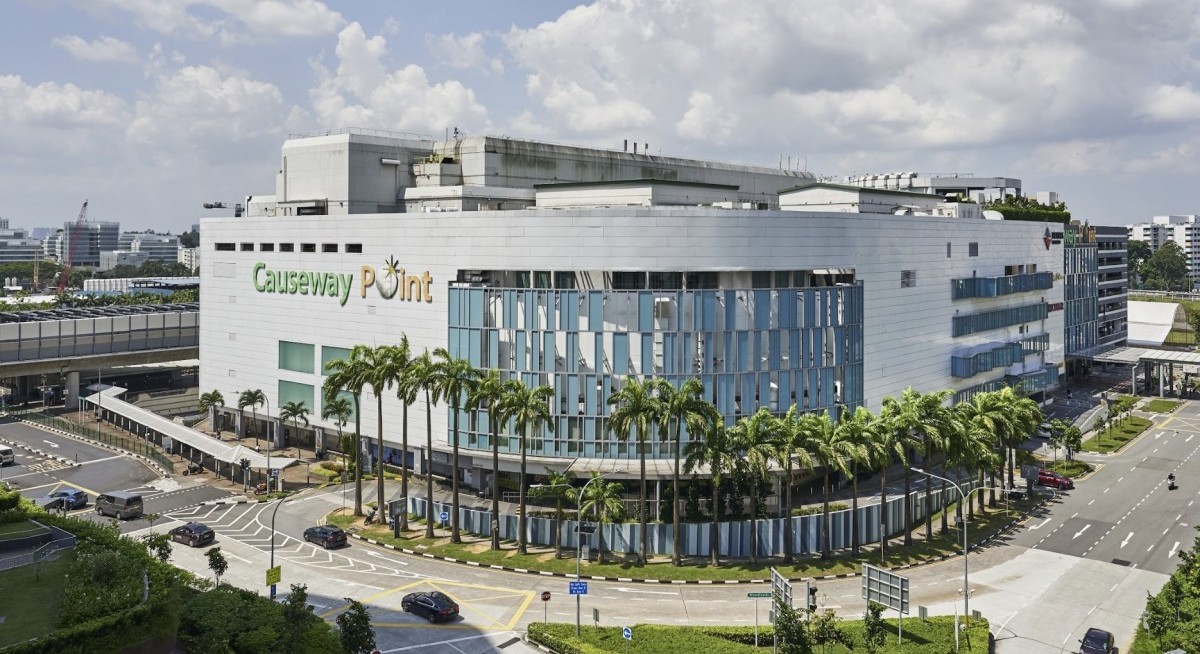


Ng is unfazed. Under his leadership, FCT has reduced the portfolio’s dependence on a single dominant mall by expanding it to nine malls, with at least four dominant malls. Causeway Point, as its name suggests, is two stops away from JB Central at Bukit Chagar. NEX is connected to the Serangoon MRT Interchange; Waterway Point is connected to Punggol MRT Station; and the North Wing and South Wing of Northpoint City are connected to Yishun MRT Station.
Causeway Point is still an important mall. With a net lettable area (NLA) of 420,000 sq ft, it is, on a standalone basis, the largest mall in FCT’s portfolio, but smaller than the 531,000 sq ft combined NLA of Northpoint City North Wing and Northpoint City South Wing. In 2019, Causeway Point contributed around 47% to 48% FCT’s total net property income (NPI). In FY2025 ended Sept 30, 2025, Causeway Point’s contribution fell to 25%.
“If you compare 2019 to where we are today, we have acquired close to $6 billion worth of assets, and at the same time, we also divested four malls, Hektar REIT and Yishun 10 Retail Podium worth some $850 million,” Ng recounts.
In 2019, FCT owned six assets and a 40% stake in Waterway Point. Three of the malls were under 100,000 square feet. When FCT acquired a partial stake in the Asia Retail Fund (ARF) portfolio from PGIM in 2019, it divested Anchor Point and Yew Tee Point. ARF comprises five malls: Hougang Mall, Tiong Bahru Plaza, White Sands, Tampines 1 and Century Square. The ARF portfolio included Central Plaza, an office block atop Tiong Bahru Plaza. The portfolio reconstitution reduced risk and lowered its reliance on a single dominant mall.
See also: Elite UK REIT maps out growth path via diversification into living sector
The malls in the ARF portfolio are 150,000 sq ft or larger and are either next to or very close to MRT stations. “When assets are small and not so well located, it is not easy for them to continue to be sustainable over the long run, especially when competition comes in,” Ng points out.
“Whenever I meet investors, they always ask, ‘What else can you do? There’s nothing to buy in Singapore. There’s no supply’. What we did was a major acquisition that put us on the path to where we are today. We acquired NEX together with our sponsor, because the size of the asset was very large, and we couldn’t acquire it at one go,” Ng describes.
FCT and Frasers Property (FPL) together took a 50% stake in NEX in 2023 for $652.5 million. Eventually, FCT acquired FPL’s stake and divested Changi City Point for $338 million. “While Chang City point is quite sizeable, 208,000 sq ft, it’s not your traditional suburban mall as it doesn’t have a natural catchment. It relies on Changi Business Park and the Singapore Expo,” Ng says. During Covid, both the business park and Expo were closed. “That mall actually suffered a lot during that period. It occurred to us that this is not an asset that we believe is sustainable, which is why we divested it.”
See also: Should we be worried about the high LTVs of Japanese assets?
In 2025, FCT acquired Northpoint City South Wing from FPL for $1.17 billion. The REIT raised $421.3 million in a preferential equity offering and $200 million of perpetual securities to fund the purchase. Northpoint City South Wing is adjacent to the North Wing. Together, Northpoint City is larger than Causeway Point. “We own fully or partially four of the 10 largest prime suburban malls in Singapore. Today, we have four very dominant malls in our portfolio, besides the other five malls, which are also dominant in their own ways,” Ng says. In Aug 2025, FCT divested Yishun 10 Retail Podium to FPL for $34.5 million.
Malls as a “second place”
Retail REITs ordinarily have three sources of growth: organic, AEI and acquisition. Organic growth consists of increasing mall traffic, increasing sales, and, through operational efficiencies, raising NPI margins and lowering occupancy costs. In both metrics, FCT comes out on top. Its NPI margins are consistently in the 70s and occupancy costs are below 16%.
As an owner of suburban malls, Ng believes FCT’s malls should be the catchment area’s “second place” after their homes. “In a way, we are transforming our malls into social hubs for the community that we serve. A mall isn’t just about being transactional; that’s why we are championing this notion of malls being the second place,” Ng says.
“You usually think of home and work or home and school and then the mall by the way. But if you look at demographic shifts and flexible work arrangements, we see more people spending time at our malls on weekdays. If they work from home, they will go to our malls for meals. Some of them actually work there because they don’t have space at home,” he observes.
In four to five years, one in four Singaporeans will be 65 years old. “The senior population is going to grow. This new wave of seniors is very different. I’m going to get there soon, but I still like to go to the malls. I still want to shop. I still want to buy things that I like, I want to go out for meals and want to meet my friends,” Ng remarks.
”Again, you see another group of younger people who want to spend time together, but they don’t have places to go. If we put all this together, the younger generation, the middle-aged, and the seniors, if we provide them with a space, we can create many place-making activities. We can make sure our trade mix attracts them. They will want to spend time at our malls. The idea is to create an environment whereby these people can come more often, and spend a longer time in the malls,” Ng continues.
To stay ahead of Singapore and the region’s corporate and economic trends, click here for Latest Section

Ng: We transform our malls into social hubs of the community that we serve
AEIs to drive future growth
AEIs are likely to be the key driver of FCT’s growth. “We are fortunate because our portfolio offers a lot of opportunities from AEIs,” Ng says. For instance, FCT completed a $38 million AEI at Tampines 1 in September 2024. The project, which started in 2Q2023, added 8,000 sq ft of new NLA. The ROI is around 8%.
By the end of September, FCT will complete a $51 million AEI for Hougang Mall, generating a 7% return on investment (ROI). More than 80% has been pre-committed. During a results briefing and an interview with The Edge Singapore, the question of the sale of a site next to and above the Hougang MRT to a consortium comprising CapitaLand Development, CapitaLand Integrated Commercial Trust (CICT), and UOL Group for $1.5 billion came up. When completed, this project will be located next to the Cross Island Line and connected to the Hougang MRT Station. The consortium’s bid was 2.1% higher than the next-highest bid from Sim Lian Group. FCT’s sponsor, FPL, was also a bidder with a joint-venture partner.
The commercial development, which will be developed by CICT (the second-largest owner of suburban malls after FCT), will cost $1.1 billion, including construction, interest costs, and other expenses, with an estimated yield on cost of more than 5%. The target completion date is 2030 to 2031.
“We knew the site was there. It’s a question of when, not if,” Ng says, referring to the GLS of the Hougang site. “We believe this area can accommodate a much larger mall,” he adds, which is why he wanted to reposition and upgrade Hougang Mall. The new CICT mall and Hougang mall will supply 400,000 sq ft of NLA. Hougang Mall’s ROI of 7% is higher than CICT’s 5%.
“When we did our AEI, we said our mall is 30 years old, and there is potential competition. We went on the basis that we didn’t win the site. What do we need to do? We need to spruce up the mall, rejuvenate it, improve all the amenities and M&E equipment, and bring in better brands to strengthen our trade mix. We moved the library from Level 3 to the upper floor, and it’s locked in for 10 years. Then we work on other anchors,” Ng reveals.
“It’s a very large catchment, about 227,000 people in terms of population, compared to Yishun with 229,000, where we already have Northpoint City,” Ng continues. Northpoint City North Wing and Northpoint City South Wing, together (531,000 sq ft of NLA), are the largest malls in Yishun and the fifth-largest in Singapore.
FCT’s next AEI is NEX
NEX’s AEI will cost around $90 million (FCT owns 50% of the mall and its share will be $45 million). “The JV company will be funding it directly, so we are not required to come in with anything,” Ng says.
The plans are to take back Isetan’s 44,000 sq ft of NLA upon its exit in April, and convert 62,000 sq ft of gross floor area from the carpark to retail and office space. “We have plans for repurposing the space with mini anchors and more brands,” Ng says of Isetan’s 44,000 sq ft. He is looking to improve the F&B offering, enhance enrichment education and fill gaps in the beauty trade.
With plans for Causeway Point’s major AEI (see sidebar) in the planning stage, how will distributions per unit (DPU) be affected?
“When we do AEI, whatever loss of income from the AEI will be patched back with asset management fees in units. For two years, we can expect disruption because we are doing NEX’s AEI in phases, but it will be covered by asset management fees in units, so unitholders will not be worse off and enjoy the upside when completed,” Ng says.

The asset enhancement initiative of NEX is likely to cost $90 million, with an ROI of 7%
Metrics remain resilient
On Jan 26, FCT announced that post-1Q2026 (the REIT has a September year-end), committed occupancy would increase to 99.9% with cinema spaces at Causeway Point and Century Square successfully backfilled. Tenant sales rose by 2.7% in the October-December 2025 quarter, and aggregate leverage stood at 40.3%. Year-to-date average cost of debt was 3.5%.
Maybank Securities’ analyst Krishna Guha says FCT delivered a set of “resilient performance” in 1QFY2026. In his Jan 27 report, Guha has retained his DCF-based target price of $2.60 for FCT and says its 1QFY2026 business update underscored a stable operating performance and continued efforts to renew existing assets.
Concurrently, Guha lowered his DPU forecasts for FY2026 and FY2027 by 0.2% and 0.7%, respectively, factoring in lower distribution from NEX due to the AEI and short-term backfilling at Causeway Point at a slightly lower rent.
PhillipCapital’s Darren Chan has upgraded FCT from “accumulate” to “buy” with an unchanged target price of $2.74 due to recent share price performance. Chan points out that FCT’s 1QFY2026 shopper traffic and tenants’ sales remained healthy at +1.3% and +2.7%, respectively. Hence, he is not changing his forecast and predicts that FCT’s FY2026 rental reversion will stay healthy at 5%, supported by limited new retail supply and a low occupancy cost of around 16%.
RHB Bank Singapore’s Vijay Natarajan believes that resilient consumer spending is supported by the fact that FCT saw faster growth in tenant sales than in shopper traffic. “Asset enhancement will be a key near-term driver with major plans for value unlocking at two of its malls, mainly Hougang Mall and NEX, with an attractive ROI target of around 7%,” says Natarajan.
Given that FCT is currently trading at one time P/BV, Natarajan sees value in the REIT and hence keeps his “buy” call and a target price of $2.70.
In FY2025, FCT reported a DPU of 12.113 cents and a 2HFY2025 DPU of 6.059 cents, translating into a DPU yield of 5.38%.




