


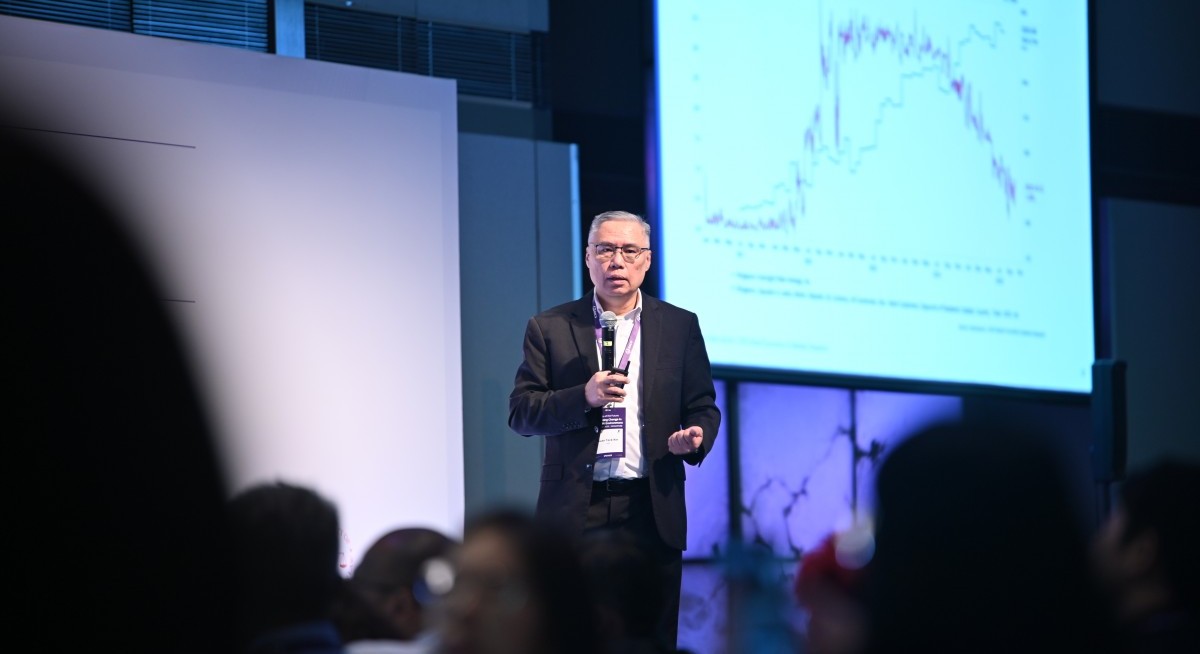


The Urban Redevelopment Authority (URA) residential price index has lagged Singapore’s nominal GDP since 2014, and three cooling measures have kept prices from surging in tandem with nominal GDP.
Speaking at the Rics-Redas Conference 2025 on Oct 16, Suan says: “Now, the correlation is a bit [lower], meaning that it’s not catching up as fast because of the cooling measures.”

Showing a chart with Singapore’s nominal GDP in red and URA’s residential price index in blue, Suan adds: “So, can you imagine, if you remove the cooling measures, chances are the blue line will converge towards the red line, meaning that the recovery will be there; the price will shoot up very quickly.”
See also: Fewer GCB deals in 1H2026, but larger quantums lift average psf near record: PropNex

Thus, Suan believes the Singapore government’s property cooling measures are likely to “stay for a while”.
The December 2021 round of cooling measures included higher Additional Buyer's Stamp Duty (ABSD) rates, a tighter Total Debt Servicing Ratio (TDSR) threshold and a lower Loan-to-Value (LTV) limit for HDB loans.
See also: ‘Breathe life’ into precincts by investing in commercial property: Steward Asia
The September 2022 round further tightened maximum loan quantum limits and added a 15-month wait-out period for private home owners buying HDB resale flats.
In April 2023, the Singapore government doubled the ABSD for foreigners to 60%. Meanwhile, Singaporeans buying their second residential property now pay an ABSD rate of 20%, up from 17% previously.
Between 1980 and 2024, URA’s home price index rose almost eight times even as cooling measures were increasingly stepped up. Compounded, the annual growth in home prices was 5.1%.
The number of marriages and the formation of households is another demand driver for Singapore’s residential property market, says Suan. “You want to make sure that more marriages will happen to keep the demand up for housing. So, encourage people around you — your friends and family — to get married as soon as possible.”

According to Suan, the number of marriages tends to track business cycles. A total of 26,328 marriages were registered in Singapore last year, 7.0% lower than the 28,310 marriages registered in 2023.
An average of 27,170 marriages were registered in Singapore from 2020 to 2023, with a sharp fall noted in 2019 and 2020. However, this was comparable to the mean number of marriages registered here from 2010 to 2019, at 27,116.
To stay ahead of Singapore and the region’s corporate and economic trends, click here for Latest Section
The final demand driver of Singapore’s residential property market is the strength of the household balance sheet, says Suan.
According to Suan, Singapore households’ total liabilities have risen at a much slower pace than their total assets, leading to a net worth of some $3.15 trillion as at 2Q2025.
Suan says currency and deposits still form the bulk of Singaporean households’ total assets, beating assets in the Central Provident Fund (CPF), life insurance and shares and securities.

“Singapore is a very cash-rich society; that includes many of you here in this room,” adds Suan. “That means all this money is sitting down there getting ready to jump into whatever asset that is of value, including property. Whenever parents finance their children’s housing purchases — or even their grandchildren’s housing purchases — [that shows the] firepower that is sitting there.”

As long as these three drivers continue in Singapore, housing demand “will be there”, says Suan to a room of real estate developers and managers. “That will be good for your business as well.”
Photo: Rics, Redas
Charts: UOB




