


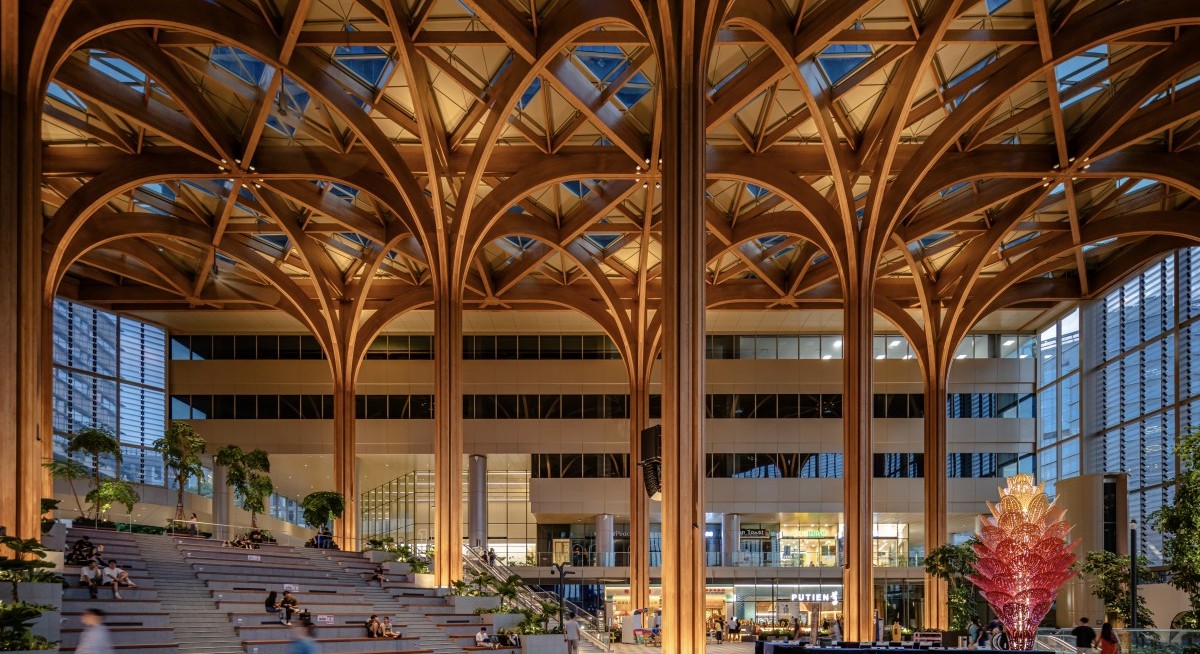


Geneo’s cathedral-like design and wide variety of dining and retail options make it unlike any other business park out there. Instead of drab concrete buildings and run-down industrial canteens, Geneo’s bright, green spaces make it a place people actually want to work.
“Geneo represents a significant $1.4 billion investment in Singapore’s R&D and innovation capabilities, focusing on the biomedical sciences,” says Tan See Leng, Minister for Manpower and Minister-in-charge of Energy and Science & Technology in the Ministry of Trade and Industry, at Geneo’s official launch on May 22.
With a total gross floor area of approximately 180,600 sqm, Geneo spans three properties: 1 Science Park Drive, 5 Science Park Drive and 7 Science Park Drive. The development has achieved over 80% occupancy thus far, with 5 Science Park Drive itself achieving 100% occupancy through its sole anchor tenant, the e-commerce platform Shopee.

See also: Coliwoo’s year of execution
(From left) William Tay, CEO and executive director of CLAR’s manager; Jonathan Yap, CLD CEO; Tan See Leng, Minister for Manpower; Wong Kan Seng, CapitaLand Group chairman; Ronald Tay, CLD Singapore CEO. Photo: Albert Chua/The Edge Singapore
Geneo’s other tenants include the Agency for Science, Technology and Research (A*Star), chocolate maker Barry Callebaut, pharmaceutical research lab Chugai Pharmabody Research, chemical and consumer goods company Henkel, and co-working laboratory and office space provider NSG Bio.
In his opening speech, Tan says siting A*Star’s new biomedical research facilities at Geneo will allow it to build on its strong foundation in nearby Biopolis while putting it in proximity to its partners in the Greater One-North area.
See also: Navigating the New York market from the Asia Pacific
For CLD CEO Jonathan Yap, putting together the right mix of tenants matters as much as Geneo’s physical design. Yap says his team put in a lot of effort to assemble a vibrant community of established foreign companies, large local companies, and even start-ups.
“In curating this place, we really are moving away from just looking at real estate but looking at what is the community that makes sense,” Yap told The Edge Singapore. “To begin with, [for] the positioning for this location, we wanted to fully leverage the advantage of being near NUS (National University of Singapore), next to Kent Ridge MRT Station. So, you really want to focus essentially on life science and technology companies and at the same time, we also want to have a healthy chain of companies.”
Geneo is but one element in CLD’s wider rejuvenation strategy for Singapore Science Park (SSP). In addition to a business park, CapitaLand launched Citadines Science Park Singapore in February 2024, SSP’s first lodging facility.
CLD is also completing its first residential project in SSP, LyndenWoods. The project is slated to be ready by 2029. On its July 12, 2025 launch day, CLD sold 324 of 343 units, or over 94%.
Yap says that because so many of Geneo’s tenants have laboratory needs, ample time and resources had to be given to accommodate their renovation works. This also meant ensuring that their renovations would not disturb existing tenants who had already moved into Geneo.
“We do try to make sure we time the renovation,” Yap says. “While we are putting in place new residents, it’s all designed in a manner that the current resident, which is a service residence, is not disturbed because that building is already in place.”
That is not to say that Geneo’s design did not matter. Besides striving for a design that is at once contemporary and modern, Yap says CLD took a customer-centric approach to designing the development’s infrastructure.
To stay ahead of Singapore and the region’s corporate and economic trends, click here for Latest Section
“How do we try to stand in the position of our customers and anticipate their needs? While we have customers that have got their own offices and laboratories, sometimes they may require additional office space or additional laboratory space,” Yap says. “That’s where The Apex, which is basically our co-sharing laboratories as well as co-working offices, comes in handy to help customers deal with that.”
Aside from providing workspaces, The Apex is home to NSG BioSuites, CapitaLand’s first co-working laboratory facility in partnership with NSG Bio. The facility spans over 3,200 square metres and is Southeast Asia’s largest co-working laboratory.
“The way we approach design. Firstly, it is design-led, and secondly, it is context-specific. As we know, every plot is a bit different, not just the physical attributes in terms of size and configuration; it is also about the positioning of the asset,” Yap says.
“So, what we always take away is the element. What is this relevant element that may be useful elsewhere across all our designs?” he adds. “With every project, we learn something and we say, ‘Hey, maybe we could have done this or done that.’ Then when the next opportunity comes along, we will apply.”
Stakeholders matter

CLD’s Yap did not rule out divesting Geneo fully into CLAR in future, as with past developments. Photo: Albert Chua/The Edge Singapore
Geneo might be another feather in CLD’s cap, but Yap says the developer doesn’t deserve all the credit for its success. The development, he says, was borne out of the feedback CLD received from its stakeholders. For instance, the decision to design Geneo as a mixed-use development with both office and retail space was made to better serve their tastes and preferences.
“These days there are actually many stakeholders,” Yap adds. “Obviously, the URA (Urban Redevelopment Authority), as a planning authority, has aspirations for the Greater One-North Area to be a live-work-play-learn location. At the same time, on the other end, right down to the user’s level, for them, they don’t want just a boring space.”
“To some extent, Covid-19 changed how people see work and what kind of work environment they want to be in. From our interaction with customers, we see that they seek an environment that is not just a place where they make a living, but also a place where they find it enjoyable.”
Tenants such as Barry Callebaut and NSG Bio told The Edge Singapore that they were drawn to Geneo for its proximity to Singapore’s wider R&D ecosystem. Barry Callebaut officially opened its global innovation centre on Feb 10, 2026, after moving in at the end of November.
Yeting Liu, vice president of the Cacao Coatings Centre of Excellence and head of R&D in Asia Pacific, Middle East and Africa, says the chocolate maker picked Geneo for three reasons: one, its access to talent from nearby universities and companies; two, access to a rich innovation ecosystem whether it be to its business partners or customers; and three, its ability to provide the best employee experience given how near it is to Kent Ridge MRT Station as well as the dining and retail options available.
“To be successful in innovation, we really require a very good ecosystem because innovation is a team sport. We ourselves alone cannot be very successful, so we depend on a lot of partners to help us and join us in the game,” Liu says.
Even though Barry Callebaut’s existing facilities are elsewhere in Singapore, Liu says that working at Geneo would not affect its overall operations. Barry Callebaut’s chocolate factory is located in Sembawang’s Senoko industrial estate, allowing it to bring its innovations to market quickly.
“We have our headquarters in the downtown area, which is 10 minutes by car or taxi,” Liu adds. “That allows us to pull the internal teams, from marketing to sales to pricing to supply chains, and easily have conversations.”
NSG Bio’s COO Hasyim Sim says his company had similar considerations when it decided to partner with CapitaLand to set up NSG BioSuites. Geneo is strongly aligned with NSG Bio’s expansion and growth plans, Sim says.
“The infrastructure is ready-built for lab spaces, which is very handy for us because we can just come in and do some renovations. So, it is very seamless,” he adds. “It’s also a natural fit with our commitment to help build and grow the Singapore life sciences ecosystem. With all the academia, research institutions and the pharma bodies that are here, it just made a lot of sense to be around the Geneo area.”
Yap says the collaborative process that went into designing and building Geneo is not an exception but rather becoming the norm for developers like CLD. Even with CLD’s strong track record, the developer still needs to engage with regulators, financiers, and customers regularly to understand what they are looking for.
“In the past, we probably could get by working in our respective areas. Therefore, your regulators come with this, you are a developer, you do that, and customers take a space. It’s very defined, but I think now things need to be more cohesive,” Yap adds.
“I really see that as a survival need, not a choice, because Singapore is only this big. We have very limited land. If we want to do all these wonderful things in Singapore on this very limited land, we need to find ways to be more productive with land use and make real estate use more efficient. That is not the ability of a single person. All stakeholders have to come together to facilitate that.”
One of many gems
Yap declined to reveal CLD’s net property income from Geneo due to the development’s shared ownership with CLAR. However, he did not rule out fully divesting Geneo into CLAR in the future, as CLD had done with other properties it owned in the past. CLD holds a 66% stake in 1 Science Park Drive while CLAR holds the remaining 34%. CLAR fully owns 5 Science Park Drive and 7 Science Park Drive is fully owned by CLD.
“Earlier this year, we divested Ascent, which we used to own, to CapitaLand Ascendas REIT. Last year, we also divested our stake in CapitaSpring to CapitaLand Integrated Commercial Trust (CICT). So, I guess at the right time, we will consider that,” Yap says.
On March 24, 2026, CLAR acquired Ascent, a premium business space property at 2 Science Park Drive, for a purchase consideration of $245 million. Earlier, on Aug 5, 2025, CICT acquired CLD’s and Mitsubishi Estate’s 45% and 10% interests in the commercial component of CapitaSpring, an integrated development located in Singapore’s Central Business District, respectively, for a total of $1.045 billion.
Geneo is but one of the many gems within CLD’s $17.8 billion portfolio. As the development arm of CapitaLand Group, CLD focuses on three core markets: Singapore, China, and Vietnam.
CLD also has exposure to Malaysia, India, and Indonesia, but Yap says they are relatively smaller than the three core markets. Interestingly, CLD does not have a target proportion to meet in its core markets, preferring instead to go deep in each market and build where there is demand.
“We will do whatever where basically demand exists, where customers are telling us they are looking for that space, unlike, say, a REIT, where normally you hold assets for a long, long time so that proportion sometimes is actually more meaningful than for our business.”
Not all business parks in Singapore, however, have enjoyed the same buzz as Geneo. For instance, CLAR’s overall occupancy rate for its properties in Changi Business Park (CBP) is 83.3%. Still, specific properties, such as 17 Changi Business Park Central 1 and Hansapoint, have occupancy rates of 37.3% and 58.2%, respectively.
CBP’s far-flung location, as well as the entry of competitors like the Punggol Digital District, has made things even harder for landlords. Aside from CLAR, CBP’s buildings are owned by various parties, including the national industrial real estate developer JTC, ESR-LOGOS REIT, and Mapletree Industrial Trust.
Yap says that unlike Geneo, which CapitaLand Group and its related companies mostly own, CBP’s buildings are owned by many different landlords. As such, the various parties will need to reach a consensus before they can move forward with any plans to bolster occupancy rates.
“What we can, however, do right away is to decide what the right positioning is for our own buildings, and just like any building anywhere in Singapore, anywhere in the world, there will be different times when it makes sense to different customers,” Yap says.
“So, Changi Business Park, while there is some pressure in terms of tenancies, I see that as part and parcel of changes, because with every evolution in any market, clearly there’ll be periods where we need to find a new solution.”
CLD has 78 properties listed in its portfolio on its website. Singapore accounts for the largest share, with 28 properties, followed by China (26), Vietnam (19), Indonesia (2), Malaysia (2), and India (1).
China’s property sector has been in the doldrums in recent years after a government push to deleverage developers sent once-sky-high valuations crashing back to earth. Yap, however, takes a sanguine view of China’s real estate market.
“Clearly, China’s real estate market has been in an uptrend for a very long time, for more than three decades. I think it’s fair to say that the real estate market moves in cycles, so there will be ups and downs. As of now, it’s probably a bit of a sideways market in my opinion,” Yap says.
“So, in a sense, I suppose that people, as in users as well as investors, are still trying to analyse and find a new equilibrium between demand and supply. That may stay for a little while more, but I guess it all depends on how the macro environment evolves, and I think that’s something we have to watch and monitor.”
Preparing for a rockier world
Companies like CLD have found themselves in an increasingly unpredictable and unstable business environment. Whether it be last year’s Liberation Day tariffs or the tensions in the Middle East, companies have been left grappling with the fallout from geopolitical flashpoints and uncertainties.
For one, the joint military strike on Iran by the US and Israel has sent oil prices skyrocketing. Both sides have mounted a blockade on the Strait of Hormuz, thus halting the flow of 20% of the world’s oil and gas supplies. Brent crude prices have hovered around the US$100 ($128) mark in recent weeks. Oil prices are likely to remain higher for longer, even if the hostilities were to end. This is because of the significant damage to the oil and gas infrastructure in the Middle East due to Iranian attacks.
Yap says that while the short-term impacts of the war on energy are manageable, the long-term outlook is much less clear. “I don’t think anybody can be confident to say that we’ll never be impacted, because we don’t know how long the conflict will stay.”
If the conflict were to persist, there could be first- and second-order effects, including rising costs and dampened demand, Yap says. “The short answer is we are fine, but we really have to watch how things progress,” he adds. “We really have to see how things evolve.”
Market watchers were initially pencilling in one or two rate cuts by the Federal Reserve this year. Those forecasts have now been turned on their heads by rising inflation driven by surging oil prices. Analysts are now expecting the Fed to hike, not cut, rates this year.
Rising interest rates could be detrimental to developers like CLD, as higher borrowing costs could affect their financing and tenant demand. Yap says such risks are part and parcel of the sector and CLD will work closely with their tenants to support them if things take a turn for the worse.
“I think by nature, all consumers will be careful with their spending. Similarly, our tenants will be careful with their cost base, so it’s to be expected whether it’s good times or bad times,” Yap says.
“Sometimes, we may provide incentives to help tenants make sense of things. That again is a process that we have to gauge to see where exactly our tenants stand and what the overall market environment is like, so it will be very much driven by the specific context of each property and at the particular point in time.”




