


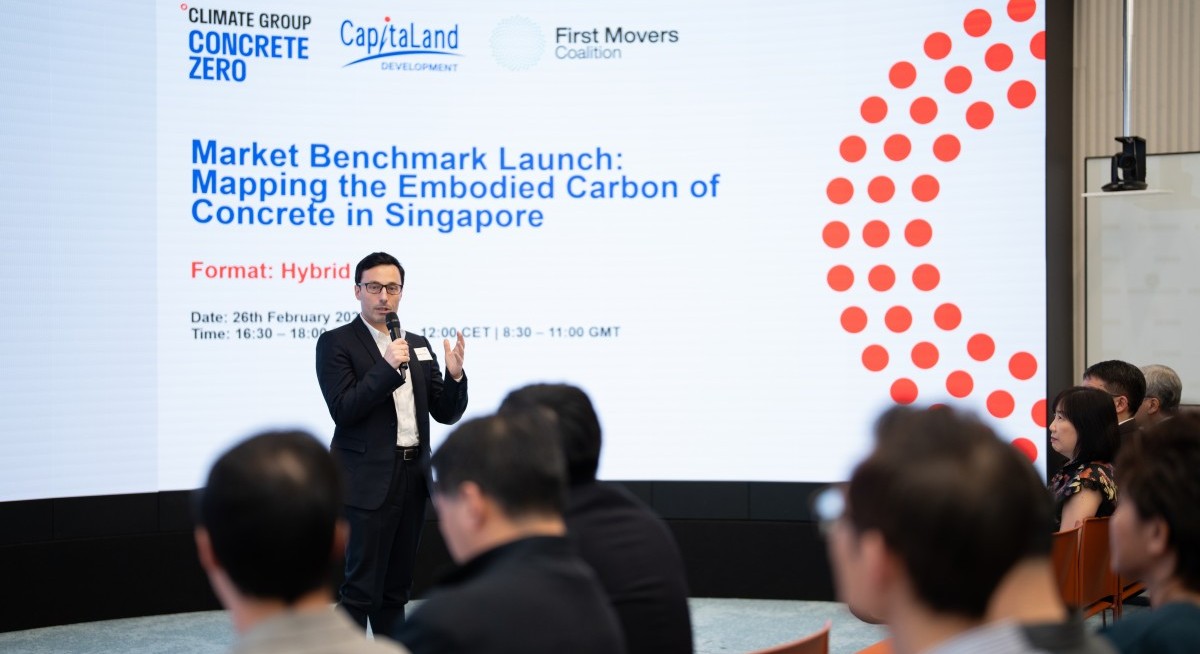


Concrete is one of the main contributors to the embodied carbon footprint of most buildings and infrastructure assets. Embodied carbon represents the carbon emissions released during the lifecycle of the building materials.
Cement, concrete and steel alone account for roughly 15% of global carbon dioxide emissions, says Daniel Boero Vargas, lead, industrial decarbonisation innovation, supply and concrete, World Economic Forum. “While operational carbon in buildings is increasingly regulated and addressed, embodied carbon is often seen as the next frontier, and that’s why the materials we choose today will shape the emissions for decades to come.”
According to CLD and ConcreteZero, the built environment accounts for almost 40% of global carbon dioxide emissions, with concrete alone accounting for 8%. “By equipping developers, suppliers, regulators and financiers with a common reference point, the benchmark accelerates the transition from isolated pilot projects to systematic market adoption, reducing embodied carbon in construction at scale.”
The benchmark presents volume-weighted average, minimum and maximum embodied carbon values across six common concrete strength classes for concrete supplied in 2024.
The data captured covers an estimated 68% of the ready-mix normal weight market over that period. Several local firms contributed to the report, including City Developments, Frasers Property Singapore, Hong Leong Asia’s building materials group, JTC Corporation, Mapletree Investment, Pan-United Concrete, Keppel, Soilbuild Contractors and Woh Hup.
A 132-page report accompanying the benchmark provides a data-driven snapshot of the carbon intensity of concrete used in Singapore in 2024. The report outlines a transparent methodology for collecting and analysing embodied carbon data.
With the market benchmark, demand and supply-side industry stakeholders can make informed decisions, say CLD and ConcreteZero. For example, concrete users can benchmark performance and set carbon targets, while regulators can align standards and track progress. Suppliers can differentiate products and guide innovation, and financiers can assess climate risk and support transition pathways.
According to CLD and ConcreteZero, the benchmark supports the evolution of certification schemes, procurement frameworks and regulatory standards. While it enables “year-on-year tracking” of the state of the industry, City & Country understands there are currently no plans for an annual exercise.
Singapore imports nearly all of its cement and building materials. The report draws on frameworks from the UK and Australia, adapted for Singapore’s market to ensure the data is relevant for overseas markets. The methodology can also be replicated across Asia and the rest of the world.
Singapore Green Building Council (SGBC) CEO Yvonne Soh says construction materials “tend to have a very long and global supply chain”. “Information is improving, but it really depends on where the cement is from, right? In different countries, you will have different energy grid emissions [and] different fuels, so therefore, the cement emissions will not be uniform across the world.”

From left: Yvonne Soh, CEO, Singapore Green Building Council (SGBC); Pang Sze Dai, Associate Professor, Department of Civil & Environmental Engineering, National University of Singapore (NUS); and Sang Lye See, executive director, sustainable finance, DBS Bank
In 2023, JTC launched the Singapore Building Carbon Calculator in collaboration with the Building and Construction Authority (BCA) and SGBC. The free web tool allows users to calculate the embodied carbon of projects using carbon emission factors adapted to Singapore’s context.
Speaking to City & Country, Soh says findings from the benchmark may be used to update the emissions factors referenced by the Singapore Building Carbon Calculator.
CLD is the unlisted development arm of the CapitaLand Group, with a portfolio valued at $18.5 billion as at Sept 30, 2025. CLD announced in 2024 that it plans to reduce its embodied carbon intensity by at least 22% by 2030 compared to a 2019 baseline.
Tony Tan, CLD’s chief corporate officer, says: “The development side is the one that has got a higher lever in terms of embodied carbon because development work is very heavy on embodied carbon, whereas most of the asset and business activity at the [CapitaLand Investment (CLI)] level are really more operational.”

Still, both sides enjoy a “symbiotic relationship”, he adds. “We want to produce products that may potentially also be available for investment under CLI, so that collaboration is very important.”
In 2021, CLI implemented a shadow internal carbon price to quantify the future carbon value exposure of assets and to calculate a return on sustainability for all green investments. The figure is not disclosed.
Giovanni Cossu, CLD’s head of sustainability, says it is premature to say if CLD will follow suit. “At the moment, we are looking into this and also looking at how this then correlates to some of the findings from this report.”
Photos: CapitaLand Development




