


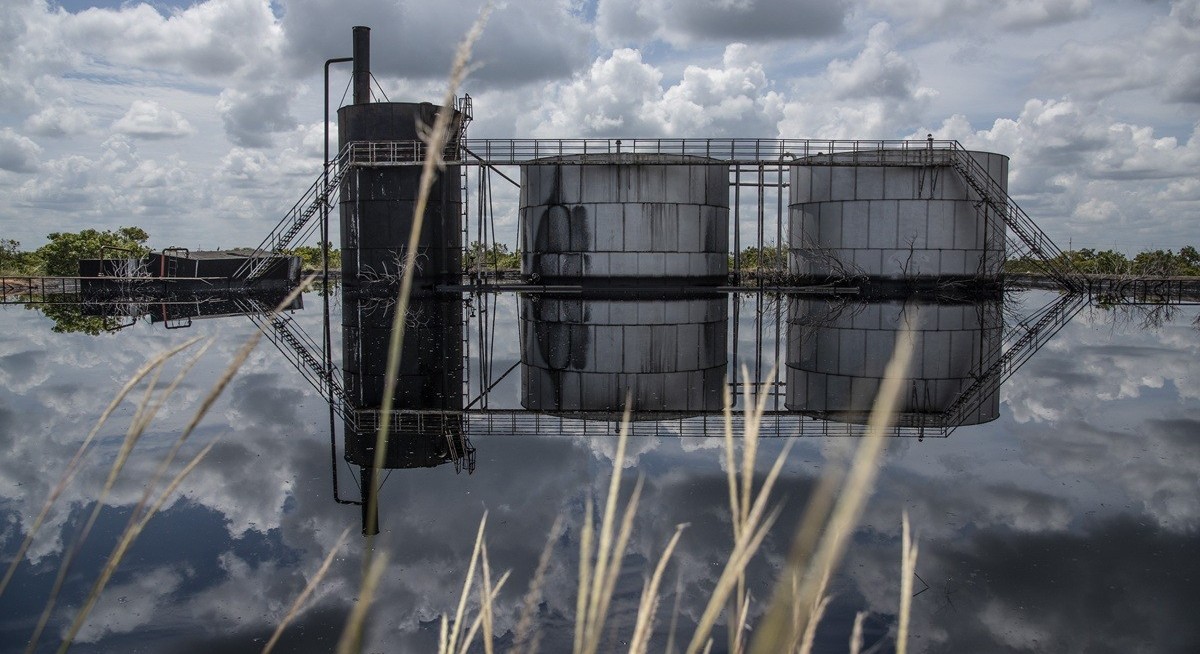


Largest oil reserves, tiny supplier
The Latin American nation possesses 303 billion barrels in oil reserves, or 17% of the world’s total. In contrast, Saudi Arabia has an estimated 270 billion barrels. In the 1970s, Venezeula was producing some 3.5 million barrels a day, or 7% of the then global total. However, due to ageing infrastructure, mismanagement and sanctions, Venezuela's current output is below a million barrels per day, or 1% of the global total. In contrast, Saudi Arabia pumps more than 10 million barrels a day,
“Its [Venezuela’s] oil production and exports have been structurally constrained for years by underinvestment, operational issues and international sanctions,” says the International Energy Agency (IEA) to The Edge Singapore.
Echoing the IEA’s view about Venezuela’s oil production capabilities, Julius Baer head of economics Norbert Rücker describes the country’s oil infrastructure as “run-down”, adding that any near-term supply risk is minimal despite the attack. “For the time being, the events in Venezuela do not alter the big picture,” adds Rücker. “The oil market appears to be in a lasting surplus.”
See also: Oil surges as US strikes targets in Iran following ship attacks
Priyanka Sachdeva of Phillip Nova spells out the reality: “Venezuela’s actual production accounts for less than 1% of global consumption. Amid years of underinvestment, mismanagement, and high extraction costs, any meaningful production revival is years, not months, away.”
On the other hand, global markets are well-supplied, notes the IEA. The US, for one, has changed the dynamics of the global market significantly when its shale oil production gets ramped up. IEA notes that Brent crude prices are “roughly” US$20 per barrel lower than a year ago, a reflection of a significant surplus accumulated over the past year.
The IEA points out that global production grew by an estimated three million barrels per day (bpd) in 2025 and is projected to increase by another 2.4 million bpd in 2026. At the same time, global oil demand is expected to increase by over 800,000 barrels per day in 2026, i.e. increase in supply tops demand.
See also: Shell signals strong oil and gas trading profit on Iran war
“This explains why a potential supply shock in Venezuela is unlikely to reverse the bearish trend — particularly since the US did not touch any oil facilities during last weekend’s operations and sanctions on Venezuelan oil remain in place, “ says Swissquote analyst Ipek Ozkardeskaya.
It would not be far-fetched to conclude that should all oil production come to a halt in Venezuela, it is unlikely to move the needle very much, if at all, on oil price and supply.
Fundamentals, not geopolitical risk
According to Rystad Energy analyst Lin Ye, the US attacks have “severely” disrupted Venezuelan crude exports by blocking sanctioned tankers. The US attack potentially exacerbates the geopolitical risk premium. “The capture of Maduro introduces a new layer of uncertainty regarding the country's immediate political stability and control,” she says. “This ongoing instability is likely to sustain or even increase the risk premium in the market, as traders weigh these tensions against other fundamentals like the recent OPEC+ decision to pause planned production increases,” says Lin.
However, Saxo Markets strategist Charu Chanana believes that oil prices have remained relatively staid because of market fundamentals. “For oil to reprice sustainably, geopolitics has to show up as actual disruption to supply chains or a broader regional shock,” she says. “Until that transmission channel is clear, crude tends to trade the bigger picture: the global balance, spare capacity elsewhere, and macro growth.”
While they might differ how oil prices will move, analysts all point out that it will take years to rebuild Venezuela’s oil production capabilities and before it can be a major oil producer again. “Recovery will be a gradual, multi-year process due to massive underinvestment, decay, and debt,” says Lin. For Chanana, she says that the sector needs “capital, equipment, people and functioning infrastructure” and adds: “Bringing meaningful barrels back isn’t a switch you flip.”
What is the path to recovery for Venezuela’s oil?
To stay ahead of Singapore and the region’s corporate and economic trends, click here for Latest Section
Petróleos de Venezuela, S.A. (PDVSA), the state-owned oil and gas company of Venezuela, was established in 1976 when the country’s oil industry was nationalised. The country’s government exercises control of its oil reserves through PDVSA.
In 2006, then president Hugo Chavez ordered that all oil projects must be at least 60% owned by PDVSA, which led to an exodus of international oil companies (IOCs). Chevron was one of the few companies to accept the terms and has retained a presence in the country to this day. Equinor and TotalEnergies remained but exited the market in 2021.
Meanwhile, Exxonmobil and ConocoPhillips both refused and their projects were expropriated in 2007. The two companies have been successful in international arbitration cases but have never been compensated by Venezuela. Other IOCs now operating in Venezuela include China National Petroleum Corporation, Italy’s Eni and Spain’s Repsol. The bulk of Venezuela’s oil is exported to China.
Compounding the exodus of oil companies, Venezuela’s oil sector has suffered from a shortage of a skilled workforce after the government fired more than 20,000 PDVSA workers or 40% of its workforce from 2002 to 2003. The volatility of oil prices and US sanctions over the past two decades have resulted in further underinvestment and neglect of both hardware and software for the industry and, unsurprisingly, a decline in production.
Responding to The Edge Singapore, Rystad’s head of analysis Artem Abramov estimates that there is up to 300,000 bpd of “easy” growth in the next two to three years should producers redrill “sweet spots” which do not require large capex.
In Rystad’s “back to three million bpd” scenario, he projects production to hit two million bpd by 2032 and three million by 2040, under the assumption that external investment of around US$30 to US$35 billion starts this year and carries on for up to three years.
Abramov, along with his colleagues Aditya Ravi and Radhika Bansal, think that Venezuela requires a total of around US$183 billion until 2040, or around US$12 billion annually for 15 years, to get back to three million bpd.

Chart: Rystad Energy Upstream Solution; Rystad Energy Research and Analysis
Rystad estimates that the US$183 billion capex would translate into service purchases of US$156 billion, after internal operator spend is removed. Fabrication and construction would take up the largest slice of the pie at around US$41 billion with five other segments ‒ major equipment, materials and metals, maintenance and mechanical, electrical and instrumentation, and logistics and support ‒ having 15-year market sizes exceeding US$10 billion. The rigs and equipment segment is worth US$9 billion while studies and engineering is at US$8 billion.

Chart: Rystad Energy Upstream Solution; Rystad Energy Research and Analysis
Rystad believes that international oil companies have to provide the majority of the investment to revitalise oil production. For context, PDVSA and Venezuela's national budget funding is around US$53 billion.
Will companies bite?
Most analysts believe companies will only invest in Venezuela if they have confidence in the country's stability and outlook. Oil companies, naturally, will be cautious about deploying capital until there is greater regulatory and contractual certainty, says Morningstar director of equity research Allen Good. “Furthermore, the bulk of its reserves are extra-heavy oil, which is costly and capital-intensive to extract.”
Most of Venezuela’s crude is located in the Orinoco Oil Belt, spanning about 55,000 sq km to the east of the country. The region produces extra heavy crude which contains more sulphur, in contrast to international crude grade benchmarks such as Europe’s Brent and the US’s West Texas Intermediate (WTI).
Abramov expects the Western oil majors to be “monitoring the situation closely” and not roll in in the short term. “They will not move until they develop full confidence in a stable investment climate and are offered reasonable incentives to commit capital,” says Abramov, “In the current market environment, it is hard to imagine what kind of measures can even trigger this ‘full confidence’ sentiment.”
Abramov suggests that a “complete revamp” of Venezuela’s governance and legal frameworks along with US government guarantees and support, potential restructuring of PDVSA and changes to the Organic Hydrocarbon Law will be necessary to trigger investment interest.
According to Morningstar’s Good, Chevron is “best-positioned” to benefit from US involvement in restoring Venezuelan crude projects. He points out that Chevron holds stakes in four key joint ventures and an offshore gas field which may now be fully developed.
Good also notes that opening up investment could potentially allow Exxon Mobil and ConocoPhillips to reenter the market, collecting what they were awarded through arbitration or having their seized assets restored.
Responding to The Edge Singapore’s queries, Interactive Brokers senior economist José says that Chevron and Exxon Mobil are the “obvious” US oil majors that are poised to invest in Venezuela, boosting production capabilities. He adds, “Smaller ones are likely to participate as well but we’d need more time and clarity on the situation before knowing who the players will be.”
Local investors may want to take note that Seatrium is involved in several floating, production, storage and offloading (FPSO) vessel projects which will be deployed in neighbouring Guyana.
Analysts from Franklin Templeton Institute have also mentioned that should investment flow into Venezuela and oil supply increases in the long-term, prices may remain relatively low, benefiting economic growth.
They note that “longer-term” stability in Venezuela, coupled with a potential peace deal in Ukraine, could increase global oil supply by more than five million bpd by around 2030. “That would amount to about 5% or more of global crude output, enough to keep oil prices depressed for longer, which would be a clear positive for global growth and a restraint on inflation,” say the pair.
Don’t forget OPEC+
In its Jan 4 meeting, OPEC+ maintained its production quotas for 1Q 2026 as eight key producers reaffirmed their commitment to market stability.
Torres says there is “little appetite” for OPEC+ to drop output volumes further. OPEC+ increased production volumes over the last two years to regain market share lost to non-OPEC producers and to manage political pressure from high energy prices.
“The path to much higher oil prices has narrowed significantly,” says Torres, “You would need OPEC+ to essentially drop production heavily which is highly unlikely because most members need hard currency right here right now.”
Concurring, UOB head of markets strategy Heng Koon How says that OPEC remains “resolute” in its ongoing campaign to pump more oil and maximise its production capabilities. “This oversupply from OPEC is keeping crude oil depressed and devoid of any geopolitical risk premium,” says Heng.
Heng forecasts the price of oil to decrease in the coming year from US$65 in 1Q2026 to US$55 in 2H2026. This decrease is in line with earlier projections prior to the attack on Venezuela.
Despite the headlines, markets seem to have reacted rationally to the US attack on Venezuela — as shown by Chevron’s statement on Jan 5 that it is business as usual: “We continue to operate uninterrupted and in full compliance with all relevant laws and regulations.”




