


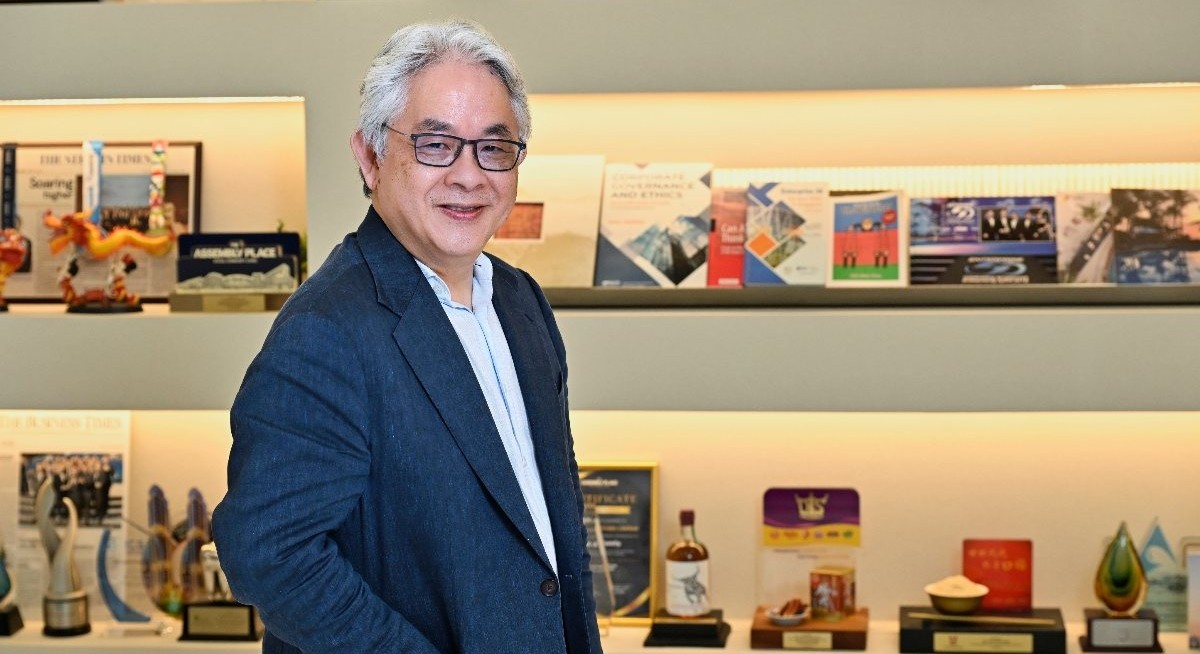


Mak’s straight-talking and blunt tone is a hallmark of his LinkedIn posts. The National University of Singapore (NUS) accounting professor does not mince his words when it comes to calling out governance lapses by companies and their directors.
Mak, however, says people are mistaken if they think he is just a firebrand with an axe to grind.
“Sometimes, you need to get the message through,” Mak tells The Edge Singapore. “I don’t go for minor technical breaches and say, ‘Oh I ‘whacked’ the company.’ Companies do make mistakes, right?”
Mak says there have been instances where he did not go public with his criticisms. On June 8, 2023, supermarket operator Sheng Siong received a query from the Singapore Exchange (SGX) when it did not comply with the Code of Corporate Governance.
See also: Barclays buys Canary Wharf HQ building for £750 mil
According to the Code, independent directors should make up a majority of the board when the board chair is not independent. Non-executive directors should also make up a majority of the board.
This was not the case for Sheng Siong at the time as only five out of its 10 board members were independent and non-executive directors. Sheng Shiong’s executive chair, Lim Hock Eng, is the brother of the company’s CEO Lim Hock Chee.
In its response to SGX on June 12, 2023, the company said its lead independent director, Chee Teck Kwong Patrick, would make himself available to shareholders who had concerns. Sheng Siong currently has nine directors on its board, with five of them being independent.
See also: Singtel CEO’s pay cut 17% to US$5.3 mil after network outages
Even though Sheng Siong was not compliant with the Code, Mak recalls he did not single the company out for criticism. “I don’t look at this and then attack Sheng Siong. Although the executive directors are paid quite well, they look after their workers. They are quite a responsible company.”
Mak says he has engaged with companies privately about their breaches instead of airing them publicly. “People don’t understand that sometimes there are situations where I will communicate with the company and then basically say, ‘You fix it.’”
Detractors of Mak often point to his academic background and say his criticisms are too often grounded in theory instead of practice. Mak disagrees with the characterisation that he lacks commercial experience, adding that he has turned down directorships at publicly listed companies because he wants to maintain his independence.
“Well, you should tackle the ball and don’t tackle the man,” Mak says. “I want to be able to speak freely. I have always taken a position. I don’t accept directorships of listed companies. People say, ‘You could earn a lot of fees.’ But I don’t want people to say I have vested interests so I have never accepted.”
To be fair, Mak is not just all work and no play when it comes to his LinkedIn postings. Besides posting the occasional cartoon, he has penned tributes to his wife — a dentist — and their marriage.
“I’ve shared before that early in my corporate governance advocacy journey when I started to be critical about companies and directors, I mentioned to her that I may step on some big toes,” Mak wrote last year. “She said that I should just do what I believe is right and she will support me. If this means having to relocate, she said that’s fine with her.”
Mak’s blueprint for boosting the Singapore market
To stay ahead of Singapore and the region’s corporate and economic trends, click here for Latest Section
Before 2024, Singapore’s stock market was long seen as sluggish. A growing number of delistings, low liquidity and depressed valuations meant the city-state’s equities market was not top of mind for most investors. Things began to pick up after the government set up a review group to recommend measures to boost the local bourse in August 2024.
The group, which was chaired by National Development Minister Chee Hong Tat, published its final report on Nov 19, 2025. Chee is also the deputy chairman of the Monetary Authority of Singapore (MAS).
The group proposed a variety of measures, including setting up an Equity Market Development Programme (EQDP) fund to channel capital into the Singapore market and raise investor interest. The fund initially started out with $5 billion but has since been raised to $6.5 billion after Prime Minister and Finance Minister Lawrence Wong said he would allocate an additional $1.5 billion to MAS.
Mak has long maintained that reviving Singapore’s stock market will involve much more than pumping capital into the market. He believes that the “death spiral” the Singapore market is in can be addressed if policymakers are willing to take “tough measures”.
Firstly, regulators need to hold companies accountable and improve investor protection. “Strong enforcement is important. When we see something wrong, be a bit more proactive rather than reactive, so [we] may have to intervene a bit more,” Mak says.
Secondly, SGX should retain its financial watchlist instead of abolishing it in October 2025. In fact, Mak thinks the watchlist should have been extended to include other criteria besides poor financial performance, such as whether a company faces serious audit qualifications.
“I would not be lenient to companies which have to be suspended,” Mak says. “The watchlist, to me, is a mechanism for getting rid of not-very-good companies.”
This is not a new concept. Financially distressed companies who are placed under Malaysia’s version of the watchlist, better known as Practice Note 17 or PN17, have to turn things around within a certain period of time or risk delisting.
Similarly, in the US, companies listed on the New York Stock Exchange (NYSE) or the Nasdaq have to maintain a minimum trading price of US$1 ($1.28). If the stock were to fall below US$1 for 30 consecutive days, companies will be given a limited period of time to raise their stock price or be delisted.
Delisting companies needs to be done even though it will result in fewer counters being traded on Singapore’s market, says Mak. “We have about 600 companies. Let’s say we make a hard decision and because of that we clean up 100 to 200 companies for SGX ... then, [we] can build up the remaining ones and attract good companies.”
This, Mak adds, is key to improving the valuations of Singapore’s listed companies. “There’s this phrase: the bad drives out the good. If you have too many bad companies, it affects valuation, it affects liquidity. The good companies are not going to come.”
Too many Catalist sponsors
Besides being stricter for Mainboard counters, SGX should reconsider its regulatory approach toward the Catalist board as well. Mak believes there may be too many sponsors trying to help companies list on the Catalist board. Catalist sponsors act as a gatekeeper for companies looking to list. Besides assessing their suitability, sponsors help companies navigate the IPO process and ensure they are compliant with SGX rules post-listing.
There are currently 19 SGX-authorised sponsors to roughly 200 companies listed on the Catalist board. This makes it highly competitive for sponsors, particularly the smaller players who will earn less in listing fees as compared to the dominant ones. Mak says this results in some sponsors having to offer additional services to their clients such as by handling their financial advisory or investor relations functions.
“You end up doing things that may put you in a bit of conflict. As a full sponsor, your main role is to make sure the company is of good quality. Then as a continuing sponsor, your main role is to make sure the company complies with the rules,” Mak says.
“How can you be an investor relations function, for example, while you are also helping to ensure compliance?”
Sponsor model should be revisited
Given this, Mak believes the sponsor model should be re-evaluated as the current sponsor model is not sustainable.
Looking to markets like Hong Kong and Malaysia, Mak notes that sponsors for their “equivalent second boards” are not around for an indefinite amount of time.
“After three years, you don’t need a full sponsor anymore,” he says, adding that companies have to build their own internal capabilities to ensure they are in compliance with the rules. The stock exchange will then have to regulate these companies directly.
Mak compares this to SGX’s Catalist model, which is based on outsourcing its first-line regulatory role to the sponsor because it is a more commercially-driven entity.
He likens this example to a company hiring an external auditor, where companies have to issue statements whenever they change auditors. A too-frequent-change in external auditors also reflects a red flag with the company.
Yet, when companies change sponsors, companies simply chalk it up to “commercial reasons”.
“If I don’t like you [as the sponsor] — you ask too many questions — [and] I replace you [as a sponsor], how can that model work?”
He adds that sponsors may also take on other roles such as being an independent financial advisor (IFA), other corporate advisory type of work or fundraisings, which may be more profitable. In that case, a sponsor may end up pushing the company to raise funds even if it does not require any fundraising at the time.
As such, sponsors still have a role to play, albeit only for a limited amount of time to guide the company. Eventually, however, the sponsor should take a step back and leave SGX to regulate the companies themselves.
Having a cap on directorships
Attention must also be paid to the capacity of directors to discharge their duties responsibility, particularly when they sit on numerous boards.
In February 2023, Chee, then the Senior Minister of State for Finance, said there is no formal limit on the number of directorships individuals may hold in Singapore-incorporated companies. However, he stressed that all directors will need to “discharge their duties responsibly, and with honesty and reasonable diligence”.
Mak, however, takes a different view. While he acknowledges that it would be difficult to impose a limit on the number of directorships held in private companies, he believes there should be a “hard limit” for listed firms.
Mak points out that several markets such as Malaysia, China and Vietnam have imposed limits. In Malaysia, directors are capped at five listed company board seats under the Companies Act 2016, a reduction from the previous limit of 10 directorships. Even then, the Malaysian bourse is running a consultation on whether that limit needs to be tightened.
In December 2024, the Hong Kong Exchanges and Clearing (HKEX) announced that independent directors of Hong Kong-listed companies must not hold more than six Hong Kong-listed issuer directorships.
Ultimately, Mak hopes SGX will follow suit. “At the end of the day… you can’t be sitting on too many [positions],” he says. “I think five is probably a reasonable limit… for [directors] with no full-time jobs”.
For directors with full-time roles, the threshold should be lower. Companies themselves should set internal expectations, he adds. “If you are [the] CEO of the company, you shouldn’t sit on more than two outside boards, which I think is quite reasonable.”
A spokesperson from the Singapore Institute of Directors (SID) notes that the number of directors on listed entities taking on multiple board seats has been “steadily declining” over the past decade.
“Today, nearly 86% of listed entity directors — or about nine in 10 directors — hold just one board seat. And just under 5% hold more than two board seats,” the spokesperson says. “Based on the Singapore Directorship Report 2025, as at the end of last year, only one director held more than six board seats.”
To SID, the issue is not about the number of board seats a director holds. What matters is whether the director is able to “devote sufficient time and attention to discharge his or her duties effectively”. This principle is reflected in MAS’s Practice Guidance, which outlines directors’ roles and responsibilities, as well as other topics such as conflicts of interest.
“As the operating environment becomes more challenging, the work of directors becomes more complex,” SID adds. “Boards should consider not just an individual’s competencies, time and capacity, but also the company’s strategy, the mix of skills on the board, and whether the candidate is the right fit. The declining trend in multiple directorships suggests that companies are already increasingly mindful of these realities.”
It is not just about the number of directorships. Mak believes certain professional groups should be more mindful when accepting board appointments.
Former public servants, he says, should not just accept positions merely because they can provide easier access to the government or can make things easier for the company when navigating governmental laws. Likewise, lawyers should avoid accepting board seats where their firms provide legal services to the same company.
“I think we have reached a situation where there are too many lawyers sitting on boards who are conflicted,” says Mak.
“In other words, their firm provides legal services to the company. While they’re sitting on the boards as independent directors, we see that too often,” Mak adds, noting that it does not happen in many other markets.
A spokesperson for the Law Society of Singapore says there is “no legal basis” for lawyers to not serve on the boards of public companies. Lawyers are also not legally bound to avoid being appointed to boards for their legal expertise.
Furthermore, a conflict of interest does not arise merely because a director is a practising lawyer. “As with all directors, where an actual conflict does occur — for example, if the director has a personal or professional interest in a matter before the board — the law already requires that the director disclose the conflict and recuse themselves from deliberations and decisions on that issue,” the spokesperson says.
The Law Society of Singapore says that many companies “value the governance, analytical and legal expertise that lawyers bring to the boardroom”. The spokesperson adds: “Their experience often helps boards navigate complex regulatory landscapes and make more informed decisions. Moreover, their disciplined thinking helps boards proactively strengthen strategy by identifying and resolving potential risks.”
Love me, hate me
As an outspoken critic on governance issues, Mak admits that his views have cost him friendships over the years, but that is a price he has learned to accept.
“That’s when you find out [who are your] good friends and [who are] the better companies,” he says. “The better companies won’t take it personally; the good friends won’t take it personally. But then you know who your friends are and companies which are truly committed to governance.”
For Mak, speaking out about good corporate governance has always been the point. Staying true to his principles may be a lonely road, but it is also the path to real change




