


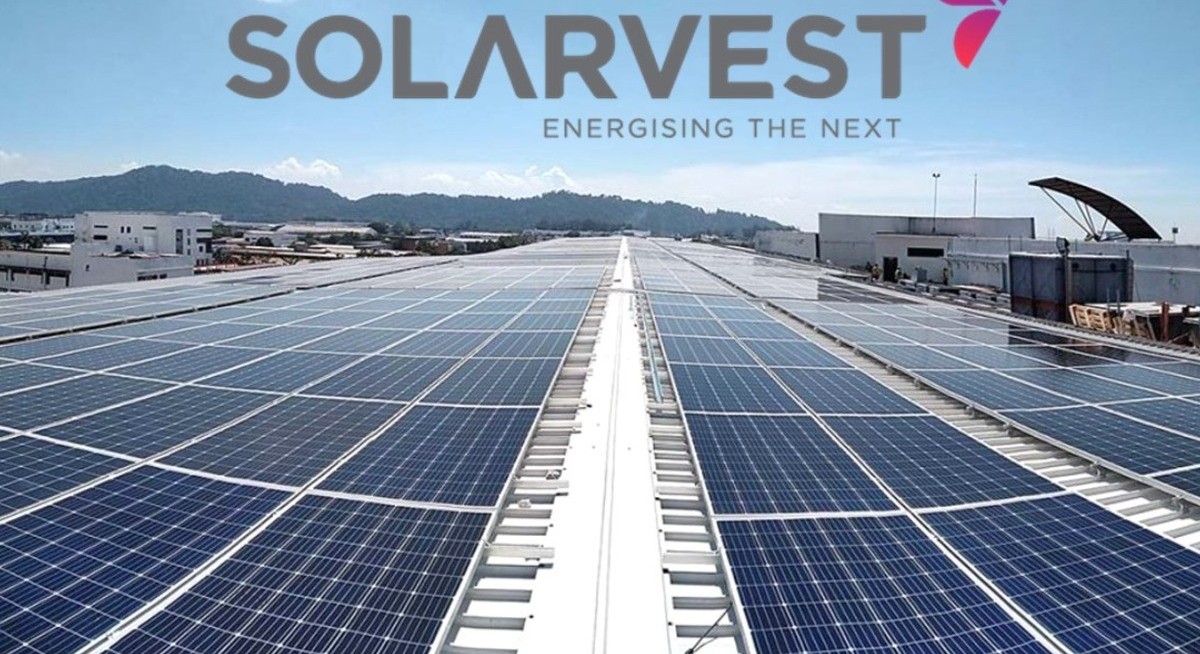


(April 15): Malaysian firm Solarvest Holdings Bhd (KL:SLVEST) is looking to speed up delivery of its large-scale projects to meet a rise in demand for renewables as the war in Iran drives up the cost of fossil fuels.
“If a project takes 18 to 24 months to deliver, we need to talk to regulators on how we can execute faster, maybe from 12 to 16 months,” Solarvest group chief executive officer Datuk Davis Chong Chun Shiong said in an interview on Tuesday (April 14).
Solarvest, Malaysia’s biggest solar firm, builds large-scale capacity to feed into the country’s grid, as well as corporate renewable energy projects via direct offtake agreements. The company is adding around 1.3 gigawatts of solar capacity in 2026 and at least another five gigawatts through 2028, according to information on Solarvest’s website. It’s planning to deploy large-scale solar projects for grid operator Tenaga Nasional Bhd (KL:TENAGA) from next year.
The company unveiled two large solar projects with Tenaga Nasional on Tuesday under the corporate partnership programme. These will supply Micron Technology Inc plants in Penang and Muar, as well as the data centre arm of NTT Inc and Texas Instruments Inc’s local operations.
Chong expects fossil fuel-backed energy bills for industries to rise further in the second half of the year, boosting interest in solar.
Solar panel and battery prices will remain stable to lower over the same period as supply routes from China are not directly impacted by the war, he said. Panel prices are currently around US$0.11 per watt, while battery prices are around US$100 per kilowatt-hour, but “fast catching up” with prices in China that are between US$60 and US$80, Chong said.
See also: Ringgit set to test new high for 2026, strategists say
The head of another Malaysian solar developer said inquiries had risen by at least 40% in April, driven by data centre and semiconductor supply chain companies seeking to build solar capacity.
“For our industry, the higher the energy costs are, the faster the return of investments, so it makes more and more financial sense,” said Cliff Siaw, the CEO of Progressture Power Sdn Bhd.
Deputy Prime Minister Datuk Seri Fadillah Yusof said on Tuesday that the country had reached 12 gigawatts of renewable energy capacity in 2025. Malaysia, one of Asia’s fastest-growing data centre hubs, is a net energy exporter, but imports half of its domestic fuel needs, and a portion of its gas requirements.
See also: Malaysia mulls adopting Bestinet's new migrant worker system, Bloomberg reports
Solarvest shares climbed as much as 3.3% on Wednesday, taking gains since the start of the Iran war to around 28%. The stock is up about three-quarters over the past 12 months.
Uploaded by Liza Shireen Koshy




