




According to JT Automation Technology group chairman Wu Si Yuan, the company sees Johor as a gateway to Southeast Asia. “The JS‑SEZ provides a platform for us to scale our presence, optimise cross‑border operations and enhance supply chain resilience as we support our long‑term growth across the region,” he tells The Edge Singapore.
JT Automation specialises in designing precision-engineered laser workcells and serves a multitude of industries, including aerospace, defence, electronics, energy, material processing, medical, oil and gas, among others.
“Beyond expanding our own capabilities, we see strong potential to collaborate with partners to further strengthen Johor’s industrial ecosystem, deepen local supply chain integration and create opportunities for small- and medium‑sized enterprises to participate more meaningfully in global value chains that span both Johor and Singapore,” adds Wu.
A strategic collaboration between Singapore and Malaysia, the JS-SEZ aims to drive cross-border growth and attract global investment. By establishing complementary operations in Singapore and the JS-SEZ, businesses can strengthen their market presence in Southeast Asia.
See also: Traders keep faith in Malaysian bonds in face of deficit warning
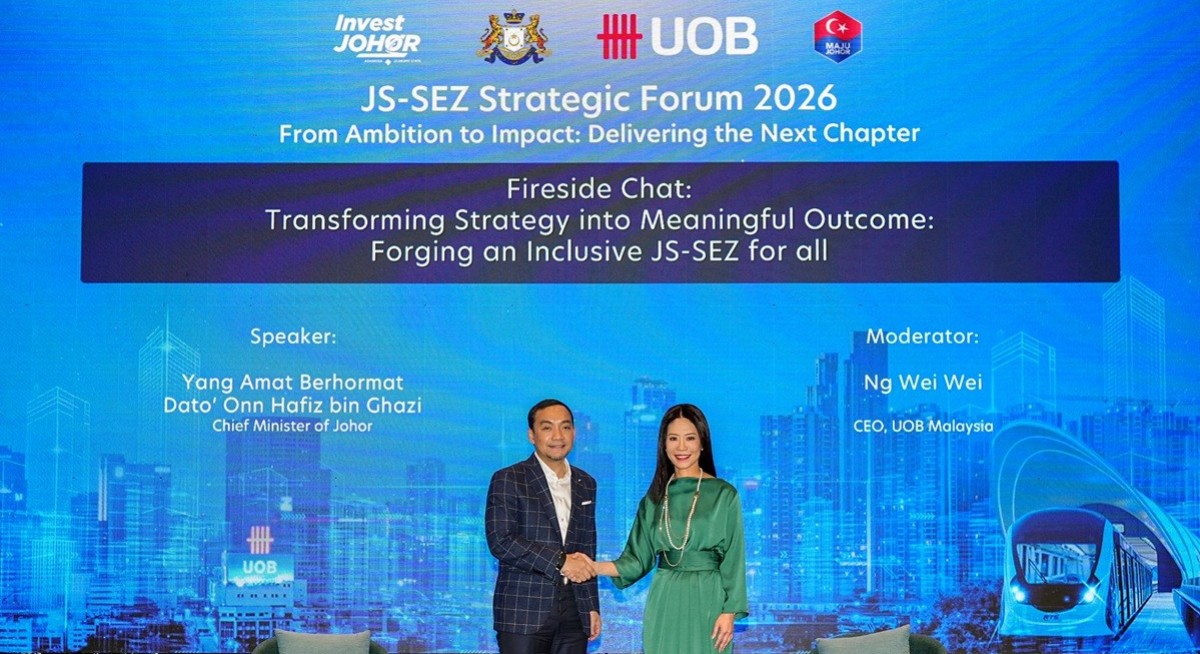
For UOB Malaysia CEO Ng Wei Wei, the JS-SEZ is still progressing despite the lack of a master plan. “Even as the market awaits the upcoming blueprint, the JS-SEZ is already taking shape in tangible ways,” says Ng. “We are seeing a strict shift from fact finding, serious land sourcing, licensing, applications and operational preparation.”
Following the launch of UOB’s Green Lane with Invest Johor in February 2025, the bank announced that it had facilitated foreign direct investments (FDI) flows exceeding RM18 billion into the JS-SEZ as at end-2025.
Ng adds that since the inception of the Green Lane, investment momentum into the JS-SEZ has accelerated, with a threefold increase in FDI. “This underscores growing investor confidence to move decisively from interest into reality,” says Ng. “We continue to actively engage and connect prospective investors from Singapore, China, across Asia and Europe.”
In a similar vein, Johor Menteri Besar (MB) or Chief Minister Onn Hafiz Ghazi says that Malaysia remains an attractive destination with growing investor confidence in Johor and the JS-SEZ according to several indicators.
Firstly, besides pointing out that the International Monetary Fund has raised Malaysia’s GDP to grow by 4.7% in 2026 while cutting global growth outlook to 3.1%, the MB also notes that Bank Negara has revised the country’s growth upwards to 4%. “This shows that both national and international institutions remain confident in Malaysia’s fundamentals,” he says.
More important for Onn Hafiz is Singapore emerging as Malaysia’s top foreign investor, contributing RM58.3 billion in 2025. From his perspective, these investment figures, along with record state revenue of RM2.6 billion, are evidence of the increasingly positive investor sentiment on the JB-SEZ.
“These are unmistaken signposts of growing global confidence in Johor and JS-SEZ as a credible, competitive and future-ready investment destination,” he says. “Together with Singapore, we will continue to attract high-impact investment across key sectors such as advanced manufacturing, digital economy, green energy and smart logistics.”
Collaboration with Singapore as a competitive advantage
Sharing his thoughts on working with Singapore on the JS-SEZ, the MB references overseas visits to other countries and says that there is “a lot” of goodwill when Johor partners with Singapore.
“We went to America, UK, Korea, Japan, China, just to name a few, and every time I visited those countries to meet potential investors, I never had to do any hardsell,” says Onn Hafiz, who attributes initial investor confidence in the JS-SEZ to the connection with Singapore.
To stay ahead of Singapore and the region’s corporate and economic trends, click here for Latest Section
He adds: “If Singapore can work with Johor, that shows that there is some credibility and they know that Singapore will not simply partner up with just anyone. [Singapore] will only partner up with states and countries that have the same aspirations and inspirations to succeed. One of the most important competitive advantages we enjoy is partnering with Singapore.”
To develop economic connectivity and nurture closer people-to-people ties, Singapore and Malaysia have introduced initiatives to ease the flow of goods and people across both country’s land checkpoints. These include more convenient immigration clearance for travellers, simplified customs procedures and more transportation options such as the Johor Bahru–Singapore Rapid Transit System (RTS) Link. Connecting Bukit Chagar in Johor Bahru and Woodlands North in Singapore, the 4km cross-border light rail transit shuttle is slated to open by end-2026/early 2027. The service is able to handle 10,000 passengers per hour per direction.
For JT Automation, such ease of connectivity played a role in its investment commitment to the JS-SEZ. “JT Automation Technology’s entry into the JS‑SEZ reflects a deliberate realignment of our regional manufacturing strategy and our confidence in Johor’s role as a key gateway to Southeast Asia, complemented by its proximity and strong connectivity to Singapore as a global business and innovation hub,” says Wu.
A vision for sustainable growth
At more than four times the size of Singapore or over 3,500 sq km, the JS-SEZ comprises Iskandar Malaysia, Pengerang, and nine flagship zones. These designated areas facilitate investments across 11 sectors: business services, digital economy, education, energy, financial services, food security, green economy, healthcare, logistics, manufacturing, and tourism.
Singapore’s Economic Development Board (EDB) highlights that the JS-SEZ enables Singapore businesses to “establish complementary operations” and access “competitive resources” in Johor, while analysts tout the JS-SEZ as a “once-in-a-generation opportunity” for cross-border investors.
According to UOB managing director Jimmy Koh, the JS-SEZ has redefined Singapore and Johor’s relationship with each other. In an online article published in July 2025, Koh highlights that the relationship has shifted from one based on synergy — the Lion City as a global business and financial hub, with Johor offering cost-competitive land and labour — to a “closely collaborative” approach anchored by a mutual vision for sustainable growth.
Addressing queries about Johor’s capability to manage the sustainability of the JS-SEZ, Onn Hafiz provides assurances on the three areas of concern, namely energy, water and talent.
Firstly, the MB shares that energy supply, at around 1,900 MW, exceeds energy demand which stands at less than 1,400 MW. He adds that there are plans for a 4GW solar farm to satisfy domestic demand and also supply Singapore. “So in terms of utilisation, it is just about 72%, so clearly, we’re not overstretched,” he says. “In terms of energy resilience, I think things are manageable as well.”
Similarly for water, Onn Hafiz cites demand at around 1,000 million litres per day (mld) for the whole state compared to a 1,500 mld supply. However, he notes that the excess is uneven across the state, but the state government is taking measures to ensure that there is enough water supply for all, especially around the JS-SEZ area.
On increasing the water supply and using it more efficiently, the MB notes that Malaysia’s Ministry of Energy Transition and Water Transformation (Petra) has approved nine projects for water catchment and treatment, which will increase supply by an additional 1,100 mld.
On the high demand for water by data centres, the MB shares that Johor is exploring the use of treated sewage water for data centre use. He adds that Johor is considering allowing more sustainable data centres such as Tier 3 ones to be built in the state.
Lastly, on the talent front, the MB shares that the state government is working with universities and schools on the matter as well as making sure that international companies, which bring in their overseas employees into Malaysia, train the local human capital to be able to take on roles.
A signal of confidence
When the agreement for the JS-SEZ was signed by both Singapore and Malaysia governments, it targeted to create 20,000 high-skilled jobs, along with investment for 50 projects in the first five years and 100 projects after 10 years.
While Onn Hafiz did not provide an update on the progress of these targets, he exudes optimism and confidence. “What’s remarkable is that our existing investors in Johor are helping us create a virtuous cycle in that many had invited the suppliers, vendors and supply chain partners to likewise come back,” he says. “This shows that we are growing as a full system, rather than just gaining isolated investments.”
For Wu, the ecosystem has supported their decision to invest in the JS-SEZ. He says: “The support and partnership of UOB are instrumental in facilitating an efficient and well‑structured investment process, while Invest Johor plays an important role in aligning our plans with the state’s broader development priorities.
“We look forward to collaborating with UOB and Invest Johor as we progress with our investment and contribute to the growth of the JS‑SEZ.”




