




Another sector that Suan expects Asean to attract investment from the Middle East is data centres, as well as tourism, with Malaysia and Thailand seeing more data centre construction, while Southeast Asia as a whole benefits from inbound tourism from holidaymakers who are avoiding conflict-ridden zones. “Some of the stocks related to data centres would potentially do well as well as tourism and our retail sector,” says Suan.
At the same time, the energy crunch caused by the Strait of Hormuz blockade will accelerate the adoption of alternative energy sources, according to Suan, who says diversification of energy supply will be on businesses’ agenda. He cites solar panel companies as a potential beneficiary of firms seeking to secure reliable energy for their operations.
However, while there are reasons to be optimistic, the spectre of inflation and its effects looms over the global economy. “The first-order impact will be inflation and we are already seeing it at the pump in Singapore and also in the US and worldwide,” says Suan, who adds that second-order impacts include supply chain disruptions, which could affect economic growth.
Outlining three scenarios — base, bad and worst — for the US-Israel-Iran war that was first shared on Mar 6, Suan says that there is a 60% probability for the base case where the war would last four weeks, with Brent crude oil hitting up to US$90 ($116) in the near-term before easing to around US$75 per barrel. In the ‘bad’ case where the war lasts for three months, UOB estimates the probability of this occurring at 25%, with oil reaching as high as US$100 before easing to US$80 per barrel. In the worst-case scenario, with a 15% chance, the war drags on for six to 12 months, with oil exceeding US$100 per barrel for “several” months.
See also: More Singapore residents target more than $1 mil and retirement in their 40s: CIMB-NTU study
While Asean may attract investments fleeing the Middle East, inflation driven by the energy crunch could dampen economic growth. Based on its simulation, UOB expects sustained US$10-per-barrel increases in oil prices over six to 12 months, which would lower Asean GDP growth by approximately 0.7 percentage points over two to four quarters and raise inflation by one percentage point over three to four months. Countries with higher vulnerability include the Philippines and Vietnam, which import 95% and 85% of their crude oil demand from the Middle East, respectively.
“So if the [worst-case] situation continues, US$100 for six months to 12 months, the effect on inflation will probably be double,” says Suan “Instead of looking at 2%, we’re probably looking at 4% [inflation],” UOB adds that central banks may have to raise interest rates the longer crude oil prices stay high and this will spillover into debt repayments and spending, with GDP growth weakening to 3%–4%, the slowest since 2020 when Covid-19 struck.
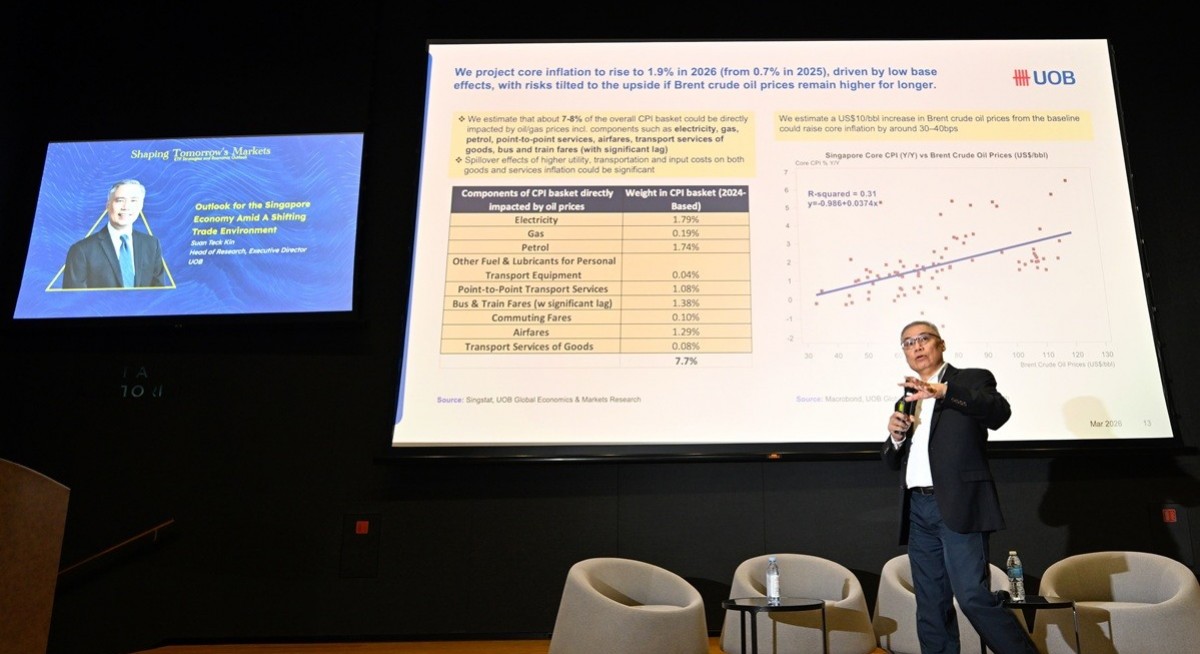
For Singapore, UOB estimates that every US$10-per-barrel price increase adds 30 to 40 basis points to core inflation, even with a firmer S$NEER. Suan expects the Monetary Authority of Singapore to strengthen the Singdollar in April to offset imported inflation.
See also: Global fragmentation drives flows to Asean
Regarding Singapore’s economy, Suan has not yet revised UOB’s earlier 3.6% GDP growth projection. The way he sees it, capital inflows, AI demand, and tourism will offset the impact of the Middle Eastern war on the island state’s GDP growth.
Suan does not expect interest rates in Singapore to move significantly unless the US hikes its rates. He explains that Singapore’s rates have declined faster than those in the US, and the US is playing catch-up.
As with its Singapore GDP growth projection, Suan says UOB remains steadfast in its prediction that the US will cut interest rates twice in 2026, despite US Futures Implied Probabilities data suggesting rates will hold steady for the rest of the year. Suan alludes to the appointment of a new US Federal Reserve chairman, who will be under pressure to cut rates, despite other factors, particularly inflation driven by higher energy prices.
“The longer the conflict goes on, the broader the effect, the negative effect is going to be more spread out and so there’s a concern,” says Suan. “It’s not going to be pretty, but hopefully, we can get through it quickly, and then things can get back to normal.”




