


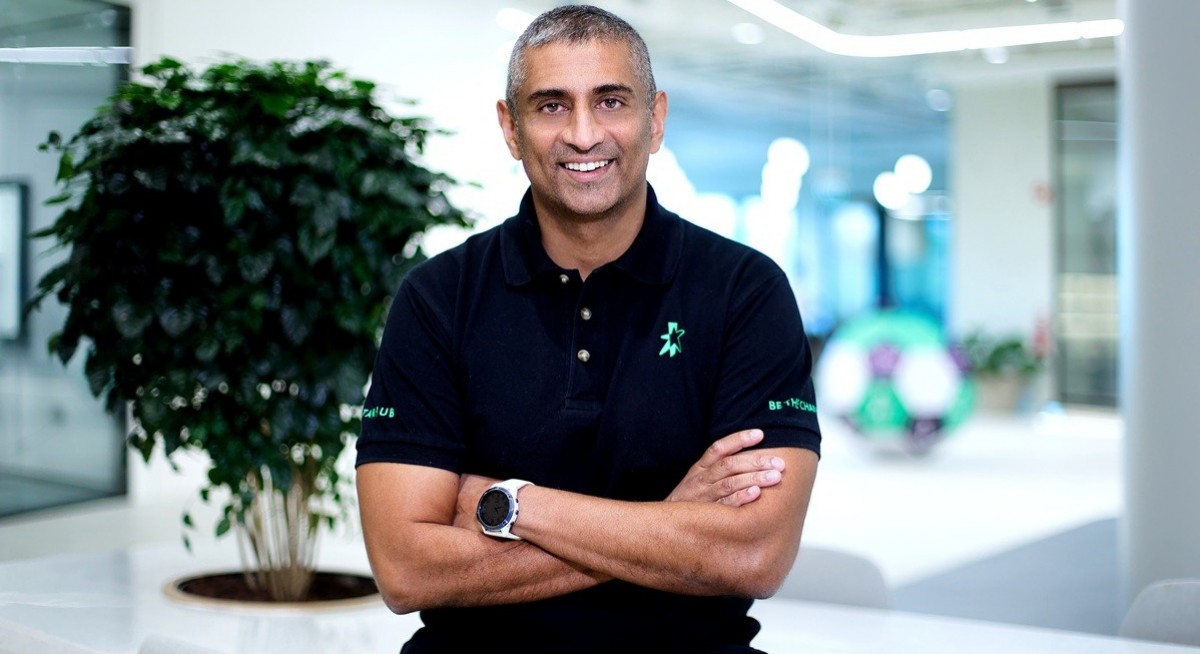


When Nikhil Eapen became group CEO of StarHub in early 2021, he inherited a company in need of reinvention.
StarHub had been built on a single insight: bundle everything. And for years, that was enough. Mobile, broadband, pay television, fixed line. StarHub was among the first telcos in the world to offer an all-in-one package.
Eventually, consumer behaviour shifted with the times, shaped by changing needs and expectations across each segment. StarHub, known as the challenger and innovator, now needed to reignite its spark.
“StarHub has changed over the last five years,” Eapen says. “We are now a full-fledged telco and enterprise services company.”
Two businesses, one company
According to Eapen, StarHub is roughly evenly split between its consumer and enterprise operations today.
On the consumer side, it considers itself number two in mobile by revenue market share, number one in residential broadband (a position built through organic growth and solidified with the acquisition of the MyRepublic Broadband brand), and dominant in pay television by differentiating itself as the “Home of Sports”.
See also: Hyphens Pharma: From dispensary to Asean’s dermatology specialist
But mobile is no longer the whole story, as its enterprise business now narrows the gap with the consumer business in scale.
The enterprise business has two components. The larger of StarHub’s regional enterprise divisions generates roughly $600 million to $700 million in annual revenue and is built around a managed digital infrastructure platform.
Rather than the traditional systems-integrator models of reselling and implementing third-party hardware and software, StarHub offers enterprise customers (campuses, large corporations, government-linked entities) a modular platform built on its own cloud-native network. Contract range varies in the millions.
See also: Soon Hock Enterprise: From operator to developer
The second component is Ensign Infosecurity (Ensign), a cybersecurity joint venture focused on government and large-enterprise clients. Ensign generates around $400 million in annual revenue and currently operates close to breakeven.
“When investors value StarHub, they don’t really factor in the value of Ensign,” Eapen says.
Since this interview, however, that has changed. On April 15, StarHub announced it had agreed to terminate its assigned rights arrangement with Temasek for total cash proceeds of $121 million, and expects to recognise a fair value gain of over $200 million from the transaction.
StarHub retains a 38.92% equity interest in Ensign, which remains an important cybersecurity partner to the group.
Winning revenue share without cutting price
At the same time, the more immediate challenge in the consumer business is the state of Singapore’s mobile market, where pricing has been driven to levels that Eapen calls “shocking.”
Plans for less than $10 a month, with generous data allowances, have become a common sight at promotional booths in Singapore shopping malls.
Eapen understands: “If it’s there, you’re gonna take it.”
But he views it as a symptom of a sector that has been “structurally distorted” and that is now correcting.
To stay ahead of Singapore and the region’s corporate and economic trends, click here for Latest Section
StarHub’s response has been to compete on value rather than to match the price cuts. Its flagship 5G Unlimited+ plan bundles unlimited voice and data, roaming inclusions, and device and cybersecurity protection into a single package.
It aims to offer more value for a slightly higher spend, rather than fewer features at a lower price.
“What we are not doing is taking revenue market share by taking pricing down,” Eapen says.
“Instead, we are delivering more value. Not the lowest price, but a good price. And at that great price, real value.”
In the fourth quarter of 2024, StarHub grew its subscriber base while holding average revenue per user (ARPU) flat at $22.
Growing subscribers without sacrificing ARPU — without cutting price — is the signal he says investors should be watching most closely.
The dividend question
StarHub has long been a familiar name among income investors on the Singapore Exchange, and it has maintained its commitment to a dividend of 6 cents per share despite challenges.
In the most recent financial year, for instance, free cash flow turned negative and net debt rose, even while its payout ratio exceeded 100%.
Eapen is keen to address each of these.
Firstly, he points out that the deterioration in free cash flow was driven primarily by a single large, non-recurring payment of approximately $190 million for 700MHz spectrum. The spectrum had been auctioned in 2016–2017, but only became available after international broadcasters in the region vacated the band in 2025.
Set against a starkly different market environment, the mobile sector at the time of the auction was in far better health than it was when telcos in Singapore received the spectrum bands in 2025.
After normalising for that payment, StarHub’s cash balance stands at approximately $857.1 million as of Dec 31, 2025.
“Our cash flow dipped, but it will start going back up,” Eapen says. “It’s something we can definitely do with high confidence.”
Steady plus
Eapen is also specific about the signals investors should look for in StarHub.
In mobile: ARPU. He points out that investors should look at whether this number holds steady across the sector, and then starts to climb.
In enterprise: Order book. StarHub has been signing contracts faster than it recognises revenue, meaning the pipeline is growing faster than the numbers currently show. Large contract announcements that StarHub is allowed to disclose would then be a secondary signal to watch.
On the balance sheet: the Ensign assigned rights transaction, which has since closed.
The $121 million in cash proceeds and the expected fair value gain of over $200 million have done precisely what Eapen anticipated, strengthening the cash position and crystallising value that had not previously been reflected.
Overall, Eapen’s phrase for the investment case is “Steady Plus”.
Steady: a dividend that is supportable now, at a yield he describes as attractive at current share prices, and backed by a substantial cash balance and a capital expenditure cycle that has largely run its course.
Plus: the operating leverage that becomes available as the mobile sector stabilises and enterprise momentum continues to build.
“Think of us as: you’ll get your dividend in the short term, we can commit to that,” he says.
“And then that should hopefully give you the patience to wait for the mid-to-long term, where you’ll see the positive benefits of operating leverage and a reflation upwards in our financial performance.”
For investors, the steady part is available now. The plus, Eapen argues, is a matter of patience. After all, as he points out, the sector is steadily moving in the right direction.
About StarHub
StarHub is a leading homegrown Singapore company that delivers world-class communications, entertainment, and digital services. With our extensive fibre and wireless infrastructure and global partnerships, we bring to people, homes and enterprises quality mobile and fixed services, a broad suite of premium content, and a diverse range of communication solutions. We develop and deliver solutions that incorporate artificial intelligence, cybersecurity, data analytics, the Internet of Things and robotics for corporate and government clients.
StarHub is committed to conducting our business sustainably and responsibly. StarHub is named among Time’s World’s Most Sustainable Companies 2025 and ranked as the world’s most sustainable wireless telecommunication provider on the Corporate Knights Global 100 (2025). StarHub also ranks 187th on the 2025 Fortune Southeast Asia 500. Listed on the Singapore Exchange mainboard, StarHub is a component stock of the SGX iEdge Singapore Low Carbon Index, iEdge-OCBC Singapore Low Carbon Select 50 Capped Index, as well as the FTSE4Good Index series.
About kopi-C: The Company Brew
kopi-C is a regular column by SGX Research in collaboration with Beansprout (https://growbeansprout.com). This MAS-licensed investment advisory platform features C-level executives of leading companies listed on the SGX. These interviews are profiles of senior management aimed at helping investors better understand the individuals who run these corporations.




