


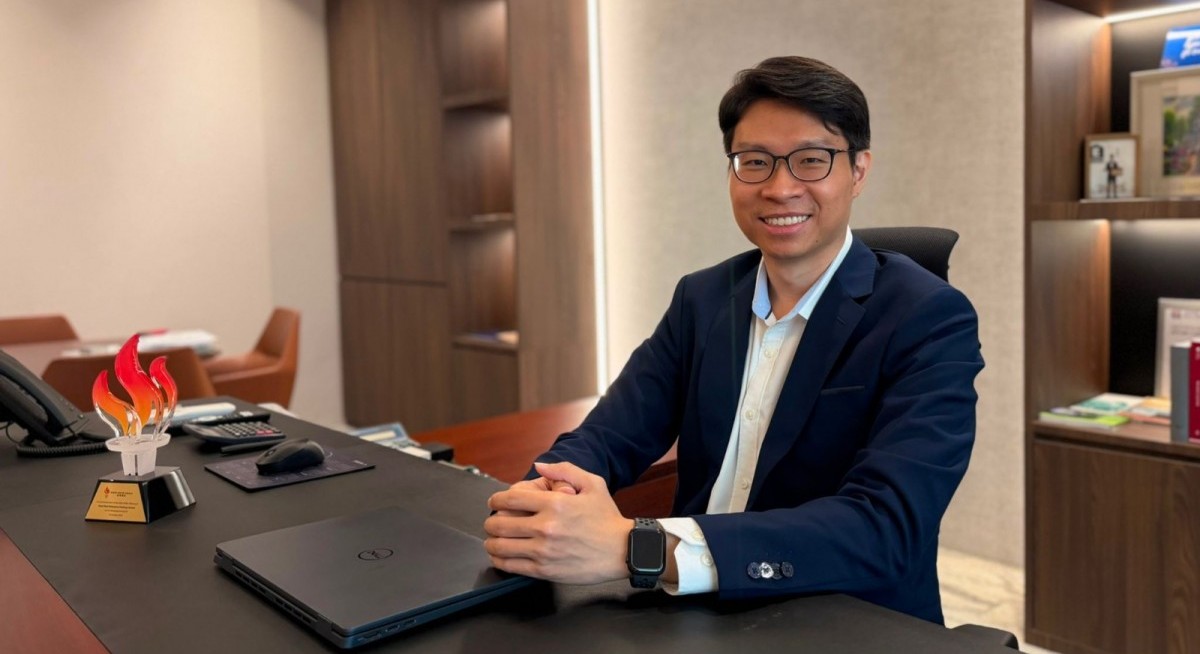


Walter Tan Min Loon grew up watching his father establish one of Singapore’s largest logistics operations. Today, as CEO of Soon Hock Enterprise, he leads a company that has evolved—from moving goods to developing the spaces that hold them.
While Soon Hock positions itself as a property developer today, its roots trace back to the logistics sector.
In the 1960s, its executive chairman Tan Yeow Khoon built a cargo transportation business. As the logistics operations expanded, the company required purpose-built facilities such as warehouses designed to meet its own operational needs.
Soon Hock began developing these spaces, initially for internal use, before extending this capability to serve external clients with similar requirements. Through years of hands-on end-user experience, the company deepened its operational insights and developed strong domain expertise in designing and building practical, user-centric warehouse solutions for the market.
Over time, this evolved into a core business.
Six decades later, the family business has grown into a listed industrial property developer, with more than 1,200 strata-titled units completed and a cumulative gross development value exceeding $1.3 billion.
See also: OUE REIT: The case for prime assets in a volatile world
After listing on the Singapore Exchange (SGX) Mainboard in October 2025, it reported revenue of $227.9 million in its maiden full-year results, a growth of around 28 times driven primarily by the completion of Stellar@Tampines, a nine-storey multi-user industrial development that received its full temporary occupation permit (TOP) in February 2026.
Walter Tan, who took on the role of executive director and CEO in 2025, shares how an operator-first mindset shapes the group’s approach to industrial property development, and what lies ahead for a newly listed developer with ambitions beyond its traditional sector.
A different kind of hands-on
Tan is candid about his own trajectory.
See also: Fuxing CEO Hong: Margin discipline matters more than revenue
“I never thought of being the CEO of the company,” he says. “Learning before you join a business and learning while you’re in the business — it’s two very different experiences.”
Tan joined the company after graduating from Columbia University in 2014, following a short internship at a Big Four consulting firm.
“I realised that instead of working outside, I can learn so much more through the family business,” he says.
For Tan, the world of entrepreneurship has never been an unfamiliar one. He shares that his business education had started much earlier, often in informal lessons delivered by his father.
He recalls a childhood visit to a supermarket, where his father pointed to a product priced so cheaply it was clearly unprofitable and asked: why would a store do that?
“My father explained the marketing strategy to me in his own way, but I only realised years later that there was a term for it — loss leadership,” he says. “There were always these very interesting observations, and my father took every opportunity to teach us [from young].”
However, the father and son’s management styles are different when it comes to the business.
To stay ahead of Singapore and the region’s corporate and economic trends, click here for Latest Section
“[My father] is very hands-on operationally,” Tan says. “I’m very hands-on in terms of creating a system and a process within a team.”
This difference explains Soon Hock’s decision to pursue a public listing last year.
In the two years leading up to the IPO, Tan began building governance infrastructure — internal audit processes, formal bank signatory arrangements and structured management systems designed to ensure the company could function independently of any individual.
“We have built an organisation that is structurally resilient, where operations continue seamlessly whether any one person is present or not,” he says.
“From a private company to a listed company, there are a lot of paradigm shifts in terms of what is the better way to do things.”
In Tan’s view, the IPO was less about capital raising and more about institutionalising the business.
“The priority is to professionalise and strengthen the organisation. With that foundation, we gain access to better financing, a broader talent pool and greater optionality in the public markets.”
Built for the operator
The design philosophy behind Soon Hock’s developments traces directly to its operational heritage.
“We approach development from a value-creation perspective rather than cost minimisation,” Tan explains. “Our focus is on maximising the usability and long-term value of space for end-users.”
In practice, this means decisions that add cost upfront but, in Tan’s view, add proportionately more value for buyers.
One example he points to is the dual-key configuration introduced in recent developments: each unit is built with two separate roller shutters, two sets of utilities and two bathrooms. The design allows an owner to partition the space, running operations from one half while leasing the other.
“It incurs more resources for us,” Tan says, “but it adds so much value to the end-user. They can rent out part of it, and the rental income helps offset their costs.”
He describes this as a first-mover approach in the local industrial sector, adding that the same value-engineering discipline brings construction costs back down to remain competitive.
Similar thinking led to the installation of more than 200 electric vehicle charging points at Stellar@Tampines.
“The market changes,” Tan says. “We try to think ahead and add value to our end-users, even if it means higher costs upfront.”
For the buyers who purchase units, the decision to own rather than rent typically comes down to one of three considerations Tan identifies: protection from rent escalation, operational stability (“customers know where you are, you don’t have to keep moving”) and the freedom to modify the space as the business evolves. A growing cohort is also buying as an investment.
“Industrial prices have been trending upward,” he notes, “and there are buyers who see these units as an investment vehicle.”
Demand, Tan says, reflects the simple reality that certain businesses need to be physically present in Singapore. These include drive-through car wash services and interior design firms.
“There are always businesses in Singapore that need to be based here,” he says.
Beyond the blueprint
Soon Hock’s next major development milestone is Skye@Tuas, a more-than-300-unit B2 industrial building adjacent to Tuas Link MRT station, expected to receive its partial TOP by 1Q2027.
The company has also moved beyond government land sales for its pipeline.
“We don’t limit ourselves to just government land sales,” Tan says. “We are also looking at private secondary land sales and en-bloc transactions.”
The two most recent acquisitions — 20 Shaw Road, a freehold city-fringe site, and properties at Senang Crescent in the east — were both sourced through the secondary market. More broadly, Tan is careful not to confine the company’s ambitions to the industrial sector.
“We don’t market ourselves as an industrial-only developer but as a ‘real estate developer’ with deep experience in industrial properties in Singapore,” he says.
Dormitories, for instance, are one asset class the group is actively exploring to strengthen its recuring income base; a facility is planned for 20 Shaw Road, subject to regulatory approvals, with a targeted completion in 2028. This is in addition to the company’s existing 300-bed dormitory facility located at Jalan Papan.
The underlying model, as Tan frames it, is a simple cycle: acquire land, build, sell the units and recycle the capital into the next acquisition. “We are capital recyclers,” he says. “As such, Soon Hock is always looking for land to build on and then to sell, and then to use that to grow the business.”
For retail investors considering this growth story, the strong pipeline, which provides clear revenue visibility, is one part of the picture. The other is about the details of the buildings: the ramp widths designed to accommodate large vehicles, the column-free floor plates that give tenants freedom over how they configure the space, the goods lift capacities and floor loading specifications.
This, Tan argues, is where a developer shaped by decades of running industrial operations earns its differentiation and edge.
“When you move into the space,” he says, “you feel as if it was built for you. After all, we are an operator building for other operators.”
About Soon Hock Enterprise
Soon Hock Enterprise is an established real estate developer, with deep experience in both industrial property development and industrial property investment in Singapore. The group’s project management team has led development projects with a gross development value of over $1.3 billion. Besides property development, the group also undertakes property investment for recurring income.
Soon Hock Enterprise has a strong track record of successful execution and monetisation of development projects, deploying a user-centric development strategy, forward-thinking design philosophy and a multi-factor site selection framework that aims to preserve the long-term capital value of its development properties while positioning them for stronger tenant retention, reduced vacancy risk and greater potential for capital appreciation
About kopi-C: The Company Brew
kopi-C is a regular column by SGX Research in collaboration with Beansprout (https://growbeansprout.com), Singapore’s trusted investment intelligence platform, which helps everyday investors build the knowledge and confidence to make decisions that matter. Kopi-C features C-level executives of leading companies listed on SGX. These interviews are profiles of senior management aimed at helping investors better understand the individuals who run these corporations




