




Of the approximately 677.17 million units offered at 88 cents each, the IPO attracted a total subscription of 2.22 billion units. The retail tranche of 33.9 million units was 2.9 times subscribed. This issue opened at 80.5 cents on March 12 and ended the day at 80.5 cents.
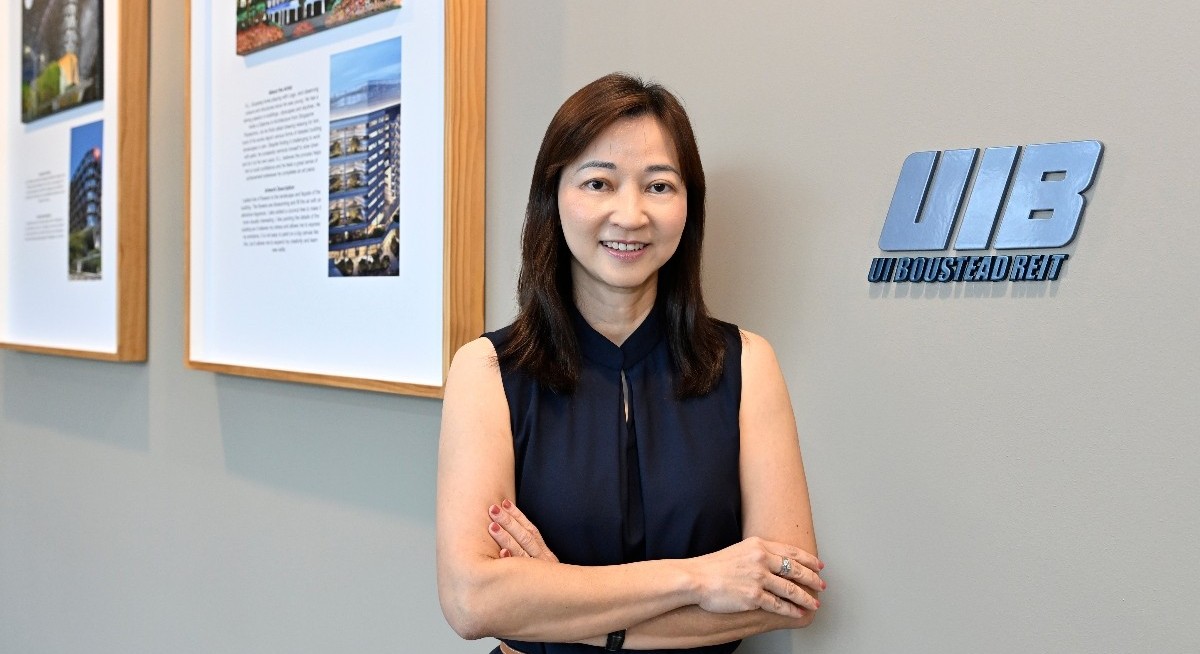
At a recent media briefing, Tan Shu Lin, CEO of UI Boustead REIT’s manager, says the REIT’s sponsor, UIB Holdings, possesses strong operations and expertise in both Singapore and Japan, which is why the initial portfolio comprised assets in these two countries.
“Apart from that, our sponsor has given us a right of first refusal (ROFR) for the stabilised assets that they owned. Through this, we will be able to continue to grow in a value-accretive manner,” Tan adds.
Diversified tenant mix
With properties spread across the logistics, business parks, and high-spec industrial spaces, Tan highlighted that the REIT’s tenant base is highly diversified as well.
“Our tenant base comes from a very good mix of industries, ranging from electronics to aerospace and automobile, as well as life sciences. These major sectors, which we describe as high-tech innovation sectors, are heavily knowledge-based,” says Tan.
She adds that exposure to these sectors is important for the REIT, given that the knowledge-based sector is a key focus of the Singapore government.
See also: Foundation Healthcare's IPO 3.8 times subscribed
“Our assets are in the right sector to serve the needs of our tenants,” Tan notes. About 69.2% of UI Boustead REIT’s gross rental income is derived from these high-tech innovation sectors.
Tan adds that the REIT’s top 10 tenants, which are mostly Fortune 500 companies, has an average working relationship of 11 years with the sponsor. Also, nearly 15% of its tenants have a remaining lease of more than 10 years.
These trends are being reflected in the portfolio’s weighted average lease expiry (WALE), which stands at 5.8 years. The WALE for the top 10 tenants is 8.4 years.
“Typically, Singapore’s average lease is around three years, but for our tenants who are on leases of more than 10 years, they see our properties as strategic infrastructure which is critical to their operations,” says Tan.
For instance, she notes, the facility of Rolls-Royce Solutions Asia — one of the REIT’s top 10 tenants — is located in Tuas and is the only service centre for all marine engines in the region.
Tan believes that the long-term leases with these tenants should provide unitholders with a stable portfolio with a stable income stream and low renewal risk. Only 1.2% of the leases are due for renewal in FY2026.
DPU Growth levers
To stay ahead of Singapore and the region’s corporate and economic trends, click here for Latest Section
Meanwhile, there are always two sides to a coin. The modest lease renewals in the near term are likely to result in limited organic growth in both distributable income and distributions per unit (DPU).
In the prospectus, the REIT manager has projected an organic DPU growth of 4.8%, which will bring the distribution yield for FY2027 ending March 31 to 7.8%.
Of the 4.8% in DPU growth, 2.8% will be from rental escalation built into lease contracts, Tan points out. A further 1.7% of DPU growth will come from the uplift in the overall portfolio occupancy rate, and the remaining 0.3% will come from positive rental reversions. As at Sept 30, 2025, UI Boustead REIT’s portfolio committed occupancy stood at 89.4%. Tan is targeting a committed occupancy rate of about 93% by March and 98% by March 2027.
The projected higher occupancy rate will come from the industrial building at 26 Tai Seng and the two assets in Japan.
Ho Tai Wing, UI Boustead REIT’s head of investment and asset management, highlights that Jumbo Group is currently the anchor tenant at 26 Tai Seng and the REIT has secured two leasing offers, mainly from a food tenant and a pharmaceutical company, to backfill the remaining spaces. Jumbo Group is also one of the cornerstones for the REIT’s IPO.
“For the Osaka logistic facility, we are seeing more leasing contracts and could see the occupancy rate hit nearly 100% by March next year. Meanwhile, our business space property in Tokyo has been fully tenanted recently,” Ho adds.
“With the built-in escalations, occupancy uplift and positive rental reversions, this is where we will see the increase in DPU. Of course, we will also be looking at asset enhancement projects such as the upcoming AUMOVIO Building Phase 3, for which we have budgeted around $3 million,” Tan adds.
Beyond that, Tan is seeking potential DPU growth through acquisitions and co-developments for the REIT, which have not been factored into the IPO forecast.
“One potential acquisition will be 36 Tuas Road, which is a logistics facility that is within the sponsor’s completed and stabilised pipeline. While it is still in the leasing-up phase, I think this is something that we can look at once the occupancy starts to stabilise,” Tan shares.
For co-development, Tan notes that the REIT is interested in participating with the sponsor, given the latter’s development capabilities.
“Currently, there are two development opportunities that our sponsor is working on, which are a build-to-suit facility for existing tenants in Singapore and a pre-committed logistics facility in Japan. We are quite interested in participating due to the high pre-committed leasing,” Tan says.
Land lease decay, demand and supply dynamics
On the topic of land lease decay, Ho reveals that UI Boustead REIT’s portfolio land lease tenure is about 28 years. “It is in line with the fresh land lease that is going to be issued by JTC (30 years); therefore, I would say that it is quite healthy from that perspective.”
Ho adds that the REIT has a chance to secure a land lease extension from JTC once the remaining land lease reaches 10 years and below.
“That is when JTC would be open for conversation and we can ask for an extension,” Ho says. “Of course, they will assess the situation, especially for end-users, to determine whether they have a strong plan in place to remain in Singapore, providing employment and contributing to the country. These are the factors that JTC will take into consideration.”
He believes that the two freehold properties from Japan will help mitigate the impact of land lease decay to some extent for the overall portfolio.
Regarding demand and supply dynamics, Ho revealed that the logistics sector has been doing well so far, allowing the REIT to secure strong cash flow from it. “We managed to maintain the 100% occupancy most of the time and achieve very good rental reversion to the tune of double-digit reversion for the past many years due to very tight supply.”
Ho adds that the business park and high-tech spaces have been facing an oversupply for the past couple of years. “Therefore, our focus is really on maintaining the occupancy level. Nonetheless, I will say that we are still pretty much in line with the market.”
The REIT’s business park properties are located in the One North Precinct, which Ho believes is better than the older business parks such as Changi Business Park (CBP) and International Business Park (IBP).
“Supply is going to be limited for the next three years and this is going to be in our favour, and we could potentially see more positive rental reversions from this type of property,” Ho says.
For the more scattered general industrial properties, Ho says they are anchored mainly by major MNCs and are generally more under-rented.
“With the lower-than-market rental rates, these are the underlying values that we can realise as and when the rental leases are up for renewal and will generate a very good upside for us,” Ho adds.
Fees, capital management
For the base and performance fees applicable to the REIT manager, Tan reveals that they will be paid out: 80% in units and 20% in cash.
For FY2026 and FY2027, the manager has elected to receive the fee under this arrangement.
“I think this is fairly unique about us versus the other recent REITs IPO. Some of the other REITs are paying out the fees 100% in units... We are trying to make our DPU as sustainable as possible and therefore we are starting with this ratio,” adds Tan.
On the capital management front, Tan highlights that the manager will adopt a conservative, prudent approach to the REIT’s debt structure. “Currently, 46% of our debts are denominated in Japanese yen, while the remaining 54% are in Singapore dollars. Upon IPO, our leverage will be about 37.9% and we are looking at an internal limit of 45%. This will bring us about $240 million in debt headroom.”
Tan believes the debt headroom can be utilised towards co-development projects or any potential acquisitions ahead.
Meanwhile, she sees the REIT having quite a long runway before conducting any refinancing activities. Excluding consumption tax debt facilities, the weighted average debt maturity stands at 4.2 years, with an overall cost of debt of around 2.4%.
To address the volatile foreign exchange rate, Tan says that the REIT will adopt a natural hedging strategy for its yen debt and also hedge rental income from Japan to lower volatility. “Given that our leases in Japan are on long-term leases, typically between 10 years and 15 years, we can estimate or project how much yen is coming back to us and we will hedge it accordingly.”
Rooted in Singapore and Japan
In the short to medium term, Tan sees UI Boustead REIT to remain in these two geographies, given that its sponsor is entrenched in these locations.
“We want to see where our sponsor goes, because we believe in having boots on the ground to really understand the market. Real estate management is not just about having a property there; it is also about managing the tenants and occupancy,” says Tan.
She adds: “If we were to go to another country that is beyond the scope of our sponsor, there would be no one for us to rely on. Therefore, we will be quite careful in our expansion beyond the geographical reach of our sponsor.”




