


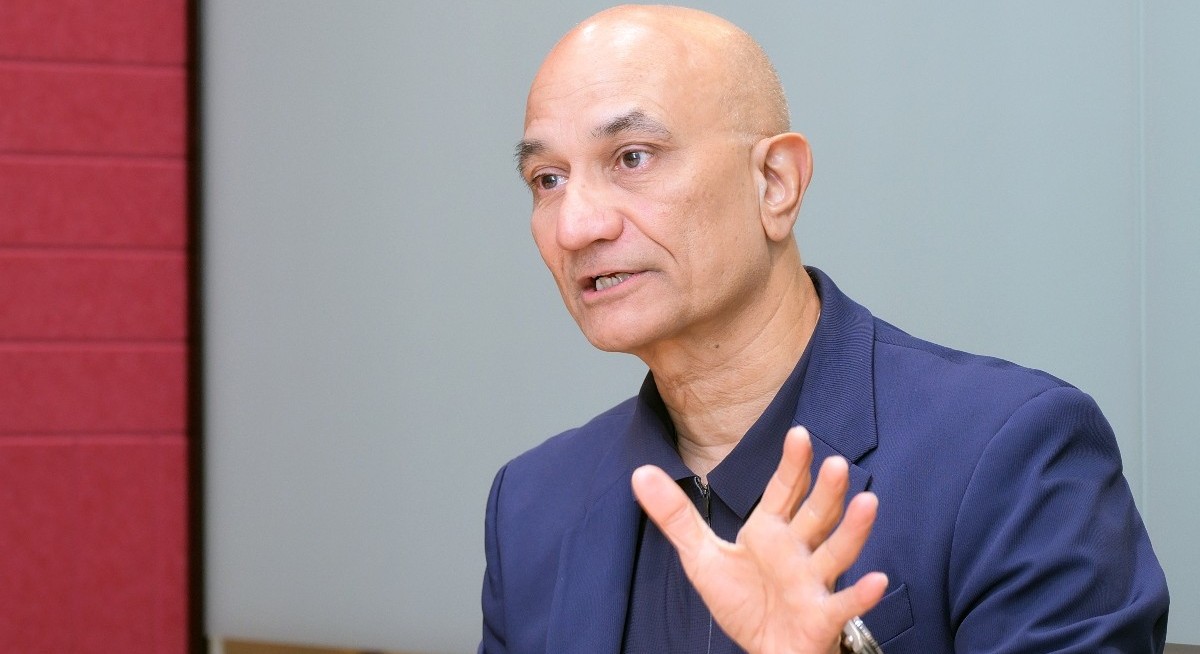


UltraGreen.ai calls itself a global leader in the fluorescence-guided surgery space. Its niche, albeit a growing one, is to pioneer AI tools for precision surgery using data-driven fluorescence imaging solutions. UltraGreen.ai offers a fluorescence imaging ecosystem — built around the Indocyanine green (ICG) fluorescent dye — that enables surgeons to achieve greater precision with real-time perfusion data, ultimately improving patient outcomes.
“My background is all in technology. If you look at some of the stuff I’ve done in the past, it is all telecommunications, optical fibres, and so on. But along the way, I learned that the only way to scale a business is to include technology,” says Sajwan in an interview with The Edge Singapore.
As he recalls, when he and his team started work on UltraGreen.ai in 2015, it was for a very specific idea. That is, to calculate the hole in the heart to find out how much plaque can go through. “But we need the ICG dye, so we started looking and found this company in Germany that produces the dye, and we decided to acquire it as it is difficult to source in the market,” says Sajwan.
Sajwan adds that after witnessing medical technology companies might not get the necessary approval over time, he decided to pivot UltraGreen.ai’s direction, and that is where he finds an incredibly safe product with a vast number of applications, but with limited adoption.
See also: Musk could earn US$760 bil from SpaceX pay packages
“Knowing how difficult it is to get the dye, that gave us the idea on how to enable fluorescent guided surgery and build an ecosystem around it at the same time. So, that was the journey,” says Sajwan.
Compared to newly-listed medical technology companies that are so-called “pre-revenue”, UltraGreen.ai is profitable and growing. UltraGreen.ai’s revenue in FY2024 ended Dec 31, 2024, stood at US$114.7 million ($148.61 million), a 59.3% y-o-y increase from US$72 million in FY2023. In the most recent 1HFY2025, revenue was US$70.1 million, an increase of 20.2% y-o-y. The higher top line was primarily due to higher sales and average prices of ICG and related pharmaceutical products, driven by increased demand. FY2024 earnings, meanwhile, were US$56 million, a jump of almost 70% y-o-y over FY2023’s, thanks to higher sales and better margins. Earnings for 1HFY2025 were US$25.7 million, down from 1HFY2024’s US$27.8 million on higher costs.
On Nov 26, UltraGreen.ai launched its IPO at US$1.45 per share, aimed to raise gross proceeds of US$400 million, with 16 cornerstone investors taking up US$237.5 million. This makes UltraGreen.ai one of the larger issues on the SGX this year, just behind the US$733 million raised by NTT DC REIT and Centurion Accommodation REIT’s $771.1 million.
See also: JustCo’s IPO 3.4 times subscribed at 94 cents per share
With a total share base of approximately 1.1 billion, the company’s market capitalisation based on the IPO price will be approximately US$1.6 billion, making this a rare unicorn in the local context. Based on its post-invitation FY2024 earnings per share of 5.07 US cents, UltraGreen.ai’s IPO is priced at 28.6 times historical earnings.
The offer’s retail tranche of 5.86 million shares was 4.5 times subscribed. In comparison, the international offering of nearly 106.21 million shares was 14.1 times subscribed, giving an overall subscription rate of 13.6 times. Shares of UltraGreen.ai commenced trading on Dec 3. It opened at US$1.51, above the IPO price and ended the day at US$1.52, valuing the company at US$1.68 billion.
Support from chairman and investor
Besides its niche position in a growing space, UltraGreen.ai draws attention too for who its chairman is: Kwa Chong Seng, a notable local corporate figure who, besides his longtime senior management role at Exxon Mobil in the region, was also chairman at different times of leading corporations, including SGX and Singapore Technologies Engineering. Kwa was also a deputy chairman at Temasek Holdings and was most recently appointed to a newly created role as chairman for Singapore and Southeast Asia at UBS.
As Sajwan recalls, he got to know Kwa through DBS Bank, which, together with Citigroup, is the joint manager for the listing. “During our initial meeting, I shared the things that we are doing, and he was impressed and wanted to invest in the company. I explained to him that I wasn’t looking for a new investment and instead wanted him to head down to our office and witness for himself what we are doing. He was amazed upon the trip down to our office,” says Sajwan.
“At that point, I told him that you can always retire as chairman for various entities. But if you want to make a mark for yourself, you will need to focus on healthcare, as it is a massive thing that affects eight billion people. After much consideration, he accepted the offer and joined us as chairman,” says Sajwan.
Besides his pre-IPO investment of nearly 5.4 million shares, Kwa, as part of the cornerstone agreement, is buying another 3.49 million shares at US$1.30 each, bringing his total post-listing stake to more than 8.83 million shares, equivalent to 0.8% of the company. In a similar arrangement, Temasek Holdings, which held 7.3% before the listing, will have 8.2% after the listing. Sajwan, meanwhile, holds nearly 683.1 million shares post listing, equivalent to 61.9% of the company.
To stay ahead of Singapore and the region’s corporate and economic trends, click here for Latest Section
Besides his network, Sajwan says that Kwa is a highly adaptable manager — equally at home running a 40,000-strong workforce at ExxonMobil as chairing UltraGreen.ai, which has a headcount of less than 100. “It is very tough to do that, but he has this very unique thought process, which allows him to scale. Therefore, I find him to be an extremely valuable board member and advisor,” says Sajwan.
Besides Kwa, UltraGreen.ai’s board is composed of other notable figures as independent directors, including finance experts Hsieh Fu Hua, a former CEO of SGX, and Nicky Tan, renowned for restructuring companies. Contributing expertise from the medical field are leading cancer specialist Toh Han Chong, deputy CEO of the National Cancer Centre Singapore, and Sir David Lane, a distinguished immunologist, molecular biologist and cancer researcher, who at one point served as chief scientist of Singapore’s Agency for Science, Technology and Research.
SGX first, Nasdaq next
With the funds raised from the IPO, Sajwan is eager to grow the company to the next level by boosting its visibility. “What we are trying to do here is to increase our marketing efforts. We are scaling the team up by adding more team members to focus on the application and head down to more clinics where our camera can be used,” he says.
Another key area for UltraGreen.ai is the addition of an extensive camera production line here in Singapore. “We currently have about 1000 units worth of production line, and with this addition, we can expand our market share in new applications where the camera can be used outside of the operating theatre,” adds Sajwan.
Sajwan further adds that another area will be the potential acquisitions of distributors in the region. “Right now, we distribute the product ourselves. The question is: can we actually identify potential distributors in different markets across Asia and acquire them? This way, we can get a footprint into the customers.”
UltraGreen.ai’s IPO launch came at a time when SGX announced a two-in-one listing deal with Nasdaq, under which companies with a market cap above $2 billion can get a dual listing on both exchanges. This is to take effect sometime in the new year. Based on the IPO offer price, UltraGreen.ai ticks this box.
Sajwan says he is going for an SGX listing first to build the company’s profile before making his debut on a bigger platform. “You establish your name here, and you can see that we will most likely be one of the prominent listings because of the market that we are in and the amount that we are raising. Furthermore, SGX has already announced that we can dual list on Nasdaq at the same time with the same prospectus,” he adds.
“Post-IPO, we still own 60% of the company. From our perspective, we are focusing on building long-term value for our investors and providing them with meaningful increments in value and getting the big ones when we head for the Nasdaq listing later on, that is the strategy from Day one.”
Sajwan also highlighted that Kwa, given his background as SGX chairman, was an instrumental figure in helping him with the Singapore listing. “Kwa’s point is that, going for a Nasdaq listing with a US$1.6 billion valuation, nobody is going to care over there. However, when you list on the Singapore market, you stand out, and you get more coverage here,” Sajwan says.
“Of course, the con for the Singapore market is the liquidity factor. However, we are one of the few companies growing healthily and generating a lot of cash from our business operations, which is rare for the healthcare sector. Most healthcare companies have been losing money for a long time. So, that is our thought process behind the Singapore listing,” says Sajwan.




