


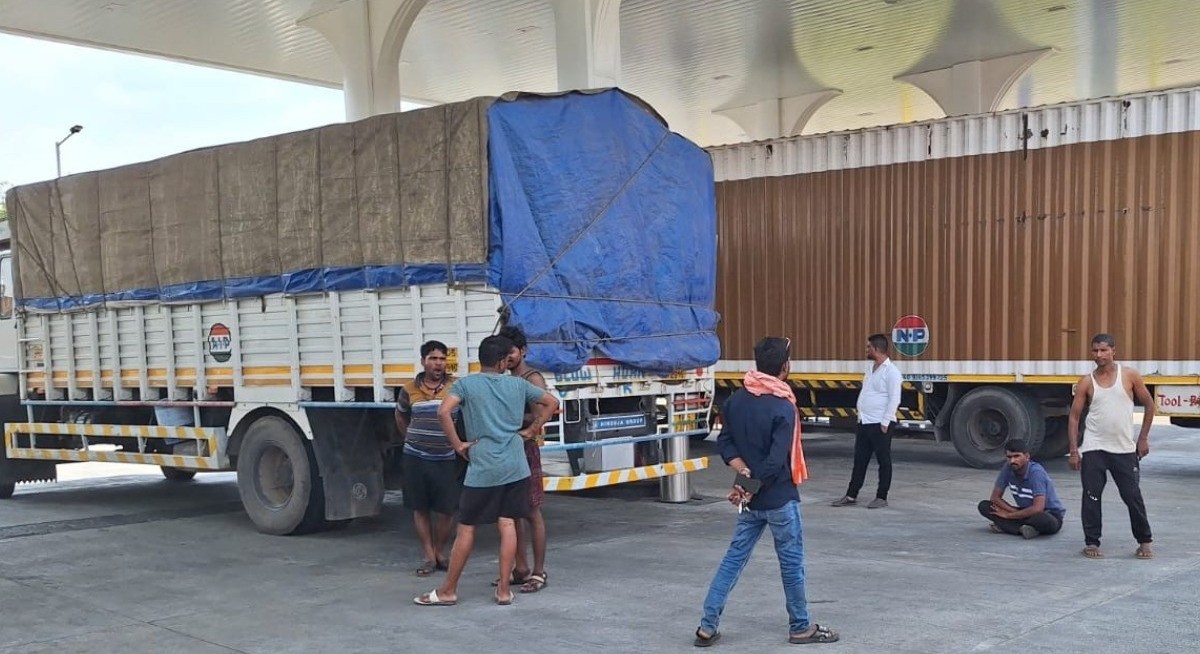


(May 13): At a service station outside Nagpur, in the geographic heart of India, nearly 30 trucks are lined up along either side of the highway, carrying everything from garments to packed snacks to Amazon packages and even railway equipment.
Most have been waiting for hours, or more.
India’s private gas-pump operators have either cut back diesel sales or hiked rates in response to advancing global oil prices, leaving the state-run refiners to struggle with the resulting surge in demand. A rise in government-controlled rates is now finally expected — the first in four years — and the rush to fill up has only become more frenzied.
For the truckers that ferry the vast majority of India’s goods around the country, that has meant days of dry pumps and long waits on hot roadsides.
“We have travelled nearly 80km looking for diesel. We checked at 15-16 pumps but there was no diesel to be found,” said Surya Kant Kendre, sitting on a Nagpur kerb by his coal truck earlier this week, squinting in the scorching sun. "Finally, when the tank became nearly empty, we were forced to halt here.”
The station’s manager, who declined to give his name as he isn’t authorised to speak to media, says he is typically able to supply just a third of demand — with fuel running out before most customers are satisfied.
See also: US seeks to drop criminal charges against Adani
India’s Oil Minister Hardeep Puri said on Tuesday there was no shortage of fuel: “There are no dry outs. Every petrol pump in the country has petrol and diesel.”
Still, truckers and drivers report cutbacks across the country as the world’s third-largest oil importer grapples with the ripple effects of a 10-week war in the Persian Gulf.
At least one large fleet operator reported his trucks were seeing retailers rationing sales, dispensing as little as 50 to 100 litres per truck — a fraction of typical requirements. Travel is taking longer as a result, he said, especially in busy freight corridors.
See also: India tells state banks to use EVs, video calls to cut fuel use
Sumit Ritolia, an analyst at data intelligence firm Kpler, said India’s refining system was well-supplied overall but panic buying had created disruption, thanks to “a combination of private retailers likely moderating sales, bulk consumers shifting toward retail outlets due to cheaper pump prices and precautionary buying ahead of potential fuel price increases".
India’s private gas-station operators have more leeway than their state-owned peers. Some, such as Nayara Energy Ltd and Shell plc, have already raised the price of petrol and diesel while Reliance Industries Ltd has rationed supplies. By contrast, state refiners like Indian Oil Corp, Bharat Petroleum Corp and Hindustan Petroleum Corp have only been able to increase diesel prices for industrial buyers by about 50 rupees a litre — roughly 50 US cents.
That has only added to lines at their cheaper retail outlets, where prices are kept flat to shield ordinary consumers.
Diesel sales at state refiners rose 4.8% to 7.6 million tonnes in April, even though overall diesel use in India was largely unchanged at 8.3 million tonnes — a testament to the imbalance.
The crisis is taking a heavy toll on state-run refiners, estimated to be losing about 10 billion rupees a day by selling fuels below cost. Profits from the previous financial year are likely to be wiped out in the current quarter, Puri said on Tuesday.
While a price increase is imminent, it will also be modest, according to state firms’ estimates, and limited to five rupees per litre for gasoline and diesel — well below the 15-20 rupees increase needed to curb losses. Indian Prime Minister Narendra Modi’s government is attempting to balance the financial health of fuel retailers with inflation risks in a price-sensitive country.
Middle East disruption has lifted crude premiums, freight and insurance costs. A weaker rupee, meanwhile, has compounded pressure on the domestic fuel market.
Uploaded by Arion Yeow




