


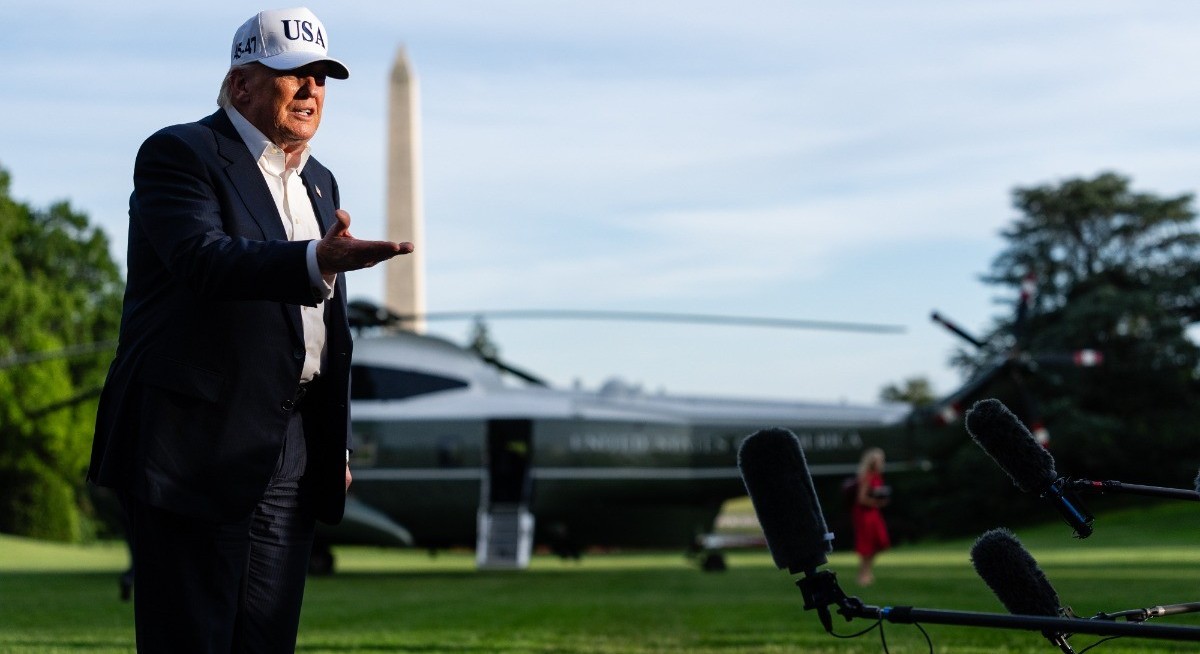


(May 19): US President Donald Trump said he called off a new bombardment of Iran planned for Tuesday after Saudi Arabia and other Persian Gulf allies wanted more time to pursue diplomacy.
The US delayed the strikes “for a little while, hopefully maybe forever”, because “we have had very big discussions with Iran, and we will see what they amount to”, Trump said at the White House on Monday evening.
Hours earlier, he said he was asked by the leaders of Saudi Arabia, Qatar and the United Arab Emirates (UAE) “to hold off on our planned military attack of the Islamic Republic of Iran, which was scheduled for tomorrow”.
Tehran repeatedly targeted the three countries with missiles and drones, damaging energy sites and ports, between the war starting in late February and a ceasefire six weeks ago.
“In their opinion, as great leaders and allies, a deal will be made, which will be very acceptable to the United States of America, as well as all countries in the Middle East,” Trump posted on Truth Social, referring to Saudi Crown Prince Mohammed bin Salman, UAE President Sheikh Mohamed bin Zayed, and Qatari Emir Sheikh Tamim bin Hamad.
Trump gave no details on what targets US forces would have attacked or what kind of deal he would accept, beyond that it would have to include “no nuclear weapons for Iran”.
See also: Japan, South Korea bolster ties amid Iran, China uncertainty
The president has repeatedly threatened renewed military action since a truce was agreed on April 8. The two sides have failed to progress to a peace deal and their forces clashed this month in the Strait of Hormuz.
The strait, one of the world’s most vital shipping chokepoints, remains all but closed, sending energy prices surging and adding to the war’s unpopularity in the US.
Brent crude fell around 1.4% on Tuesday, trading at US$110.50 ($141.60) a barrel in response to Trump’s announcements late on Monday. The benchmark is still up more than 50% since the war erupted with US-Israeli strikes on Iran.
See also: Marcos says Philippines would be involved in any Taiwan conflict
That’s led to concerns of higher inflation and slower economic growth worldwide. Government bond yields have jumped in recent days as traders raise bets that central banks will be forced to tighten monetary policy.
There was no immediate confirmation from Tehran of renewed talks. The shakiness of the truce was underscored on Sunday when the UAE’s nuclear-energy plant of Barakah was hit by a drone, causing a fire at a power station and forcing engineers to switch on emergency generators. There was no radiological impact, the UAE said.
The United Nations’ nuclear watchdog announced late on Monday that normal power had been restored at Barakah, easing safety concerns over the Middle East’s biggest atomic plant.

Trump’s comments were the latest indication of the bind he’s in. Tehran’s leaders, who see the war as an existential threat, have taken a hard line. They have insisted the US ends a blockade of Iranian ports, along with assurances they won’t be attacked again, continued control over traffic going through Hormuz and war reparations.
Iran also continues to say it will not accept any deal that completely bans it from enriching uranium, which many officials in the US and Israel want.
Tehran’s signalled it could again strike its Gulf neighbours if the US renews its attacks. The UAE has been the most aggressive in its rhetoric and tried in vain early in the war to get the six-member Gulf Cooperation Council to coordinate strikes on Iran, Bloomberg reported. It carried out limited attacks on its own, as did Saudi Arabia, people familiar with the matter said.
To stay ahead of Singapore and the region’s corporate and economic trends, click here for Latest Section
Pakistan has been the main mediator, but the two sides haven’t met for talks since discussions in Islamabad around five weeks ago that ended without a deal.
Iran’s semi-official Tasnim news agency said earlier on Monday the US had offered to lift sanctions on the sale of Iranian oil until a final deal is reached, as part of a new proposal to end the deadlock. A US official who requested anonymity due to the sensitivity of the matter said the story was false, but didn’t elaborate.
Also on Monday, the US Treasury Department said it’s extending a sanctions waiver to allow sales of Russian oil for another 30 days. The move highlighted the pressure the White House is under — especially ahead of midterm elections in November — to lower fuel costs. US gasoline pump prices have spiked to their highest in almost four years.
On his way back from a summit in Beijing last week, Trump told reporters he spoke with his Chinese counterpart Xi Jinping about potentially lifting sanctions on Chinese oil companies that buy Iranian crude. About 90% of Iranian oil exports before the war were purchased by China.
Meanwhile, Russian President Vladimir Putin is due to visit China on Tuesday and Wednesday, where he is expected to discuss the Iran war with Xi.
Uploaded by Tham Yek Lee




