


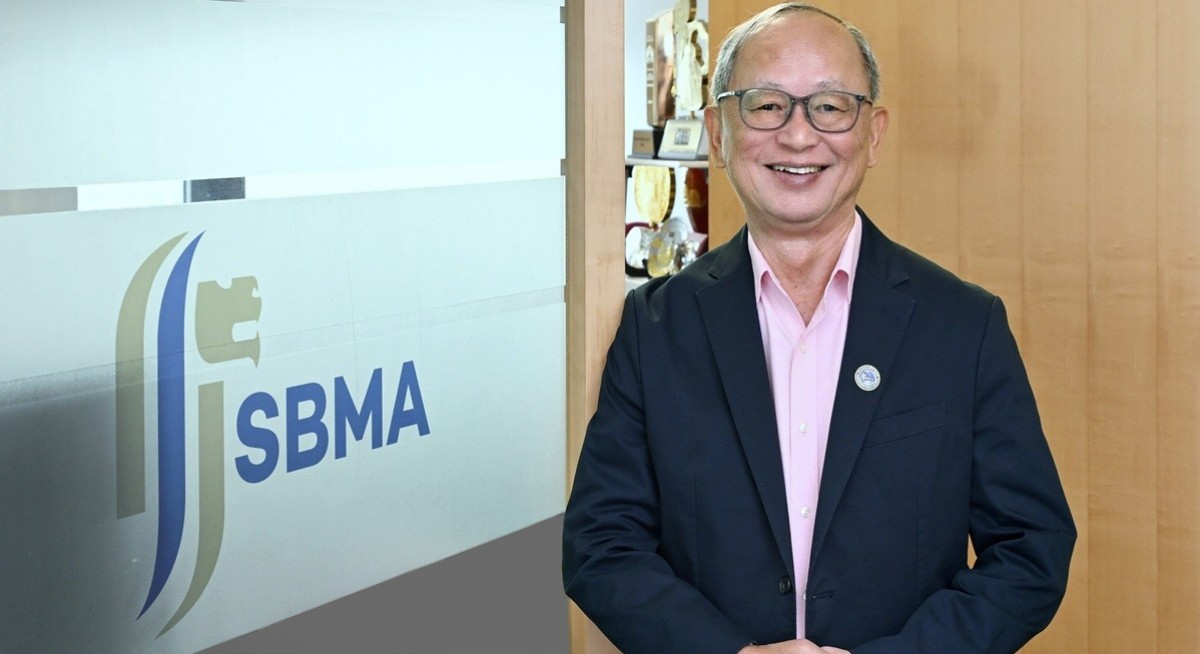


Before joining the SBMA, Cheng, who is from Hong Kong, was the managing director of the Far East for the World Gold Council (WGC) from 1993 to 2015, primarily responsible for market development for the region. He started his journey in the industry as a marketing professional for the Royal Canadian Mint.
“I visited Singapore in 1985 to sell Maple Leaf gold coins to Singapore banks,” Cheng tells The Edge Singapore. He adds that he has always been interested not just in gold itself but also in building trust, growing markets and fostering collaboration across the industry. This led him to join the WGC and relocate to Singapore in 1993, where he played a significant role in developing the region’s precious metals industry.
These interests also motivated Cheng to accept the appointment of Honorary CEO of SBMA after retiring from the WGC in 2015. He was drawn to the role by the opportunity to contribute meaningfully to Singapore.
A conservative industry
See also: War in Ukraine hands Singapore a new opportunity in gold
Singapore’s push to become a gold hub began in 2011 with SBMA’s Project Lion One. The initiative led to the removal of GST on investment-grade precious metals in 2012 and helped establish refining and vaulting capacity while attracting global trading operations.
For Cheng, SBMA’s role is not just to represent members, but also to help shape the industry ecosystem. “SBMA is here to convene, to connect, to build trust and to help move the market in the right direction,” says Cheng. “An association like SBMA has to do more than organise events or speak for the trade; we [also] have to help create the conditions for the market to grow in a serious and sustainable way.”
Cheng’s approach is to have a clear direction, maintain relationships and keep pushing the development agenda one step at a time. Under his stewardship, SBMA has grown to 90 members as of March 2026, reflecting the burgeoning interest in developing Singapore as a gold trading centre and SBMA’s efforts to garner industry participation.
See also: DBS to offer tokenised physical gold for Singapore customers
Establishing Singapore as a regional gold trading centre would be one way to grow the market. But it would be a task filled with challenges that would require years, if not decades, to overcome, which Cheng recognises: “The biggest challenge is that bullion is not a market you can transform overnight.
“It is a trust business. Institutions are conservative. Infrastructure takes time [to build]. Confidence takes time. Alignment takes time.”
For reference, London is the world’s primary gold trading hub, handling more than 40% of global gold trading volumes in 2025, with the London Bullion Market Association (LBMA) gold price — set twice a day — used as a global benchmark throughout the market.
London’s dominance in gold trading was built over centuries and supported by several developments. These include the UK’s prominence during the days of the British empire where the discovery of gold in British colonies, Australia and South Africa increased flows of the precious metal into London.
In addition, the establishment of the LBMA Good Gold Delivery List facilitated gold trading by providing a standard for gold bar quality that allows physical bullion to be traded and cleared without constant reassay. When the standard was later recognised as the globally accepted wholesale bullion benchmark, it meant that bars being circulated in the market met consistent quality thresholds for trading.
More importantly, London possesses a vaulting infrastructure with a strictly enforced chain of custody, which enables central banks and other institutional traders to store gold safely. These sizable stocks of gold in London contribute to the city being referred to as the “terminal market” that offers a liquidity pool, something which Singapore lacks.
“We are only able to use Singapore as a hub for our regional business with settlement clearing still occurring in London because we don’t have the liquidity pool in Singapore,” adds Cheng.
To stay ahead of Singapore and the region’s corporate and economic trends, click here for Latest Section
He shares that analysing both cities reveals that the city-state is comparable to London except for two areas: a clearing and settlement system and a custodian service for central banks or sovereign states.
Project Lion Two
With Project Lion One achieving its objectives, Project Lion Two was launched in 2024 to advance Singapore as a complementary gold trading centre to London. Forward SBMA 2030, launched in 2025 with five strategic pillars, articulated the strategic roadmap to execute Project Lion Two.
Forward SBMA 2030 begins with building an Asian hours clearing and settlement infrastructure to reduce dependence on Western time zones and financial infrastructure. This will enable more efficient trade processing for Asian market participants while reducing settlement risks associated with time zone differences and location disparity.
It also seeks to build central bank vaulting facilities so that Singapore may serve as a neutral custodian and secure storage centre for institutional precious metals holdings. This allows central bank reserve diversification strategies while providing secure storage solutions for private institutional clients seeking regional alternatives.
In a speech at the SBMA’s flagship Asia Pacific Precious Metals Conference (APPMC) 2025, Cheng said that SBMA envisions a future where the Singapore government, through the MAS, takes on a catalytic role as a neutral custodian or observer in governance to help build the trust and confidence required by central banks, many of which, by policy, can only store or transact go through another sovereign institution.
The third pillar is for Singapore to position itself as an innovative financial capital market and gold hub, with the country serving as the launchpad for technologically advanced gold products and exchange-traded funds (ETFs) designed to drive innovation in precious metals investment and attract new investor categories.
Next, to facilitate the trading of gold, Forward Singapore 2030 posits the Republic as a leader in harmonising regional standards and aligning them with the global framework and in particular, LBMA protocols.
The final prong requires the establishment of comprehensive integration with major regional bullion hubs, including Tokyo, Shanghai, Hong Kong, Gujarat, Dubai and London, ensuring Singapore’s position at the centre of global bullion flows rather than direct competition with established hubs.
“At the heart of it, the idea is simple: connect markets, build trust and strengthen the ecosystem,” says Cheng. “A gold hub is built layer by layer, from physical infrastructure, market confidence and international participation, to talent, standards and liquidity.”
New gold hub
With heightened geopolitical tensions and concerns about the security and accessibility of assets, Cheng thinks it is the right time to push Singapore’s gold hub ambition.
“Asia is too important in gold not to have a stronger market infrastructure in this time zone,” says Cheng. “The market has been saying for some time that Singapore has the potential to play a larger role, especially as a trusted and neutral centre in Asia.”
As such, SBMA made a proposal to the Monetary Authority of Singapore (MAS) to develop the republic as a gold trading centre. MAS endorsed the proposal and, with SBMA, established a working group to identify key focus areas Singapore needs to develop to fulfil its golden vision. Not coincidentally, these focus areas reflect Forward SBMA 2030’s strategic pillars.
As The Edge Singapore reported earlier during the announcement of the working group, MAS deputy chairman Chee Hong Tat believes positioning Singapore as a regional gold trading centre builds on the country’s reputation as a financial centre. “It plays to our strengths, and it adds a new vertical pillar to what we are already offering in terms of wealth management and asset management,” says Chee, who is also the Minister for National Development.
The ‘right ingredients’ for a gold trading centre
On the reason for joining SBMA and his belief that Singapore can succeed in its gold trading centre endeavour, Cheng says that the city-state has the “right ingredients” and outlines six: the rule of law, political stability, strong institutions, good connectivity, efficient logistics and a respected financial ecosystem.
And what does success look like? Cheng says that building the clearance and settlement and vaulting infrastructure are key priorities with Singapore achieving a modest 1–3% of London’s trading in a “few years’ time” as a step in the right direction. For reference, more than US$160 billion ($204 billion) of gold was traded daily on the London market in 2025.
Reiterating that London took centuries to arrive at where it is today, he says that the vision is to build something credible and long-lasting and that the actual results should be measured in 20–30 years.
After nearly 40 years in the business, Cheng says that he has learned that gold ultimately flows to where confidence is strongest.
“Sometimes I joke with people that this is a 50-year project,” he says. “If Singapore can continue to build that confidence, I believe we can make a meaningful contribution.”




