


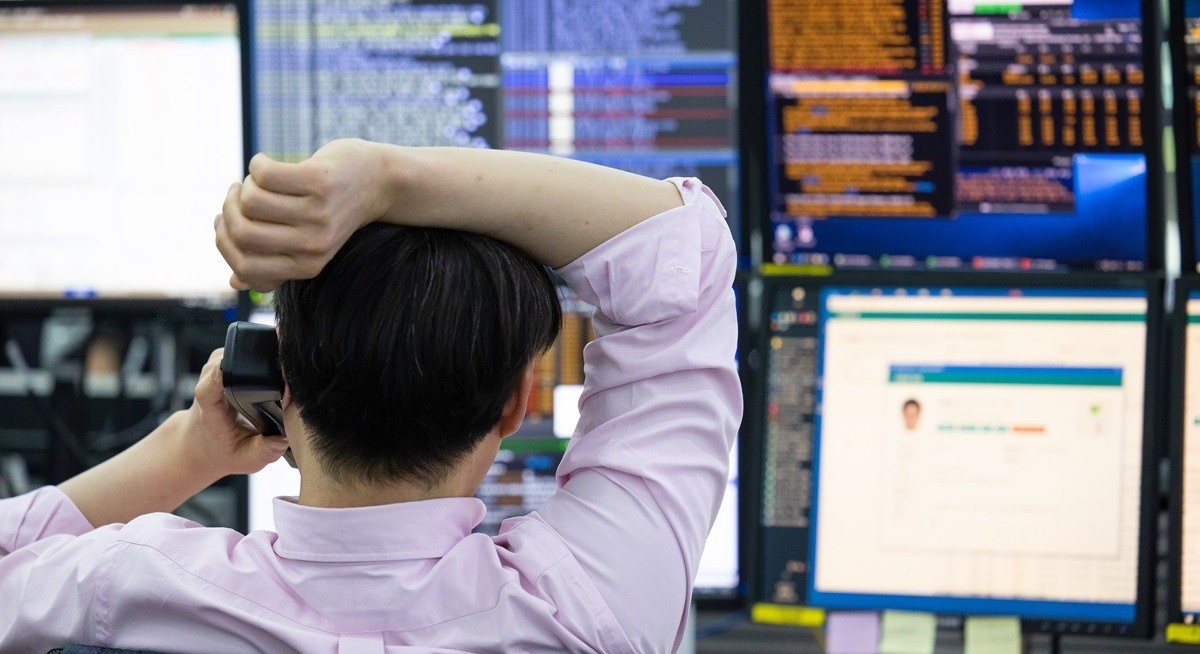


(May 20): Global equities headed for their longest losing streak in more than two months on Wednesday as mounting inflation concerns drove bond yields higher.
MSCI’s All Country World Index slipped 0.2%, set for a fourth day of declines, as the firm’s Asia-Pacific gauge dropped 1%. South Korea’s Kospi, a key barometer for artificial intelligence (AI)-related investments, fell 1.5%, with Samsung Electronics Co declining after its labour union decided to go on strike. Contracts indicated the losses will spread to Europe.
Brent crude held around US$111 ($142.25) a barrel, with no sign of easing in the Iran conflict. That’s stoked inflation concerns, weighing on government bonds globally. Yields on the 30-year Treasuries climbed to levels last seen in 2007 on concern elevated energy costs may push the US Federal Reserve towards an interest-rate hike rather than a cut.
Global stocks have retreated from all-time highs after investors spent weeks brushing aside concerns over the war in the Middle East on optimism that AI spending would continue to fuel corporate earnings growth. Attention is now turning to Nvidia Corp’s earnings on Wednesday, with investors increasingly questioning whether the AI-driven rally has run too far, too fast.
“The recent rise in yields is a negative trend driven by inflation concerns stemming from Middle East tensions,” said Kazunori Tatebe, the chief strategist of Daiwa Asset Management in Tokyo. Unlike the positive yield rise backed by economic strength, which would boost corporate earnings, “when yields rise for negative reasons, it tends to weigh not only on growth stocks but on equities broadly”, he said.

See also: US 30-year yield hits highest since 2007 on inflation angst
The 30-year Treasury yield climbed as high as 5.20% on Wednesday, a level last seen during the global financial crisis.
Longer-maturity government bond yields have surged to the highest levels in almost two decades, according to a Bloomberg gauge. The index, which tracks government bonds maturing in 10 years or longer, has dropped 4.6% this year on concern accelerating inflation will convince central banks to raise rates.
“The issue of rising bond yields is still something which could create problems for today’s expensive stock market,” said Matt Maley at Miller Tabak.
See also: Bond sell-off deepens, stocks fall as oil gains
Even so, China’s bonds diverged further from peers as a fragile economic recovery and ample market liquidity keep local yields anchored despite a global sell-off. Japan’s 20-year bonds gained after an auction calmed nerves in the market with the highest average yield in three decades reflecting firm investor interest.
In other corners of the market, the Bloomberg Dollar Spot Index held near its highest level in six weeks. Gold, a non-yielding asset, edged lower to around US$4,470 an ounce.
Meanwhile, the Group-of-Seven finance chiefs pledged not to overdo any fiscal aid as the Iran war raises growth and inflation risks to the global economy. In a communique issued in Paris on Tuesday at the end of meetings overshadowed by sovereign-bond gyrations across much of the club of rich nations, officials committed to a measured approach that won’t overstretch public finances.
Elsewhere, the European Union expedited start of the US trade deal.
On the geopolitical front, US President Donald Trump threatened to resume strikes on Iran in the coming days as part of the push for a deal to end the war. Meanwhile, Nato is discussing the possibility of helping ships pass through the Strait of Hormuz if the vital waterway isn’t reopened by early July.
In Asia, Chinese leader Xi Jinping welcomed Russian President Vladimir Putin to Beijing on Wednesday for talks aiming to reinforce bilateral ties and make progress on a long-stalled energy project.
Focus later will turn to Nvidia’s first-quarter earnings, which are due after the closing bell on Wednesday.
To stay ahead of Singapore and the region’s corporate and economic trends, click here for Latest Section
Sales at the world’s most valuable company are estimated to have grown 80% in the period — the fastest clip in more than a year — but investors will be more focused on what Nvidia has to say about ramping up production and fending off competitors.
The giant chipmaker’s earnings should take on greater importance at a time when the market is facing renewed worries about rising bond yields and the possibility of a rate hike, according to Paul Stanley at Granite Bay Wealth Management.
“Investors need some reassurance that the AI story is still alive and well and that the company is producing enough revenue growth to back up its elevated valuation,” he said. “We believe that Nvidia will report financial results that justify its valuation, which is just what the stock market is looking for.”
Corporate news:
- Meta Platforms Inc is alerting thousands of employees that they are being laid off, part of a restructuring aimed at improving efficiency and reducing costs while investing heavily in AI.
- Goldman Sachs Group Inc has the leading role on the cover of SpaceX’s initial public offering, according to people familiar with the matter, giving the firm a prominent position in potentially the biggest listing of all time.
- Kokusai Electric Corp shares dropped after saying its biggest holder KKR & Co is offloading its entire stake in the Japanese supplier of chipmaking gear.
Some of the main moves in markets:
Stocks
- S&P 500 futures were little changed as of 6.55am London time on Wednesday
- Nasdaq 100 futures rose 0.1%
- The MSCI Asia-Pacific Index fell 1%
- The MSCI Emerging Markets Index fell 0.6%
- Japan’s Topix fell 1.7%
- Australia’s S&P/ASX 200 fell 1.3%
- Hong Kong’s Hang Seng fell 0.7%
- The Shanghai Composite fell 0.3%
- Euro Stoxx 50 futures fell 0.6%
Currencies
- The Bloomberg Dollar Spot Index was little changed
- The euro fell 0.1% to US$1.1593
- The Japanese yen was little changed at 158.98 per dollar
- The offshore yuan was little changed at 6.8148 per dollar
- The British pound was little changed at US$1.3391
Cryptocurrencies
- Bitcoin rose 0.2% to US$77,129.2
- Ether rose 0.4% to US$2,124.44
Bonds
- The yield on 10-year Treasuries was little changed at 4.67%
- Japan’s 10-year yield was unchanged at 2.785%
- Australia’s 10-year yield advanced three basis points to 5.09%
Commodities
- Spot gold fell 0.2% to US$4,471.54 an ounce
- West Texas Intermediate crude fell 0.3% to US$103.81 a barrel
Uploaded by Tham Yek Lee




