


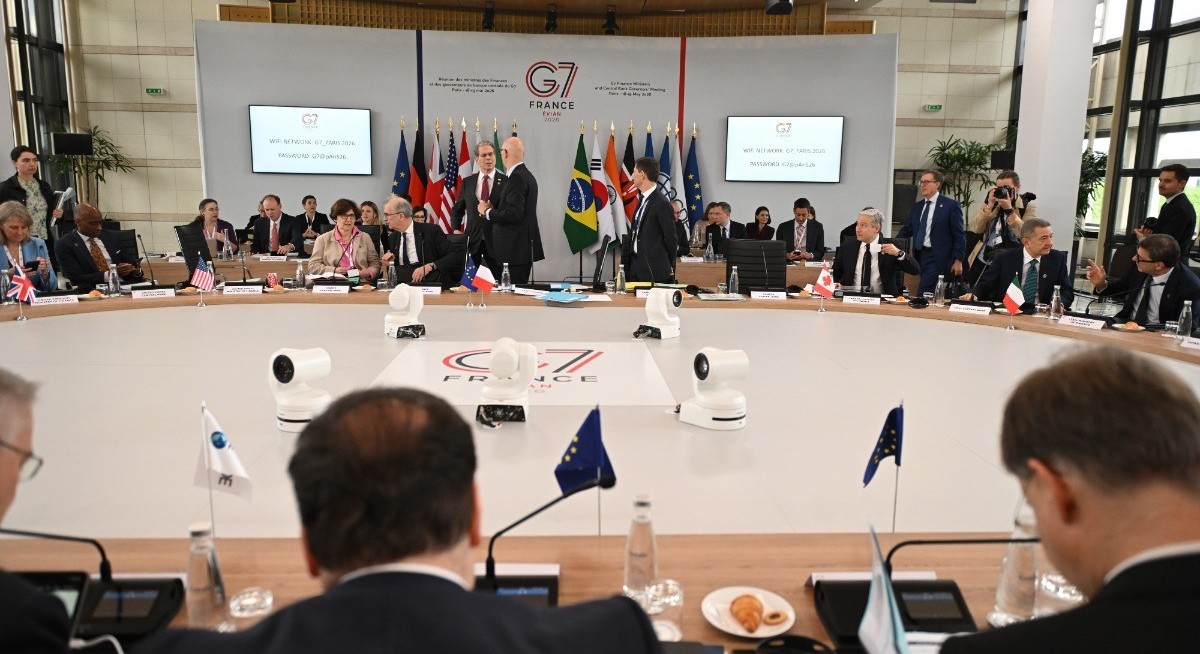


(May 19): Group of Seven finance chiefs pledged not to overdo any fiscal aid as the Iran war raises growth and inflation risks to the global economy.
In a communique issued in Paris on Tuesday at the end of meetings overshadowed by sovereign-bond gyrations across much of the club of rich nations, officials committed to a measured approach that won’t overstretch public finances.
“Global economic uncertainty has heightened risks to growth and to inflation amid the ongoing conflict in the Middle East, particularly through pressures on energy, food, and fertilisers supply chains,” they said, committing “to cooperating on our policy responses that should be temporary, targeted and fiscally responsible to protect growth, support economic security, and enhance resilience.”
The gatherings of finance ministers and central bankers that began on Monday took place just as investors alarmed at the prospect of inflation driven by the energy supply crunch at the Strait of Hormuz drove up bond yields of governments across the G7. US Treasury 30-year yields are now close to the highest since 2007.
Against that backdrop, the group sought to reassure investors that policymakers won’t take their eyes off the ball, even if they none of those present has raised rates since the war began.
“Central banks are strongly committed to maintaining price stability, and to ensuring the continued resilience of the financial system,” the communique said. “Monetary policy will remain data dependent: central banks are closely monitoring the impact of energy and other commodity price pressures on inflation, inflation expectations, and economic activity.”
See also: Global bond selloff threatens turmoil in weakest Asian economies
The persisting worry for investors is that a cost-of-living shock derived from higher energy prices will feed into inflation, necessitating higher interest rates, and forcing higher borrowing costs upon already-indebted governments.
Bond yields across the whole G7 reached the highest since 2004 this week, according to research from Apollo chief economist Torsten Slok.
Government actions have done nothing to dispel the impression among investors that governments could overdo the fiscal response to the energy crisis. This week, Japanese Prime Minister Sanae Takaichi called for an extra budget, while Italian Prime Minister Giorgia Meloni asked the European Commission for greater latitude to extend energy aid to consumers.
See also: EU races to finalise US trade deal to avoid more Trump tariffs
In the UK, Andy Burnham, the mayor of Manchester who is seeking to replace premier Keir Starmer, was forced to rule out changes to the government’s borrowing limits if he were to gain power, after jitters from investors.
Joint remarks by ministers also covered a panoply of other topics, ranging from critical minerals to global imbalances and artificial intelligence.
Although the US issued a new waiver for Russian oil already loaded onto tankers, the world’s largest economy also agreed alongside its G7 partners to repeat prior wording in condemning that Russia’s continuing conflict against its neighbour.
“We are united in our condemnation of Russia’s continued brutal war against Ukraine and escalatory actions undermining collective efforts to broker peace, and reaffirm our unwavering support for Ukraine in defending its territorial integrity and right to exist and its freedom, sovereignty and independence toward a just and lasting peace,” the ministers said.
On AI, the G7 officials said they’re undertaking additional efforts to map cybersecurity risks and, “where appropriate, to enhance information sharing and identify best practices, in light of the recent developments regarding frontier AI models.”
A new, powerful AI tool unveiled by Anthropic last month has raised concerns among government officials and central bankers about its potential threat to global financial stability.
Uploaded by Magessan Varatharaja




