


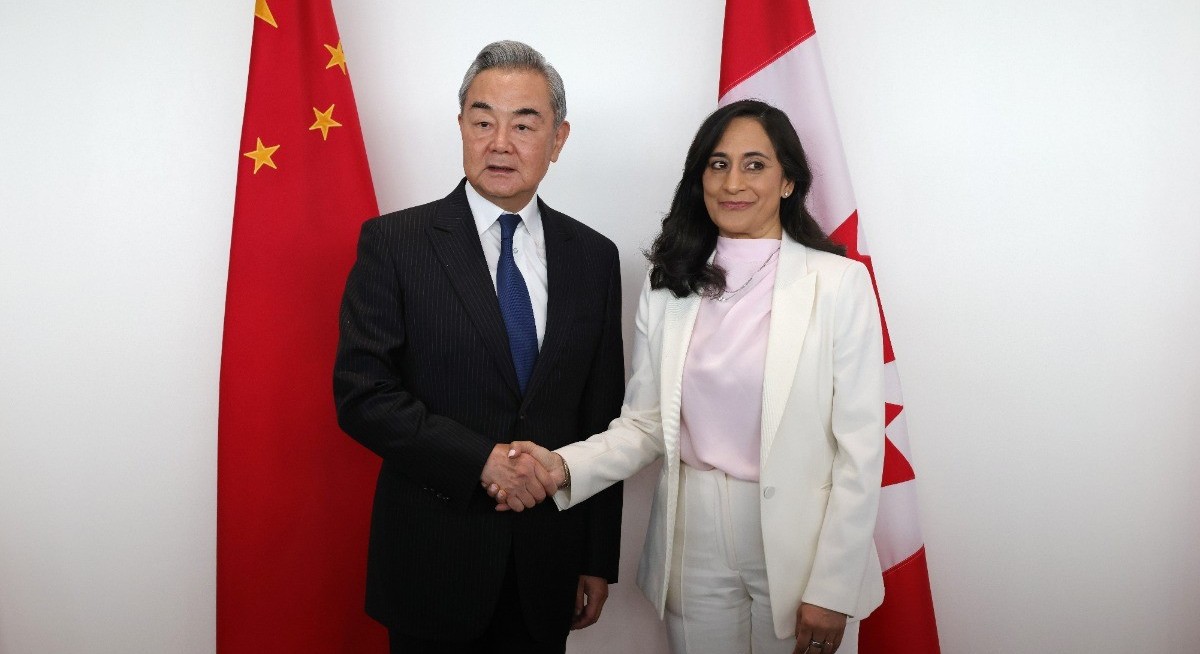


(May 30): Foreign Minister Anita Anand said Canada aims to grow exports to China by 50% by 2030, as her Chinese counterpart visits Ottawa in a sign of a shifting global order shaped by US tariffs.
Wang Yi’s trip to Canada marks his first in a decade and he also met with Prime Minister Mark Carney on Friday. US President Donald Trump’s trade policy has pushed Carney to step up efforts to diversify Canada’s trade, with expanded oil and gas shipments to China high on the agenda.
Speaking before her meeting with Wang, Anand said total bilateral trade between Canada and China reached C$125 billion (US$90.7 billion or $115.71 billion) last year.
“We are committed to growing this relationship responsibly with a goal of increasing exports to China by 50% by 2030, while safeguarding Canada’s economic and national security interests and values,” she said.
Wang’s trip follows Carney’s fence-mending visit to Beijing in January, where the Canadian prime minister struck a deal with President Xi Jinping to lower trade barriers. As part of that agreement, Canada will allow 49,000 Chinese electric vehicles annually at a tariff rate of 6.1%, removing a 100% surtax, in exchange for China easing agriculture tariffs.
During his Beijing trip, Carney heralded Canada’s new “strategic partnership” with China, telling Premier Li Qiang that it “sets us up well for the new world order”.
See also: US hits Vietnam with third investigation as trade pressure grows
Wang said Friday that the bilateral relationship has achieved a “turnaround” and is now “improving and growing”, something he said is in the interest of both countries.
Anand said China and Canada’s leaders have set out a “clear and ambitious vision” for the countries’ new relationship.
“It includes elevated engagement and cooperation on trade and investment, energy, finance, public security and safety, and people-to-people ties,” she said.
See also: EU warns trade relationship with China ‘not sustainable’
A readout from her office later said the ministers discussed a “wide range of topics in a frank and constructive manner, including consular issues, foreign interference, forced labour and human rights.”
The countries will regularise annual foreign ministers’ meetings and have resumed mechanisms to discuss sensitive bilateral issues and national security, it said.
Canada has accepted China’s invitation to be a country of honour at the China International Import Expo in Shanghai in early November, it said, adding “the ministers discussed supporting two-way investment and trade in clean and conventional energy”.
Carney’s government has promised to support the province of Alberta’s proposal for a new oil pipeline to Canada’s west coast, which would carry at least one million barrels a day for shipment to Asia. Currently, Canada only has one pipeline that serves Asia, and most of the country’s oil still goes to the US.
US policy fallout
The two nations saw years of frosty diplomacy under Canada’s previous prime minister, Justin Trudeau.
Relations cratered in 2018 after Canada arrested a Huawei Technologies Co executive at the request of the US, with China detaining two Canadian citizens soon after. Allegations of Beijing’s election interference and trade tit-for-tats have further strained ties since.
To stay ahead of Singapore and the region’s corporate and economic trends, click here for Latest Section
For Beijing, mending ties with a close American ally that has been increasingly frustrated by Trump’s erratic trade and foreign policy serves its long-time strategy to drive a wedge in US alliances — and their concerted efforts to counter China.
US policymakers, including Trump himself, have been sharply critical of Carney for cutting a deal with Xi on electric cars. Canada’s decision marked a major break with US policy, and also opens a new market for Chinese EV manufacturers grappling with cut-throat competition at home.
Carney defended that move at the Economic Club of New York on Thursday, saying Canada’s relationship with China required a reset. Key Canadian sectors such as agriculture and fisheries had been effectively shut out of a market that once supported hundreds of thousands of jobs, he said.
“In this world, it’s the second-largest economy — you need to have a dialogue with China,” he said.
The top Chinese diplomat last visited Canada in 2016, months ahead of late Chinese Premier Li Keqiang’s trip to Ottawa. That was the last time a Chinese leader has visited the country.
Xi has never been to Canada since coming to power in 2012, making it the only Group of Seven nation he has not visited as president.
Uploaded by Chng Shear Lane




