




NAIROBI/WIEN/LONDON (March 29): Donald Trump’s willingness to attack adversaries while rattling allies is threatening to push the world into a new nuclear age.
From the North Atlantic to the West Pacific, governments are debating more publicly than before whether they, too, must get the bomb. Germany and Poland, who have long been satisfied to sit under the US' nuclear umbrella, have in the wake of Trump’s musings about taking Greenland welcomed French overtures about extending the country’s own strategic deterrent across the continent.
China and Russia, both longstanding members of the exclusive club of nuclear-armed nations, have raised alarm about the risk of weapons proliferation in Japan and South Korea, even as they upgrade their own arsenals. The US, the only country to use a nuclear weapon against a civilian population, is assessing a return to atomic bomb tests to comply with an executive order by Trump after a hiatus of more than three decades.
During the same week that the US president issued an ultimatum to Iran’s leadership to surrender its nuclear programme, his administration was circulating a report giving its regional rival, Saudi Arabia, potential access to uranium-enrichment and -reprocessing technology, according to documents seen by Bloomberg. One diplomat from a European state said the need for the continent to develop its own nuclear capabilities was an active discussion across its capitals.


See also: Iran and Israel keep up attacks as Trump extends deadline
In January, the Bulletin of the Atomic Scientists advanced its “Doomsday Clock” to 85 seconds to midnight — the closest to catastrophe it’s been. They cited among other things Trump’s attacks on Iranian nuclear facilities and his efforts to build his “Golden Dome” missile shield, as well as the expiration of the last arms control treaty between the US and Russia.
“The possible acquisition of such weapons of mass destruction is openly discussed, even in countries that have pledged never to possess them,” Rafael Mariano Grossi, director general of the International Atomic Energy Agency, said in an interview. “But more nuclear weapons in more countries will not make the world more secure — on the contrary.
“It is more important than ever to uphold the non-proliferation norms that have served the world so well for the past half century,” Grossi said.
See also: Riyadh, Dubai delay finance events as Iran war disrupts region
While only nine nations are currently considered nuclear-armed states, more than 20 others have energy programmes, industrial bases and engineering expertise that could allow them to begin climbing the ladder to the bomb. It takes just 25 kilogrammes (55 pounds) of highly enriched uranium or eight kilogrammes of plutonium to make a weapon capable of destroying a small city.
The scramble is fuelled by the belief that forgoing nuclear weapons leaves nations exposed, with Libya, Ukraine and now Iran underscoring the consequences. While possessing a nuclear arsenal is no guarantee against attack, they do raise the stakes of one.
The more nations that get the bomb, the harder it is for big powers to control how it’s used, and the more dangerous the world becomes. Last year, India and Pakistan exchanged airstrikes in the latest flare-up between the two neighbours, which both acquired nuclear weapons in the 1990s.


Non-proliferation experts warn that the arms control system painstakingly built through the Cold War could soon unravel. That system was forged after the US and the Soviet Union were forced to contemplate nuclear annihilation and decided to step back.
In 1987, US President Ronald Reagan and Soviet leader Mikhail Gorbachev signed a treaty eliminating the intermediate-range ballistic missiles that both sides aimed across the European frontier. A few years later, they agreed to sharp reductions in their weapons stockpiles, which later became the New START treaty.
To stay ahead of Singapore and the region’s corporate and economic trends, click here for Latest Section
Both of those agreements were left to expire without replacement, as relations between Washington and Moscow deteriorated and the US began to fret over China’s ability to expand its arsenal outside of the two-way deals. Now, as conventional missiles regularly fall on cities in Europe and the Middle East, the remaining treaties that underpin global arms control face an uncertain future.
United Nations meetings to review the 56-year-old Treaty on the Non-Proliferation of Nuclear Weapons next month are expected to lay bare growing resistance from nuclear-armed states to its restrictions. The Comprehensive Nuclear-Test-Ban Treaty is also at risk amid Trump’s threats to resume detonations and US claims that China secretly conducted its own.
The worst-case scenario is a so-called proliferation cascade, said William Alberque, a senior fellow at the Pacific Forum who has negotiated nuclear arms issues at Nato and in the US government.
“If South Korea goes, Japan goes,” Alberque said. “Then Taiwan goes. Then China is in a panic and they now have a timer for their invasion of Taiwan. The possibility of a cascade in the Middle East and East Asia make those two regions far more dangerous.”
Trump himself has been among world leaders warning that the danger of nuclear conflict is rising. On the campaign trail in October 2024, he said the US was “very close to having” World War III and vowed to prevent it.
But the US-Israeli decision to attack Iran in a bid to eliminate its nuclear programme shows just how precarious the situation is. As of June, IAEA monitors verified that Iran possessed than 440 kilogrammes of near-bomb-grade uranium, theoretically enough to quickly make about a dozen devices.
While the NPT allows signatories to enrich uranium, with countries including Argentina, Brazil, Germany, Japan and the Netherlands all in the fuel business, many in Israel and US found the Islamic Republic’s stockpile of the dual-use material intolerable. Acquiring it might require sending ground troops into the country of more than 90 million people.
But the hard line against Iran contrasts with the US’ approach to its regional ally, Saudi Arabia. The kingdom has long threatened to seek the bomb if Iran got one.
The White House last month sent to Congress a three-page report arguing for sharing sensitive nuclear technology with Riyadh, including potential cooperation on uranium enrichment and plutonium reprocessing. The document, seen by Bloomberg, says such a deal would advance US security interests while giving Washington greater visibility into the kingdom’s programme.
“Saudi Arabia is an important US partner in the Middle East,” the White House wrote in a statement. Trump’s deal with Saudi Arabia is a “risk informed agreement on peaceful nuclear energy that reaffirms both countries’ mutual commitment to non-proliferation and lays the foundation for a partnership for the coming decades.”
American non-proliferation experts say otherwise.
“It bucks all precedent,” said Robert Kelley, a former director at IAEA who led inspections in Iraq and Libya. “The idea the administration is prepared to give Saudi Arabia the ability to do the very things they are bombing Iran for looks hypocritical.”
Asked about the Saudi deal during an appearance on Capitol Hill on Wednesday, Thomas DiNanno, the secretary of state for arms control and international security, told lawmakers he couldn’t discuss the details because it hadn’t been signed. Pressed on whether the government was taking sufficient steps to ensure the kingdom didn’t get a bomb, DiNanno said the administration would be “concerned about any nuclear weapons programme” outside of the non-proliferation framework.
Trump has often warned about the dangers of nuclear weapons and, as recently as February 2025, floated cutting America’s stockpile and opening talks with Russia and China on disarmament. But his actions in Iran have made them look more valuable.
Almost a decade earlier, Trump had contemplated a similar “bloody nose” attack on North Korea to keep Kim Jong Un from expanding his own atomic arsenal. The president instead opted for a pair of media-captivating summits in Singapore and Hanoi that shattered diplomatic precedent, but ended in failure.
Trump rejected Kim’s offer of dismantling its ageing Yongbyon nuclear complex as insufficient. Kim wasn’t ready to give up the “nuclear shield and sword” that protected his dynasty from regime-change operations like the one that resulted in the death of Moammar Qaddafi.
The US had helped topple the Libyan leader less than a decade after he gave up his own nuclear weapons. Ukraine, which gave up the Soviet-made nuclear weapons stationed on its soil in the aftermath of the Cold War, offers a similar cautionary tale for small states looking to deter powerful foes.
Now, most non-proliferation experts count North Korea among the world’s established nuclear states. It routinely lobs ballistic missiles into the Sea of Japan that could potentially be used to carry atomic warheads to South Korea, Japan and even the US mainland.
North Korea’s success is reshaping defence calculations across East Asia, where Chinese President Xi Jinping has also been engaged in his own nuclear buildup as part of a historic military expansion. The Pentagon estimates that China has amassed more than 600 operational warheads and could exceed 1,000 by 2030.
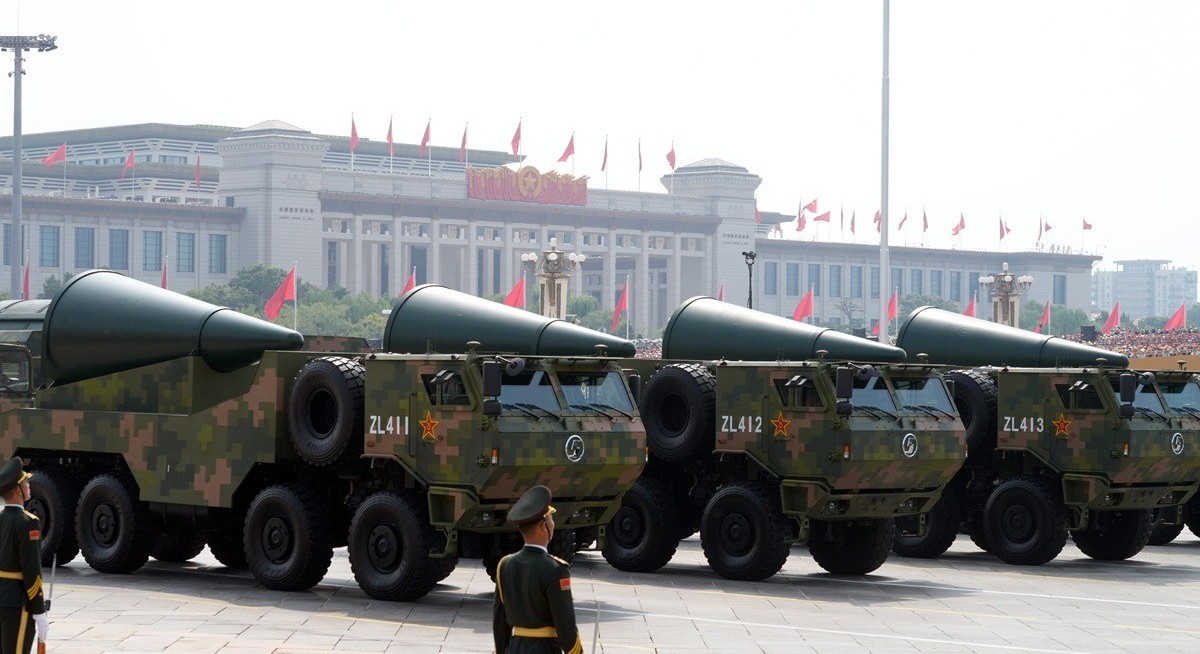
Beijing continues to develop new nuclear-capable delivery systems, including an intercontinental ballistic missile and hypersonic warheads designed to evade missile defences, although it last tested the bomb in 1996. The country argued in a white paper last year that it had followed an “extremely restrained” approach and would not engage in an arms race.
The expansion of nuclear arsenals in the region — along with Trump’s occasional threats to pull back military support — has undermined confidence in Washington’s ability to ensure the security of allies such as Japan, South Korea and Taiwan. All three advanced economies, with a history of nuclear energy generation and robust arms manufacturing sectors, have long been considered among the world’s most latent nuclear powers.
More than three-in-four South Koreans support acquiring indigenous nuclear weapons capability, according to an Asan Institute report released last year — an all-time high. While South Korean President Lee Jae Myung told his Cabinet late last year that it would be “impossible” to avoid international condemnation if the country pursued atomic weapons, Russia argues Seoul’s efforts to build a nuclear submarine programme already represents a proliferation risk.
Even in Japan, where the US bombings of Hiroshima and Nagasaki in 1945 has long fuelled opposition to nuclear weapons, the debate is shifting. In December, a senior official who advises Prime Minister Sanae Takaichi told reporters that Japan should have the bomb amid heightened tensions with China over the future of Taiwan.
Although the government quickly reaffirmed its non-nuclear principles, China signalled concern. Beijing’s envoy to the IAEA warned in Vienna this month that countries should be “highly vigilant” over the nuclear posture of Japan, which has amassed more than eight tonnes of separated plutonium.
A similar tectonic shift is happening in Europe, which has largely outsourced its nuclear deterrence to Washington for decades. While France maintains a small, but “sovereign” nuclear arsenal that the country’s president can deploy independently, the UK relies on the US to supply the missiles that arm its four Trident submarines.
Extending French and British protection across Europe not only offers a chance to deepen their influence in the region, it could help them share the onerous costs of maintaining their arsenals. President Emmanuel Macron has announced an expansion of France’s nuclear role, saying Paris would increase its stockpile and deepen coordination with allies.
“A strengthening of our arsenal is indispensable,” Macron said in a speech at the Ile Longue submarine base in Brittany this month. “To be free, one must be feared, and to be feared one must be powerful.”
German Chancellor Friedrich Merz has said he began “confidential talks” with Macron on European nuclear deterrence, adding that Berlin would “not allow zones of differing security to emerge in Europe.” Germany has also agreed to join French nuclear exercises this year.
Meanwhile, Polish Prime Minister Donald Tusk has said his country would eventually seek nuclear weapons and has pursued deeper cooperation with France. In the UK, some, including Liberal Democrat leader Ed Davey, have called for the country to restart domestic manufacturing of nuclear missiles to allow its submarines to attack without US oversight.
Moscow is already framing such moves as escalation. In a Russian cable circulated among IAEA diplomats on March 11, officials described closer coordination among North Atlantic Treaty Organization (Nato) members as a buildup of “overall nuclear potential” that could be directed against Russia. They warned that any future arms-control talks would have to take that combined capability into account.
“The zeitgeist is much more pro-nuclear armament now than ever before,” said Jeffrey Lewis, director of the East Asia Nonproliferation Program at the Middlebury Institute of International Studies. “If you believe you live in a world of great-power predation where collective security is a sham, it’s pretty hard not to think, ‘Well, better take a long hard look at the big one’.”
Uploaded by Liza Shireen Koshy




