


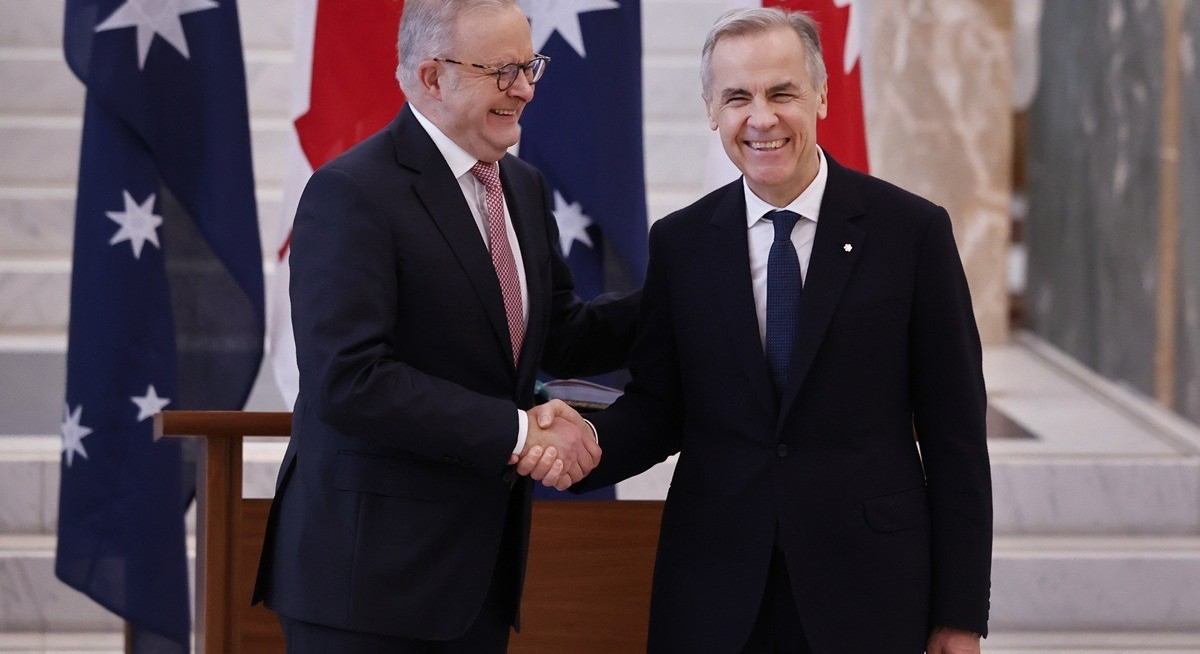


(March 5): Canada and Australia should use their reputations as stable, trustworthy democracies to lead coalitions that can resist domination by the US, China and other great powers, Prime Minister Mark Carney told Australia’s Parliament.
“In a world of great power rivalry, middle powers have a choice: compete for favour or combine for strength,” Carney said in a prepared speech to the chamber on Thursday.
“The question for middle powers like us is whether we establish the conventions and write the new rules that will determine our security and prosperity, or let the hegemons increasingly dictate outcomes,” Carney said.
He argued that Canada and Australia have earned the credibility to lead coalition-building efforts “because others know we mean what we say and we will match our values with our actions.”
“The world will always be shaped by great powers,” he said. “But it can also be shaped by middle powers that trust each other enough to act with speed and purpose.”
Carney’s trip is the first bilateral visit to Australia by a Canadian prime minister since 2007, and comes between stops in India and Japan.
See also: Shippers and oil traders seeking details on Trump’s convoy plan
It’s also set against the backdrop of the war in Iran. Both Carney and Australian Prime Minister Anthony Albanese have given qualified support for the US and Israeli bombing campaign, but Carney also told reporters his backing comes “with regret” given it represents a breakdown in the international order.
In the address in Canberra, Carney expanded on themes from his widely-watched speech to the World Economic Forum in Davos, arguing that middle powers can’t solely rely on global institutions such as the United Nations, and must instead form “different coalitions for different issues, based on common values and interests.”
“While we are committed to UN reforms to better reflect today’s world, we need these coalitions now to address emerging challenges,” Carney said.
See also: Small container ship struck while transiting Hormuz strait, UK says
Carney sketched out a mesh of different international networks for different purposes that can buttress middle-powers against coercion from superpowers, which he calls “variable geometry.”
In commerce, he said both countries are “championing efforts to build a bridge” between two major trading blocs, the Comprehensive and Progressive Agreement for Trans-Pacific Partnership (CPTPP) and the European Union. In defence, both are members of the so-called "coalition of the willing" for Ukraine, pledging aid and security after a ceasefire with Russia can be agreed.
Such coalitions can also bolster the sovereignty of middle powers, Carney said, and cited a number of areas where Australia and Canada can develop strategic advantages together: critical minerals, artificial intelligence, trade and defence equipment such as drones and satellites.
He told Australian lawmakers that their two countries should see themselves as collaborators rather than competitors in critical minerals, as two of the world’s top mining jurisdictions.
“Earlier today, we signed a series of new agreements on critical minerals, including Australia joining the G7 minerals alliance — the largest grouping of trusted democratic mineral reserves in the world,” Carney said.
Canada’s leader said the two nations can also collaborate in defence as they ramp up military spending. He alluded to the planned launch of a new low-Earth orbit satellite fleet by Ottawa-based Telesat Corp which will offer an alternative to Elon Musk’s Starlink.
He also pointed to Canada’s choice to use an Australian-developed radar system to detect incoming missiles, and said the two countries “will explore new opportunities to protect our vast territories together”.
The two-time former central banker said Canada and Australia are “under-invested in each other’s economies” and welcomed an agreement to modernise the two countries’ bilateral tax and investment treaty. On Wednesday, more than a dozen pension giants from the two nations signed a first-of-its-kind agreement to ramp up investment between the countries.
Uploaded by Liza Shireen Koshy




