




Chasen’s history has largely involved helping firms relocate their plants. In 2007, Chasen was listed on the Singapore Exchange’s Sesdaq board — now known as Catalist — via a reverse takeover of China Entertainment Sports.
Following this, in 2011, it was awarded its first major Korean project: the relocation of an OLED (organic light-emitting diode) production line from Busan, South Korea, to Shanwei in Guangdong province, China.
In 2016, it clinched a US$12 million project to handle inbound cargo and the move-in of equipment and materials for an automobile manufacturing plant.
Over the years, Chasen has worked with clients such as ASML, Applied Materials, Intel, LG and Micron.
See also: It’s steady-drip growth for this instant coffee maker
Relocation core
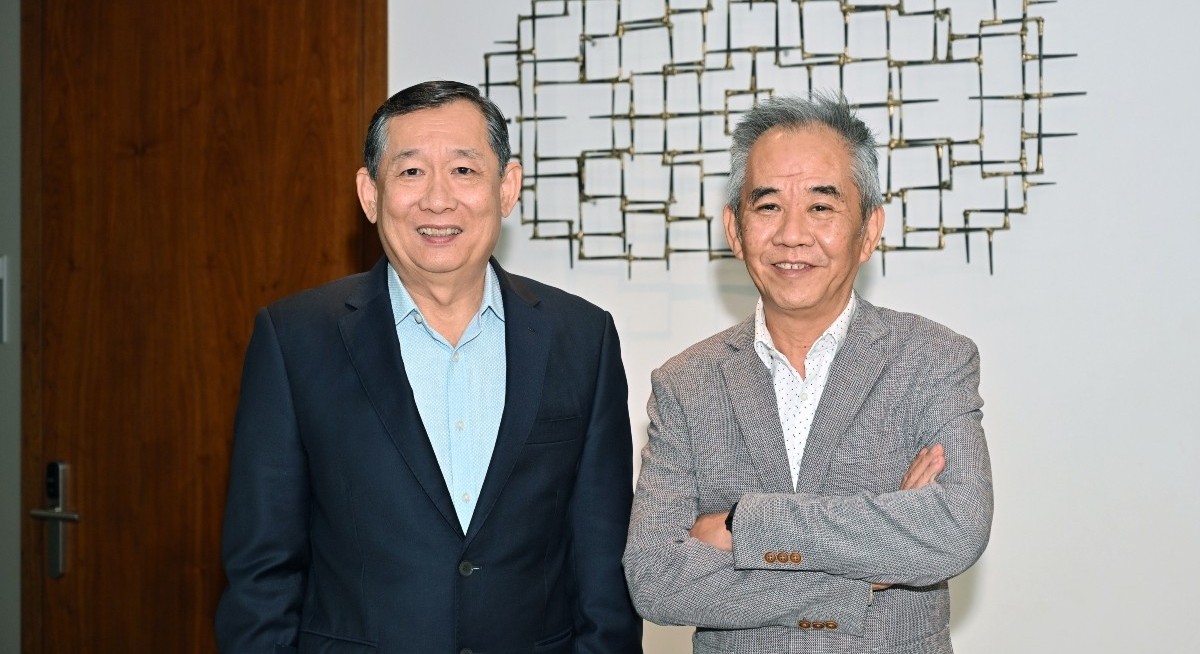
In a recent interview with The Edge Singapore, managing director and CEO Justin Low Weng Fatt and executive director Eddie Siah Boon Hock share that the company is now positioning its specialist relocation segment to benefit directly from the global surge in data centres and AI infrastructure.
For Chasen’s recent FY2026 results ended March 31, revenue grew by 2% y-o-y to $118.3 million, supported by the specialist relocation segment where its US operations continue to benefit from the scale-up under the multi-million-dollar relocation contract with a major electric vehicle battery manufacturer, alongside semiconductor-related project work.
See also: Hong Lai Huat maintains property focus despite marble mining bonanza in Cambodia
The specialist relocation segment accounted for close to 73% of its total revenue in FY2026, with the remaining 27% from its third-party logistics and technical & engineering segments.
Gross profit margin for the year also improved from 18.2% to 19.7%, driven by a more favourable service mix, with higher revenue and margin contributions from high-value services within the specialist relocation segment.
“Our specialist relocation business is providing us with the highest gross profit margin across all the business segments,” says Siah.
Apart from the higher gross profit margin, the fair value uplift on its investment property at the recently completed Chasen Logistics Hub and the absence of one-off non-cash charges helped the company return to the black, with a $7.78 million profit after tax.
On the contract front, Chasen has secured about $45 million in projects to be delivered in FY2027, with about half of the project value, or $23 million, coming from a specialist relocation contract supporting the second-wing build-out for a Japanese electric vehicle (EV) battery customer in Kansas, US.
At the same time, market participants have started to take a closer look at Chasen as its share price has gained 28.7% since the start of the year to 11.2 cents on June 26, translating to a market capitalisation of around $43.55 million.
Growth from India
To stay ahead of Singapore and the region’s corporate and economic trends, click here for Latest Section
The company is upbeat about the specialist relocation segment picking up in the near term. “We are seeing more opportunities now, both in the US and India. Apart from that, we are not only doing relocation, but we are also involved with moving machines and equipment and installation works as well,” Siah says.
In particular, Siah says India’s economy is growing strongly, with significant investment, especially in industries such as electronics manufacturing, renewable energy and semiconductor manufacturing.
“These industries are the ones that we are currently focusing on for our specialist relocation segment. We foresee that in the next few years, there is a lot of growth and potential from this segment,” Low adds.
Within the electronics manufacturing industry, Chasen provides relocation and rigging services for a major provider in Uttar Pradesh. The service provider is a contract manufacturer for major global brands across different products.
It has upside from the renewable energy industry, too. For one, Chasen is providing installation support for Reliance Industries, which is building the world’s largest integrated solar manufacturing facility at its Dhirubhai Ambani Green Energy Giga Complex in Jamnagar, Gujarat, says Siah.
The two India projects above have a combined contract value of approximately INR 461 million ($6.33 million).
For the semiconductor manufacturing industry, Siah says Chasen hopes to ride on India’s latest policy, which aims to build its semiconductor ecosystem and position the country as a global hub for electronics manufacturing and design.
“The semiconductor industry operates in an ecosystem where you have a big wafer plant that does all the chip’s fabrication and supporting players such as the outsourced semiconductor assembly and test (OSAT) companies, packing and coating companies as well,” Siah says.
From Siah’s perspective, the semiconductor ecosystem in India is growing, and he believes that Chasen has a first-mover advantage, given that the company established its footprint two years ago.
“Although our India operating activity is rather on the low end, we are now ramping up our manpower in anticipation of more projects coming in,” he adds.
Operating costs
Chasen’s aim to ramp up its operations in India is coming amid widespread inflationary pressures. As such, higher operating costs will be a key concern for investors.
Siah seems to have a solution in mind. “For the initial phase, we will deploy our managers and supervisors on the ground and at the same time, we will hire locals and allow our staff to train them. Once the operations have stabilised, we will pull out most of our deployed staff and keep maybe one or two of them to ensure the operations are running smoothly and keep our overhead costs manageable,” he explains.
Meanwhile, Siah admits that costs are rising due to higher wages across the board for Chasen’s operations in Singapore and companies cannot run away from it. “With the higher cost hanging over us, we will try to inject more technology into some of the processes that we do, such as digitalising some of our processes,” he says.
Siah adds that Chasen also purchased numerous pieces of equipment, including remote-controlled handling equipment. “Our business involves handling sensitive equipment, and therefore, we still need the human touch. Previously, we required four to five people to push and guide a 30-tonne machine.
Right now, with the new equipment in place, we only require two people to move the same machine,” he says.
As much as Siah wants to keep Chasen’s headcount lean, he admits he will still need people to ensure the company runs smoothly on the operational front. “In our line of business, it is not possible to do away with human touch,” he explains.
Apart from these initiatives, Siah says that Chasen will engage customers in discussions to adjust pricing and, where appropriate, pass through a portion of the increased operating costs. “We also work with our suppliers to contain cost increases, including through bulk purchasing arrangements and longer-term service contracts,” Siah adds.
Solar panel projects
Apart from growing its specialist relocation segment, both Low and Siah want to ride the sustainability trend by growing their technical & engineering business segment.
According to the latest Singapore Green Plan, the country hopes to increase solar energy deployment to at least 2 gigawatt-peak (GWp), which will meet 3% of Singapore’s 2030 projected electricity demand and generate enough electricity to meet the annual needs of around 350,000 households.
“Previously, under this segment, we were doing steel fabrication for the construction industry. But we faced many challenges, including payment issues. Therefore, we decided to pivot away and focus on solar photovoltaics (PV) installation,” Siah says.
According to them, Chasen installs solar PV on the rooftops of HDB flats and condominiums. Apart from residential properties, the company also installs them in warehouses and other industrial properties, as well as in public institutions such as schools and military camps.
Low and Siah share that, even though there are many solar PV installers in Singapore, Chasen does not face much competition, given the company’s greater focus on government-related projects and larger-scale commercial projects.
“For us, we are just like an engineering, procurement and construction (EPC) contractor. We get the solar panel from the suppliers and install the rest of the parts, including electrical wiring and switches,” Siah explains.
With the recent Middle East conflict, which resulted in a sharp rise in energy costs, Siah is seeing strong demand for solar panel installation among residential and commercial building owners. “At the same time, falling PV panel costs have made adoption even more attractive, as shorter payback periods improve returns on investment for owners and installers,” Siah claims.
Growth path
Looking ahead, Chasen’s growth will come from three main areas, says Siah. “First, we will scale up our capabilities at Chasen Logistics Hub to improve efficiency, maximise margins and build passive revenue by leasing specialised, cleanroom-ready space to semiconductor tenants.”
Apart from that, Low adds that Chasen will continue to leverage its operational moats to expand specialist relocation and maintenance footprints within the global EV lithium-ion battery market (specifically in the US), semiconductors, advanced display tech upgrade cycles, and data centres.
“Lastly, we want to also expand our solar EPC and green engineering execution capabilities in Singapore and regionally to capture continuous multi-year pipelines linked directly to renewable energy targets,” Siah adds.




