


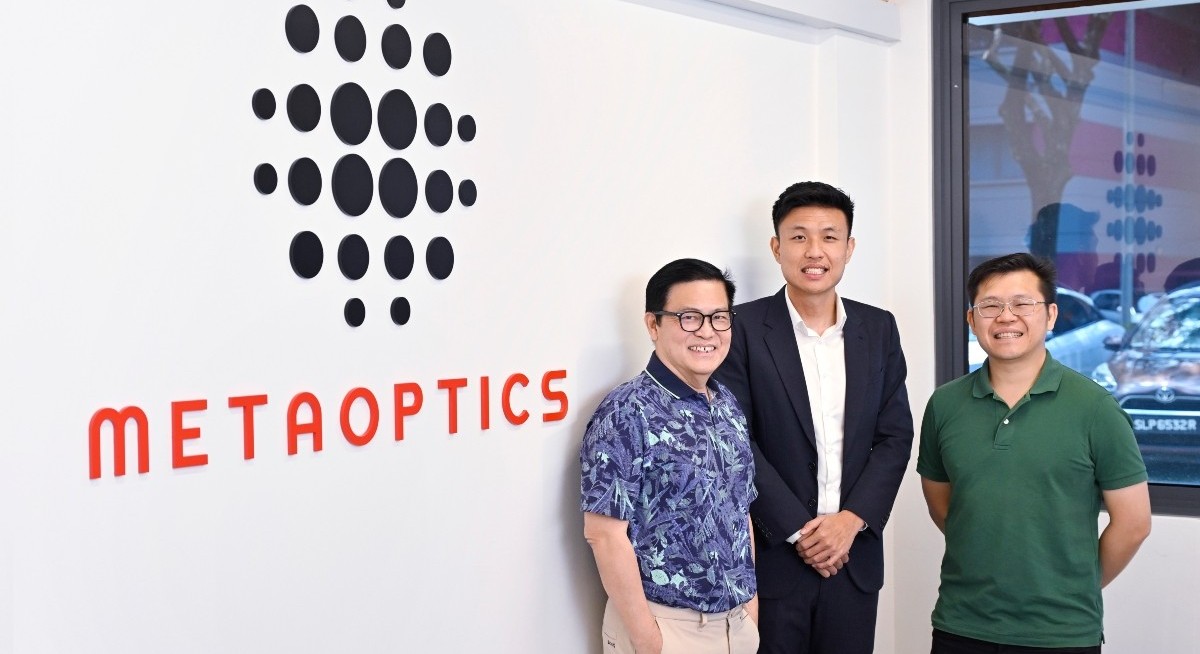


According to MetaOptics’ Feb 27 filing, the move is part of the group’s succession planning. “The succession is not a sudden decision. We’ve been thinking about that for a long time,” says Chua, who was deputy CEO previously and has been with the company since day one.
As executive director and CEO, the younger Chua will “continue to lead strategic initiatives and oversee key projects such as equipment development, metalens fabrication and the assembly of cutting-edge meta optics components and products”. He will also continue to spearhead the “set-up of key supply chains, work with suppliers on various key metalens component specifications and evaluate them for functionality and drive innovation in metalens technology and business development”.
Despite the title change, the division of labour between the two men remains largely unchanged. Thng remains in charge of the company’s day-to-day operations and the company’s direction. He will also continue leading conversations with key customers. Chua will remain in charge of supply chain management, the research and development (R&D) team, product development and new projects, and operations and sales.
“I started the company with Mark and have been there since day one. Anything about the company, both of us know the best,” says Aloysius, who has a mechanical engineering degree from the National University of Singapore (NUS). “There will be no difference… I’ll still need to get approval from the board,” he adds when asked about the company’s execution or strategy.
See also: Thomson Medical Group, Johor Bay and its Southeast Asian ambitions
Chua’s path to the role was serendipitous. He was on his way to becoming a commercial pilot until Covid-19 hit, putting his plans on hold. He first helped his father’s F&B business before being introduced to Thng by a mutual friend, who asked him to join Thng’s new company at the time.
The timing of the succession, Chua explains, reflects the company’s preparation for bigger plans and larger orders, momentum that followed MetaOptics’s strong showing at CES in Las Vegas in January.
As CEO, Chua’s priority is to increase sales and achieve profitability. “The most important thing right now is to make the company profitable,” he says. “No matter how good your management team is, you may have the best technology, [but if] you don’t make money, [your company] is still a failure.”
See also: E-commerce logistics hub gives SingPost flexibility to value up its floor space
MetaOptics ended FY2025 ended Dec 31, 2025 with a net loss of $5.4 million from the $2 million loss in FY2024, mainly due to listing costs. Revenue for the year, however, surged 891% y-o-y to $787,388.
Progress indicators
The higher revenue is a “good indicator”, says Thng, given that the company is barely five years old.
On April 22, MetaOptics said it achieved a “progressive milestone” in securing design and evaluation orders for its metalenses and modules from “world-class customers”. These included a major South Korean consumer electronics company, a leading European engineering and technology company, a European semiconductor foundry and manufacturing company, and a motor vehicle intelligence sensing company based in South Korea.
Thng notes that the industry is “still young” with metalens penetration still in the single digits. “We actually have a very good, long runway to capture market share.” Achieving profitability, he adds, will depend on how quickly MetaOptics becomes the leading metalens company.
“Metalenses are not mainstream, but there’s been a lot of traction over the past two years,” says Chua. “The first adopters of metalens, which are our first few customers, are facing a problem that conventional optics cannot overcome.”
“The metalens is made of glass. In contrast, traditional polymers degrade in high heat and their efficiency decreases in a high-heat environment,” he explains. “Some of our lenses are used in LiDAR (light detection and ranging) applications where high-power lasers go through them, resulting in a high-temperature environment. This environment deforms traditional plastic lenses, which results in a drop in efficiency.”
To stay ahead of Singapore and the region’s corporate and economic trends, click here for Latest Section
MetaOptics spent more than $1.8 million on R&D, so how does it balance profitability with investment in business growth? Chua is clear: “Everything we spend on R&D has to be commercialised.” This includes the lenses the group produces and the costs of their design and fabrication. “We don’t invest our resources in things we don’t think are able to be commercialised.”
Regarding competition in the field, Chua and Thng remain unfazed. As far as they know, MetaOptics is the only vertically integrated company among its peers. “We are a one-stop shop,” says Chua.
Part of that offering is a demonstration kit shipped to clients, bundled with software to help them better visualise their product. The kits, says CFO Chu Wee Liat, allow customers to try MetaOptics’ metalens and set specifications. “After sending out many demo kits in 2HFY2024, we were able to secure design projects in 2025,” he says.
The demo kits, adds Thng, contributed 30% of MetaOptics’ revenue in FY2024. “We’re already reaping results.” These kits also help pull in one of the largest consumer electronics customers in South Korea. Thng’s wish is for these demo kits to be converted into product agreements.
The demo kits also help clients save time. “We ship them together with our software… Instead of one to two years to put a lens onto a sensor, we save them a few years of their time,” adds Chu.
MetaOptics, which is not affected by supply disruptions caused by the Middle Eastern conflict, says the biggest hurdle is actually getting its customers to adopt its products as quickly as possible.
Yet, as with every new technology, customers tend to be sceptical.
That said, he believes that as long as more talent enters the industry, metalenses will become more mainstream.
At the moment, the company plans to be based in Singapore and the US and to sell its products worldwide, including Taiwan and Hong Kong. For now, the business model is focused on keeping costs down. “Of course, we want to make as much money as possible,” says Chua.
Chasing unicorns
MetaOptics, a relatively new company that listed on the Singapore Exchange’s (SGX) Catalist board in September 2025, has big dreams. Two months after its listing, the company announced its intention to list on the Nasdaq.
On May 4, MetaOptics filed its draft prospectus for listing on Nasdaq. In its statement dated Nov 17, 2025, the company said the dual-listing will allow it to gain access to a diversified base of shareholders and investors. A Nasdaq listing, it added then, would allow it to “build up its metalens design and fabrication capabilities in the US and to also position the group in proximity to potential key customers”.
A revised filing on May 18 indicated that the company will offer 4 million American depositary shares (ADSs) with a par value of $0.00000025 per ADS; each ADS represents 12 ordinary shares. On May 29, the company filed a registration for its securities through Form 8-A. Another filing on June 10 revealed that the company will now offer 3 million ADSs. The company will trade under the ticker symbol MOT with an expected price of between US$5 ($6.43) and US$7 per share.
In an August 2025 interview, MetaOptics famously said it chose to list on the SGX over Nasdaq. Back then, Thng had said that the company was focused on getting purchase orders, even though it did not rule out a Nasdaq listing down the road.
When asked about the decision to go to the US now, Chua explained that the company had already received “a lot of traction from [its] US customers” and came in the form of “qualification process, discussion of design [and] mass production testing”.
As of Dec 12, 2025, MetaOptics shares also rose by an impressive 480% from its IPO price of 20 cents to $1.16. Even at its last close of 78.5 cents on June 15, which gives it a market cap of $190.48 million, investors who bought into the company at its IPO would have seen a 292.5% gain. Ultimately, Chua envisions the company becoming a unicorn.
The company is also hoping for a slice of the Equity Market Development Programme (EQDP), which is disbursing $6.5 billion to SGX-listed counters through fund managers. “We’ve been speaking to the fund managers, but we have not received feedback yet… We’d love to have this support,” says Chua.
Succession planning doesn’t end with Chua’s promotion. The company’s two vice-presidential-level hires — Dr Egor Khaidarov, vice-president of engineering and Dr Tobias Wilhelm Wolfgang Massis, vice-president of systems — are candidates to head one of MetaOptics’ four business divisions: metalens capital equipment, metalens design and foundry, metalens IoT products and smart devices, and metaoptics AI algorithms. With the company now operating across all four, the logic is straightforward. “It can’t be all Mark running all four divisions,” says Chua.




