




After peaking above $3.50 in 2007, the company’s shares entered a long decline, falling to four cents in 2024 amid mounting debt pressures and softer student enrolment. The situation was compounded by a long-running feud between Chew and substantial shareholder Oei Hong Leong, alongside a series of legal disputes.
In recent years, Raffles Education has mostly made headlines for sporadic updates on property divestments in Singapore as it sought to lighten its debt load. Sentiment turned sharply earlier this year. The company sold its 51 Merchant Road property for $121.8 million, below its June book value of $152.7 million, but still recorded a net gain of $53 million, which will be used to reduce debt.
Chew, the controlling shareholder, has also increased his stake. Last October, he said he would convert about $16.5 million of unlisted convertible bonds into new ordinary shares at 6.44 cents each, instead of seeking repayment. He also elected to receive scrip shares in lieu of cash for his entitlement to the special dividend funded by the divestment of 51 Merchant Road.
These moves lifted his stake in Raffles Education from 37.82% to 47.99%, with the potential to rise further to 55.6% if the remaining unlisted bonds are also converted.
See also: Indonesia’s Danantara wealth fund sees senior management shakeup
In another move to lighten the debt load, on May 11, the company announced that it is buying and cancelling around $35 million in convertible bonds now held by Chew and his wife, Doris Chung. Following this, the company will issue another new tranche of unlisted non-convertible bonds of the same amount, carrying a coupon of 5.5% over five years. In addition, they will be issued 538.9 million warrants that come with the right to subscribe for new shares at 6.5 cents. From the cash saved from repaying Chew and Chung, Raffles Education plans to pay a special dividend of 0.3 cents.
They also appear to have won over a group of investors, including Lion Global Investors, Azure Capital and Bobby Lim of Tai Sin Electric, which collectively bought more than 44.6 million treasury shares at 12.7 cents apiece. The purchase price represented a sharp discount to the company’s NAV of 35.13 cents per share as at March 31.
Raffles Education’s shares have recovered sharply from their lows last year. From a trough of 3.2 cents on April 22, 2025, the stock surged to as high as 18.6 cents on Jan 20 before easing to 13.1 cents as of May 19, giving the company a market value of $238 million.
See also: Relocation specialist Chasen rides chip growth; eyes more solar panel projects
“When my share price was still at a sluggish level of just 4.5 cents, I was literally begging investors out there to buy my shares,” says Chew in a recent interview with The Edge Singapore.
“With the significant jump over the past year, they can now sell it easily between 12 and 13 cents. Can you blame them for cashing out so early? No, in fact, I told them to cash it out and secure the profit.”
Results have shown further improvement. For 1HFY2026 ended Dec 31, 2025, while revenue remained almost unchanged at $56.6 million, net profit after tax and adjusted ebitda were down 58% and 4% y-o-y to $3.1 million and $17 million, respectively.
On May 7, the company reported further improvements. For 9MFY2026 ended March 31, while revenue was down 8% y-o-y to $81.1 million, net profit after tax was up by 274% y-o-y to $24.2 million, while adjusted ebitda declined 5% y-o-y to $22.7 million.
Plugging into Iskandar
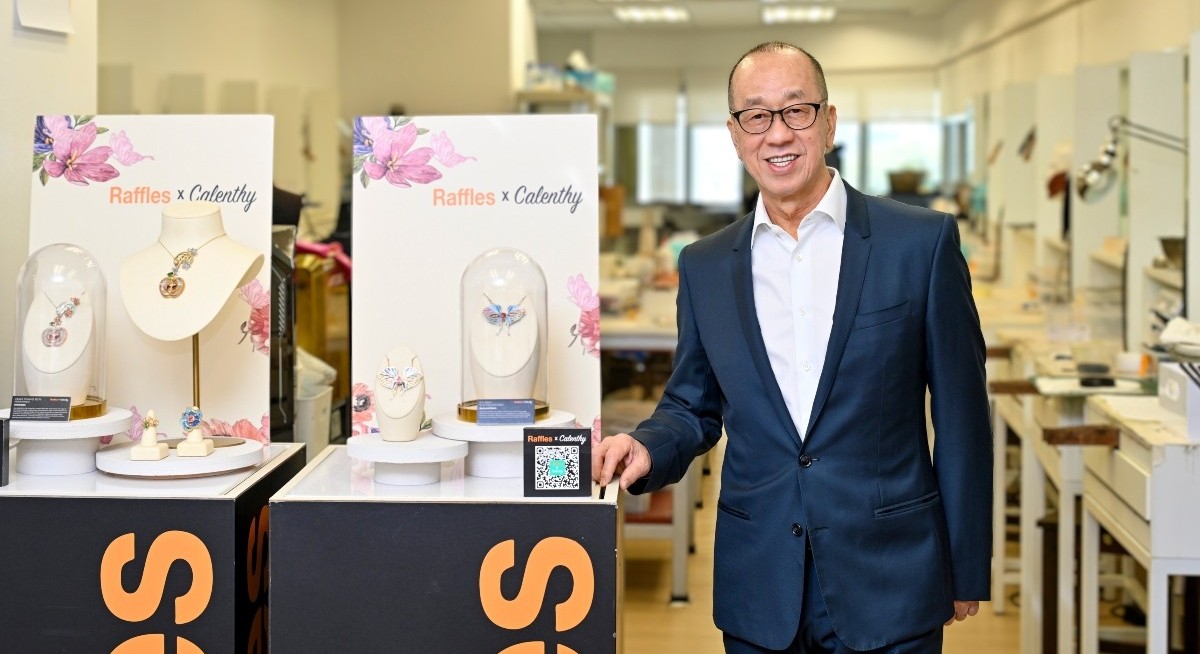
When Raffles Education was a high-profile listed company, it was known largely for its design and fashion courses offered to students here, both international and local. Back then, Chew sported his signature red-rimmed spectacles, befitting the image of a don straddling both arts and commerce, and the face of a red-hot stock.
In the years that followed, Chew expanded into markets such as China and India. More recently, he has shifted his focus to Malaysia, where he now aims to offer K–12 education — from kindergarten to Grade 12 — through Raffles American School (RAS) in Iskandar Puteri, Johor. Throughout, 72-year-old Chew, now wearing black-framed glasses, a more conservative colour, remains very much in charge.
To stay ahead of Singapore and the region’s corporate and economic trends, click here for Latest Section
Singapore, with its large expatriate population, might seem a natural market for K–12 education providers, as reflected in its many private schools, including Singapore Exchange (SGX)-listed Overseas Education. But Chew has instead turned to neighbouring Johor, citing high investment costs in the city-state, and remains confident in his bet. He adds: “I am investing for the long term, not for the sake of trying to make a quick buck. If you look at the entire scale of RAS here today, it is almost equivalent to our current market capitalisation right now.”
Raffles Education’s market capitalisation currently stands at around $238 million. With enrolment at about 500 students versus a capacity of nearly 2,000, Chew says higher intake would feed directly into earnings. RAS could grow enrolment to between 1,000 and 1,200 students over the next five to 10 years. “The various operating costs at RAS, such as overhead, land and building costs have already been accounted for.”
According to the school’s website, annual tuition fees at RAS start at RM98,500 ($31,814) for Grades 5 to 8 and rise to RM106,500 for Grades 9 to 12. By comparison, nearby Marlborough College Malaysia — located just a two-minute drive away — charges higher fees, ranging from RM177,300 for Grades 5 and 6 to RM216,000 for Grades 10 and 11.
Chew credits his wife Chung, who is the co-founder and director of operations at Raffles Education, for taking a more hands-on role in running RAS. “She is the one who started this school from the previous forested land. You can see that the last 10 years have been very fruitful for us.”
Raffles Education has secured backing from Malaysian state capital, with Khazanah Nasional, the country’s sovereign wealth fund, acquiring a 10% stake in its subsidiary Oriental University City (OUC) in February 2010.
Chew believes the investment will allow Khazanah to tap Raffles Education’s expertise in the sector, while also contributing to the development of EduCity Iskandar, a key component of southern Johor’s broader growth strategy. Developed by Iskandar Investment (IIB), a subsidiary of Khazanah, EduCity Iskandar is recognised as Asia’s first multi-campus education city.
“I remember Khazanah approached me at that time, given that I have OUC at my back, they asked me to help visualise the setting up of EduCity Iskandar, and of course, we went ahead and participated in this education hub development,” he adds.
Apart from driving enrolment figures at RAS, the company will also aim to increase enrolment figures at Raffles University Iskandar (RUI). The latter received formal approval from Malaysia’s Ministry of Higher Education (MOHE) in October 2011 and is licensed and accredited to independently develop and confer new academic and TVET (Technical and Vocational Education and Training) programmes.
Chew hopes that RUI will secure QS World University Rankings status by the end of this year. The QS World University Rankings, published annually by Quacquarelli Symonds (QS), assess universities worldwide based on factors such as academic and employer reputation. The rankings provide comparative insights across institutions, subjects and regions.
‘Fantastic’ Asean
Beyond individual markets, Chew is most upbeat on the wider region, which he says will be “fantastic” over the next decade. Raffles Education currently operates 16 institutions across nine countries in Asia-Pacific and Europe. He expects Asean’s education sector to outperform other regions in the years ahead.
Beyond Malaysia, Raffles Education offers K–12 education in Thailand and is moving ahead with plans to establish a campus in Jakarta, targeting growing demand for “quality international education.”
Chew also points to Asean’s population of around 700 to 800 million, suggesting that even a modest intake of 1,000 students could be highly lucrative — joking that it would be enough to be “raking in big profits.”
In Indonesia, Chew is looking to acquire land or take over an existing school to advance his expansion plans. He targets K–12 education for children of local high-income families and expatriates in a country of more than 280 million people.
Over in Thailand, Chew says Raffles American School (Bangkok) is operating at full capacity. Expansion works are underway, with two new blocks scheduled for completion by the end of the year that will double the capacity to 1,000 students. As in Indonesia, the focus will be on local high-income families and expatriates.
Divestment in China
Chew is, however, more cautious about Raffles Education’s prospects in China. The group operates subsidiaries in several cities, including Shanghai, Guangzhou, Suzhou and Tianjin. On Nov 26, 2025, it announced the sale of Raffles Hefei for about RMB426.4 million ($80.2 million). He is now looking to pursue further divestments.
He says Raffles Education’s assets in China have largely outlived their usefulness amid a declining and ageing population, as well as stiff regulation and intense competition. “Given China’s policy, especially in the education sector, holding assets in China in fact will be a cost burden for me. Hence, I want to get out, and I am looking to sell away my assets in China.”
But Chew says that he is in no rush. “If we are talking about divestment proceeds, I can have approximately half a billion anytime, but it will take time to sell those assets. If you look at my history, almost all the divestment proceeds were used to reinvest in the education business.”
As of March 31, Raffles Education has a net asset worth of some $713.2 million, mainly backed by freehold investment property assets. Meanwhile, the company is also monetising its long-standing investments in China through other means. On Jan 29, Raffles Education said its China subsidiary, Langfang Hezhong Education Consulting Co, had responded on Jan 27 to a notice from local authorities to repossess its land in Langfang, Hebei province, which is carried on its books at about $113 million. The SGX filing did not state when the notice was received. A divestment of Raffles Tianjin could also be on the cards. Chew says it could fetch between $150 million and $200 million.
He is considering using divestment proceeds to establish an education fund of at least $200 million for investments and acquisitions. He points to private equity firm KKR’s recent US$1.3 billion ($1.6 billion) acquisition of Singapore-based XCL Education, which operates schools across Southeast Asia, including Malaysia, Thailand and Vietnam.
KKR is approaching the deal purely from a private equity perspective — in other words, to invest, extract value and exit. By contrast, he describes himself as both an operator and an investor.“Our objective is more on investment and acquisition, but more importantly, we have an edge over them as we know how to run the education business.”
Despite ongoing property divestments and plans for an education fund, Chew says the company will stay focused on its core education business and steer clear of real estate.
The next generation
Even with early signs of improvement, Chew remains mindful of the challenges of running the business. “To start a university, you will need a licence. Even if you manage to get a licence from the government, you need to accredit your various courses, one by one. Most importantly, you need to have students to enrol into your university and take up the course.”
His three children are actively involved in the company and are keen to take it forward. “My children always said they are thankful to me for doing this [Raffles Education] for them. The journey is not easy for me as there is a lot of hard work, sweat and tears involved.”
“I came from a poor family, given that my dad was a fisherman. For my children, I do not spoil them, and now they are more driven and helping out in the business,” he adds.
For him, his children are now better than him and he sees that as a big blessing. “As long as they continue to do well and stay healthy, I am all good.”




