


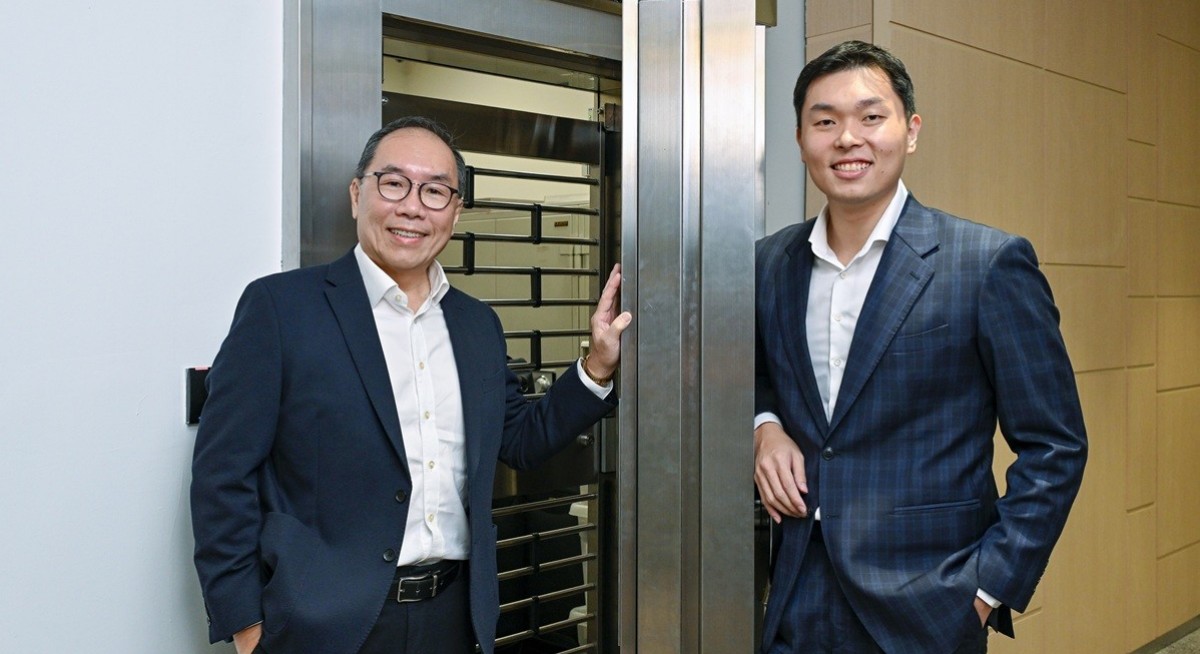


The way Lim sees it, pawnshops have not died off as they serve a niche in the market that banks cannot (or are unwilling) to serve. He explains that pawnbrokers provide collateralised loans with swift approval processes. “You see, if you’re serving the community, there’s actually a huge group of people that banks simply can’t serve,” he says.
To MoneyMax, their business is built on serving the underbanked. In general, there may be situations in which a person has difficulty securing a loan from a bank or needs funds urgently. If they have something of value, the item may be pledged to the pawnbroker for a cash loan at a lower interest rate (1.5% per month). This is more attractive than borrowing from licensed moneylenders, who may charge up to 4% per month, while avoiding the crippling interest rates charged by loan sharks.
If the borrower misses a payment or fails to redeem their item at the end of the tenure period, which is usually six months, the loan ends without further consequences for the borrower, such as debt collection or harassment.
Pawnshops hedge the risk of borrower default by providing loans of 60%–80% of the pawned item’s value, which can be sold to recover the unrecovered loan.
See also: GKE signs non-binding LOI to develop and operate warehouse in Dubai for up to 50 years
Lim shares an example: “Maybe a microbusiness owner needs a short-term loan; business is slow, and they have a bill to pay and they have no way to solve this. He brings you this $2,000 watch, takes out a loan, and pays his bill.
“Then he comes to redeem his item a few days later, paying the principal and $20 in interest. No need to answer lots of questions or jump through hoops for a loan.”
Therefore, pawnbroking is a business designed to address cash-flow challenges, according to Lim. “Over half of our customers pay back the interest or the principal within a month,” he shares, adding that MoneyMax usually provides an incentive by charging only 1% interest for the first month.
See also: Jardine to buy back US$500 mil shares, seeks to boost returns
Lim explains that the lower interest rate is intended to encourage borrowers to repay their loans and to earn customer loyalty. “We’d rather earn a little less than insist on maximum interest revenue so our default rate will be very low,” he says. “What we’re hoping for is long-term customer support.”
The business model as a microfinancier providing securitised loans ensures that MoneyMax and pawnbrokers in general remain profitable and resilient. It is reasonable to say that this is why they have endured throughout multiple millennia without causing financial crises. Through booms and busts, pawnbrokers serve as a source of credit support and cash flow for people from all walks of life.
Roots in gold
MoneyMax opened its first pawnshop in 2008 as a form of diversification for goldsmith SK Jewellery. For context, SK was formerly listed on the SGX Catalist board from 2015 to 2020.
Lim relates that it was a “coincidence” that pawnbroking was discovered as a new business segment suitable for building on the existing business. “We kept in touch with employees who left SK and understood that many of them joined pawnbrokers,” says Lim, who says that SK maintains good relations with ex-employees.
Thus, SK realised that there could be some commonalities between the gold trade and pawnbroking. After doing further investigation, they felt that expanding into pawnbroking was a logical step.
“We did a lot of research on various types of business and found that it’s rare to find a business that can last for three or more generations,” explains Lim, adding that pawnbroking was one business that stood the test of time. Along with their earlier observation on ex-employees joining pawnbrokers, SK concluded that pawnbroking was a feasible business and proceeded to open its first store.
To stay ahead of Singapore and the region’s corporate and economic trends, click here for Latest Section
Fast forward to today, MoneyMax operates over 120 stores across Singapore and Malaysia and has further diversified into automotive and property financing, as well as the trading of new and pre-loved jewellery, luxury watches, and designer handbags.
Lim lists a few factors for the company’s success in pawnbroking — expertise in gold, integrity and human capital.
“We’re well-versed in gold trading, appraisal, repair, and production, and our sales team is highly experienced,” Lim explains the first factor. “So, we can say we’re quite knowledgeable about gold and this is our core competitive advantage.”
Secondly, Lim says that integrity is fundamental to its business. He says: “In the gold business, every company values integrity — we’re honest and diligent in our work. Consequently, we’ve built strong relationships with our customers, the community, our employees, and even the banks. We believe our reputation remains solid.”
Lim credits his employees as the most crucial factor in MoneyMax’s success. “Both money and gold are very valuable assets and you need people you can trust, as well as a team capable of building the business with you,” he says.
Growing with gold
In particular, gold has been on a bull run, with gold prices gaining more than 60% y-o-y to above US$4,300 ($5,532) per ounce, reaching a new record high 53 times in 2025. It peaked at around US$5,500 in January 2026 before tapering off.
The high price of gold has enabled pawnbrokers such as MoneyMax to book higher revenue and profits for the pawnbroking segment. A higher gold price allows pawnbrokers to provide a higher loan quantum for any pawned gold bullion or gold product.
For FY2025, MoneyMax reported an 88% y-o-y jump in profit to $33.2 million for pawnbroking on the back of some $97.1 million, or a 46% y-o-y increase in revenue.
At the same time, a higher gold price increases revenue for the retail and trading of gold and luxury goods. For this segment, profit more than doubled y-o-y to $41.2 million from $19.9 million, while revenue increased around 43% y-o-y to $420 million.
The stronger earnings have helped drive the company’s share price to as high as $1.17 before easing, with the share closing at 86 cents on June 16, still valuing the company at $806 million.
“Gold is a robust asset with good fundamentals and external analysts view gold favourably in the medium to long term,” says Lim. “To me, recent geopolitical events have made gold more attractive as customers feel that gold is still a more tangible asset.”
According to Lim, confidence in the yellow metal has not wavered, with customer buying volume remaining constant over the past few months. Presumably, FY2026 may also be a good year for MoneyMax.

Photo: MoneyMax Financial
Sprouting new branches
Both gold and pawnbroking have stood the test of time and it is probably no surprise that businesses in these sectors have also appealed across generations.
Lim’s son, Chun Seng, was recently promoted to deputy COO of MoneyMax. A lawyer by training, Lim has always been interested in expanding the family business since a young age. He joined the family business in 2018 and started the automotive financing department.
“Evolving the business beyond its original scope to become a financial services provider is part of our vision,” says Chun Seng, who adds that his father allowed him to establish a new business segment.
For Lim, he was adamant that his son had to build something from scratch to prove himself to other employees. Lim says: “He has had to go through the process of setting up and building a company to have a solid foundation for any business he pursues in the future. I gave him a lot of advice, with the condition that as long as he didn’t lose money, he should go ahead and do it.’
Lim’s emphasis on training the next generation has borne fruit, with the company also expanding into real estate financing. Both types of financing fall under MoneyMax’s secured lending business segment, which has seen earnings grow from $2.2 million in FY2020 to $5.8 million in FY2025, while revenue increased from $4.7 million to $24.3 million over the same period.
Generational value
MoneyMax transferred to the Mainboard of the Singapore Exchange on May 6, as part of a wave of transfers. “The organisation has grown and made significant progress in many ways,” says Chun Seng. “Moving to the Mainboard reflects the organisation’s value and interest from institutional investors.”
For context, 53 million new MoneyMax shares at 83.5 cents were snapped up by three Equity Market Development Programme (EQDP) asset managers — Fullerton Fund Management, Lion Global Investors and Eastspring Investments — in April.
Meanwhile, in addition to expanding into Malaysia, the company is eyeing other Southeast Asian markets, including Thailand, Indonesia, and the Philippines, as well as Mainland China. To Lim, there is strong market demand for microfinancing in these countries.
“Moving forward, as opportunities arise, we will actively seek out development opportunities to explore growth potential in other countries,” he says. “We’ll take a pragmatic approach and won’t rush into this; it is a plan for the next five to 10 years.”
With a prudent business model and prudent management, it may not be a surprise if pawnbroking survives and thrives for another three millennia.




