


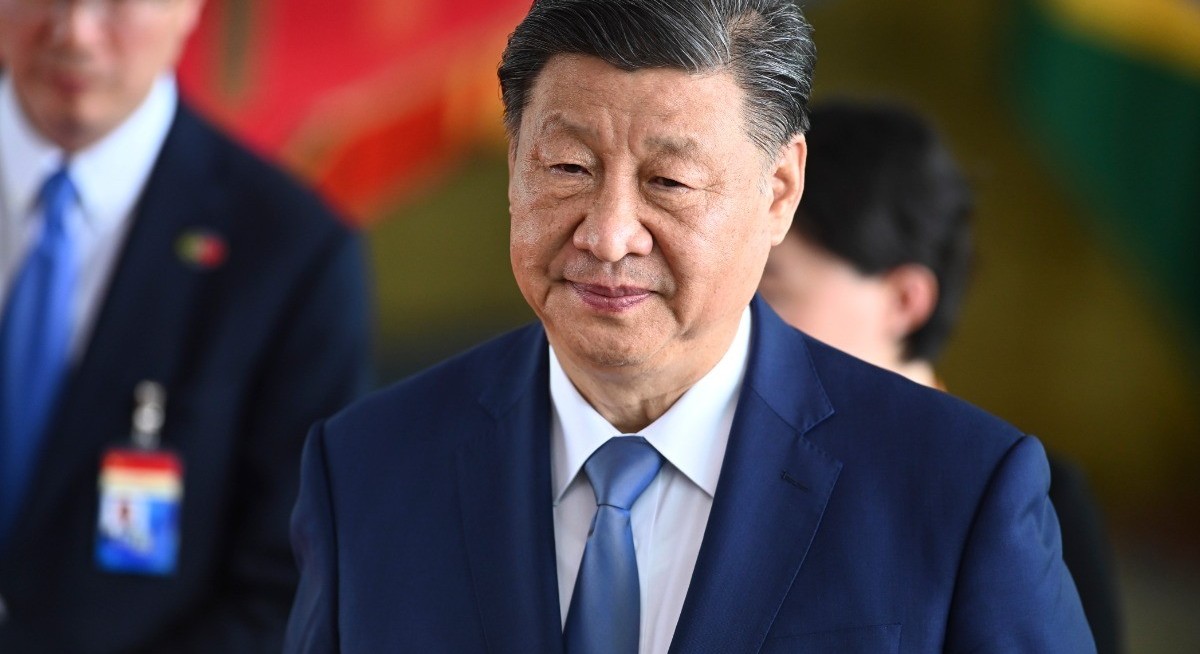


(April 17): Chinese President Xi Jinping is wrapping up what’s been an unusually busy week of diplomacy in Beijing, showcasing the fervent interest of world leaders to develop ties with China while the US is embroiled in a conflict with Iran.
Xi has held at least five high-profile tête-à-têtes, despite the lack of any formal gathering in China’s capital this week. Excluding weeks the country hosted major summits, it’s the quickest tempo since July 2024.
The roster has ranged from a US Nato ally — Spain’s Prime Minister Pedro Sánchez — to a Middle East representative — Abu Dhabi’s Crown Prince Sheikh Khaled bin Mohammed. The meetings were followed by a visit from the leader of neighbouring Vietnam — To Lam, the nation’s president and Communist Party chief, who recently secured a fresh five-year term.
Xi has been positioning his nation as a source of stability and bulwark of respect for international rules, against the backdrop of US President Donald Trump’s threat to bomb Iran “back to the Stone Ages”. Left unclear: Whether China’s leaders, who have long promised benefits from deeper ties to the world’s No 2 economy, will offer concrete help for countries facing the current energy crisis.
“World leaders are heading to Beijing because they increasingly see China as a hedge against an unpredictable United States,” said Neil Thomas, a fellow on Chinese politics at the Asia Society Policy Institute’s Center for China Analysis. “Many want Beijing to play a larger role as a defender of stability, diplomacy, and an open global economy.”
Trump, by contrast, has spent the week deepening his isolation on the global stage, by openly lambasting one-time close allies including Italy’s Giorgia Meloni and the UK’s Keir Starmer. He also launched a broadside against Pope Leo XIV, calling the popular and highly visible spiritual leader “terrible for foreign policy”.
See also: Foundation for business growth in China
Italy’s foreign minister this week visited Beijing, where officials pledged to deepen ties with Rome.
Trump has increasingly — and unsuccessfully — turned to threats to pressure allies into working with the US military to open up the Strait of Hormuz and restore flows of energy from the Persian Gulf to the rest of the world.
Global leaders have sought to coordinate without the US present. Starmer is travelling to Paris to host a video conference on Friday alongside French President Emmanuel Macron, bringing together a coalition of roughly 40 countries working to help restore free transit through the Strait of Hormuz. South Korea, Japan and Australia have been part of that effort previously, which focuses on supporting a ceasefire.
See also: China’s economy revs up despite war as growth tops forecasts
China’s neighbour Japan has already been active in terms of opening up the checkbook. Prime Minister Sanae Takaichi this week promised a US$10 billion ($12.73 billion) aid package to help nations in Southeast Asia cope with soaring crude oil prices.
She made that announcement while hosting a virtual meeting with regional leaders on Wednesday on a new initiative, “Power Asia”, designed to strengthen the energy supply chain. Included in the session was Vietnam’s prime minister, on the same day that To Lam met in Beijing with Xi — who offered words of solidarity, but no hard support.
_20260417155944_Bloomberg_kpa6hz.jpg)
Japanese Prime Minister Sanae Takaichi
China’s most concrete public action so far has come alongside its “no-limits” friendship with Moscow. Xi again touted the stability of ties with Russia and pledged deeper bilateral coordination in his meeting with Foreign Minister Sergei Lavrov this week.
Russia and China, two of Iran’s most important backers, earlier this month vetoed a United Nations Security Council resolution encouraging countries to coordinate efforts to reopen the Strait of Hormuz. That motion would have tacitly condoned military action in the waterway. Beijing argued the “unbalanced” proposal failed to address the root cause of the problem and only made accusations against Iran.
Trump has publicly credited Beijing with nudging the Islamic Republic to participate in peace talks last week, an assertion bolstered by Iranian officials reportedly saying the same. But Chinese state media has pushed back on that, saying that claim incorrectly blames Iran for blocking talks, and puts a burden on China to negotiate ceasefire conversations, according to a social media post from CCTV.
To stay ahead of Singapore and the region’s corporate and economic trends, click here for Latest Section
China’s Foreign Ministry has said Beijing had made its “own efforts” in pushing for a ceasefire without providing more details.
Xi and Chinese officials have cautiously taken a more vocal approach, keeping enough distance so they aren’t blamed if the talks fail, according to Ja Ian Chong, an associate professor of political science at the National University of Singapore.
“Beijing also has concerns about managing its own relationship with Washington,” he said. “More direct and active involvement in negotiations could win the Trump administration’s affirmation as much as earn its ire and blame.”
China — the world’s largest oil importer — isn’t yet incentivised economically to take a more proactive role in the Iran conflict. Its vast commercial oil reserves have so far insulated the country from the dramatic price shocks ripping through the rest of Asia.
That may change as the war drags on. Rising prices have broken the country’s longest deflationary streak in decades and higher operating expenses will drain industries already labouring under razor-thin margins.
Still, China has been reluctant to become directly embroiled in a volatile conflict. Beijing’s friendship with Tehran and commercial ties with Gulf states took centre stage as China helped broker a detente between Saudi Arabia and Iran in 2023 — a breakthrough widely hailed at the time as a sign of Xi’s growing clout in the region.
Since then, China has largely taken a backseat as fighting reignited in the Middle East. The October 2023 Hamas attacks on Israel and ensuing escalation exposed the limits of its influence. Official messaging has confined itself to calls for restraint and de-escalation, preferring to focus on booming business.
Beijing has demonstrated it’s not willing to actively resolve a stand-off, which is devastating for the global economy, according to Richard McGregor, a senior fellow for East Asia at the Lowy Institute.
“It is very easy to criticise the US,” he said. “Even America’s allies are at odds with Trump and Washington these days — but sooner or later, China needs to go beyond the position of a critic, and get some real diplomatic skin in the game.”
Uploaded by Tham Yek Lee




