


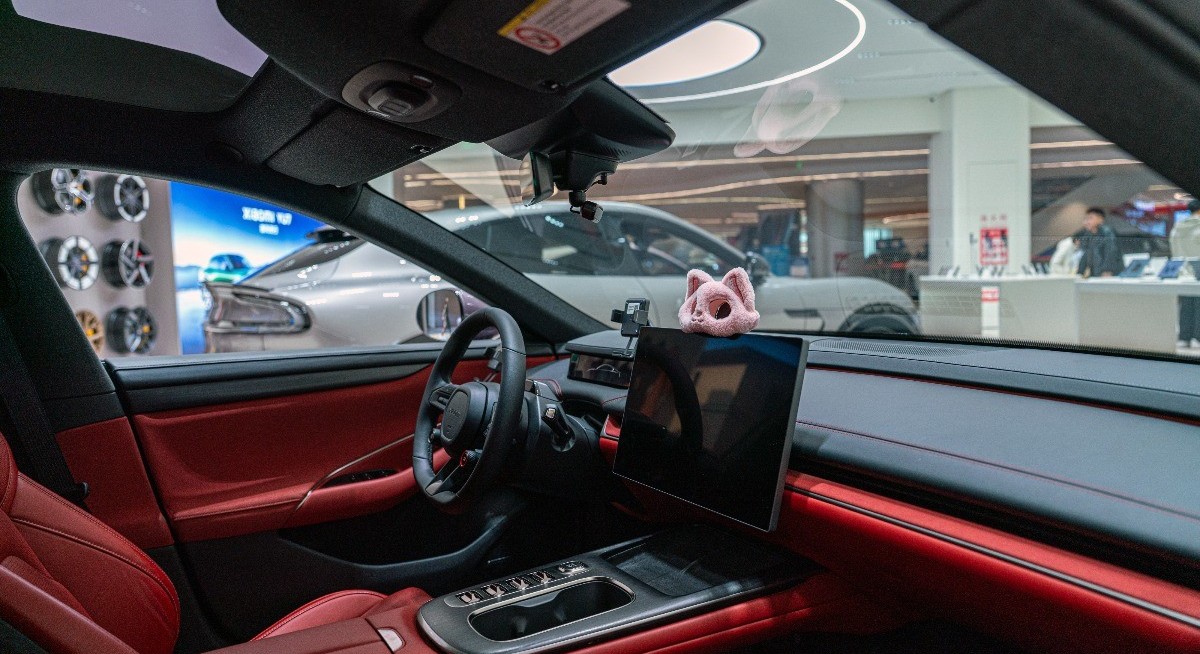


(Feb 13): China is taking aim at stripped-down, screen-dominated car interiors favoured by the likes of Tesla Inc and Xiaomi Corp, requiring that essential safety functions be controlled by physical switches or buttons.
In a set of proposed regulations, China’s Ministry of Industry and Information Technology said that functions including turn signals, hazard lights, gear selection and emergency calling must have fixed buttons or switches with a minimum surface size of 10mm x 10mm.
The move marks a direct challenge to the minimalist interior design popularised by Tesla and adopted by Chinese electric car makers such as BYD Co and Xiaomi amid growing safety concerns about driver distraction and screen failures. It comes after China earlier this month became the first country to ban concealed door handles on electric vehicles, which have been linked to a spate of fatal incidents around the world.
Beyond the dashboard, China’s government is codifying safety expectations for high-level driver-assistance technology. A mandatory standard for Level 3 and Level 4 automated driving systems stipulates that these vehicles must demonstrate a safety level at least equivalent to a “competent and attentive human driver”. At these levels of automation, the car can handle all driving tasks, though at Level 3 the driver must be ready to take control if alerted.
The proposed regulations also introduce a “safety case” requirement, requiring manufacturers to provide structured, documented evidence that their systems can handle both daily driving and critical high-risk scenarios.
The standards also define a “minimal risk condition”, requiring that if an automated system fails or a driver ignores a takeover request, the vehicle must be capable of autonomously reaching a stable, stationary state.
See also: CK Hutchison warns Maersk of legal action if it takes over Panama Ports
It also formalized the remote assistance for fully-automated cars, allowing human operators to intervene in complex environments, a crucial step toward the mass commercialization of robotaxis and hands-free driving on Chinese highways.
The proposed changes will be open for public comment until April 13.
Uploaded by Tham Yek Lee




