


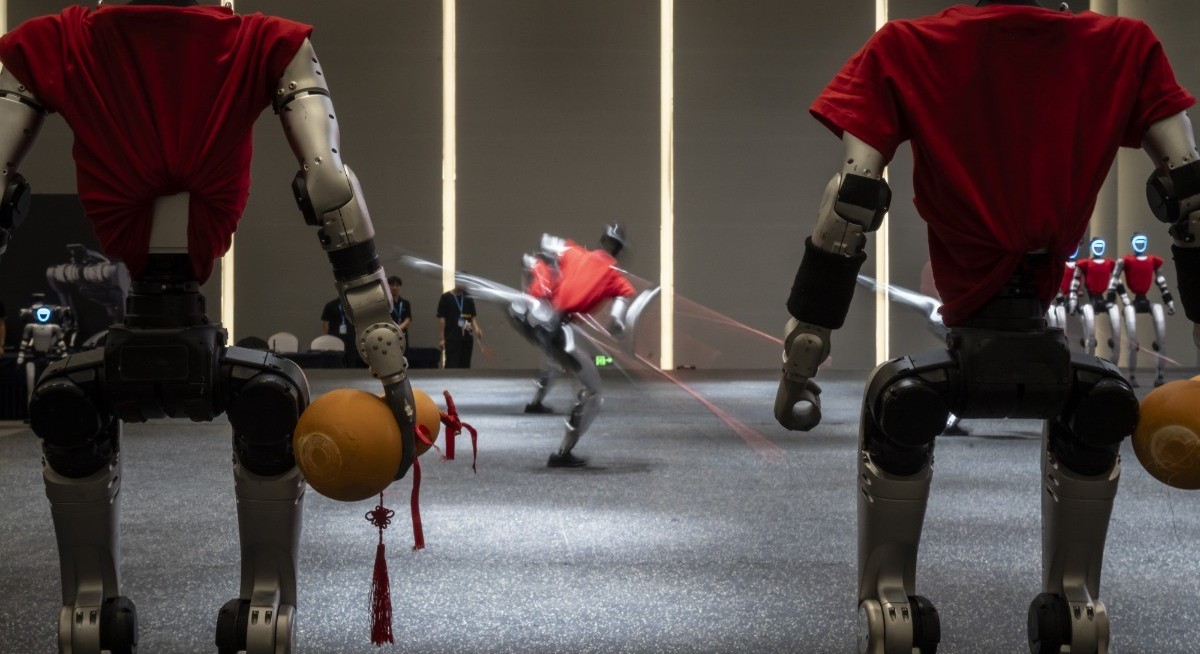


(July 16): In an industrial park on the outskirts of Beijing, a humanoid arm picks up a bag of Lay’s potato chips and places it neatly along a row of snacks on a shelf. Nearby, a worker films himself grabbing cushions off a sofa and folding sheets on a bed, recording videos that will be used to develop brains for robots.
China is deploying more humanoids than ever before, sending thousands to logistics hubs, battery factories and other industrial locations at a faster pace than the US. Buoyed by support from the government and a flood of investment, start-ups are getting their most advanced machines out into the world in a bid to gather torrents of data that can fuel the development of smarter, more humanlike machines.
President Xi Jinping is looking to the robotics industry for help beating the US in a global technology race. China’s manufacturing prowess and robust supply chain management position it well to reap the benefits of humanoids before its geopolitical rival. Xi is due to address the country’s flagship artificial intelligence (AI) conference this week for the first time, where the latest humanoids will be on display.
After Unitree Robotics turned heads with the popular kung fu moves of its G1 model, China’s humanoid industry is now undergoing a seismic shift from body to mind. Investors are pouring cash into firms developing AI for robots, known as embodied intelligence, and the biggest names in Chinese tech, from Alibaba Group Holding Ltd to Xiaomi Corp, are joining the fray with their own models.
In the US, a host of firms from giants like Alphabet Inc’s Google to start-ups such as OpenAI-backed Physical Intelligence Inc are chasing the same technology. Nvidia Corp operates its own open-source foundational AI model for robots, named GR00T, while backing an array of promising start-ups, including Figure AI Inc. The world’s most valuable company recently struck a partnership with Unitree in a rare breach of the US-China divide over sensitive tech.
A divergence has emerged between Chinese and American firms developing embodied intelligence. In China, models are increasingly trained using data generated by humanoids in the environments in which they will be operated. In contrast, US firms are buying data and looking to lab simulations as well as human workers in India, Vietnam and other low-cost markets for their training needs. At stake is the future of the humanoid market, which Morgan Stanley estimates will be worth US$5 trillion ($6.5 trillion) a year by 2050.
See also: Innolight is said near approval for US$7 bil Hong Kong listing
“The whole world is still at the starting line in physical intelligence,” said Su Hao, a US-educated computer scientist who returned to China to set up an institute at Shanghai’s Fudan University. “China, with its supply chain edge, has the opportunity to set the direction and define the paradigm.”
For years, China has led the world in robotics. The country installed about 300,000 robots in 2024, according to the latest estimates from the International Federation of Robotics. That eclipsed the 38,000 machines that were set up in the US last year, the group said.
Now, facing a rapidly ageing population, Beijing is pinning hopes for future economic growth on a breakthrough in embodied intelligence that will allow humanoids to replace human workers and ease a looming labour shortage. The government is looking to the machines to make up as much as 60% of a projected shortfall, analysts at Barclays plc estimate. The Ministry of Industry and Information Technology wants to deploy 10,000 of the machines to factories by year end.
See also: ‘Bad inflation’ ends China’s record streak of price declines

Investors from venture capital to carmakers and state-backed funds are heeding Beijing’s call, pouring at least 100 billion yuan (US$14.8 billion or $19.1 billion) into the sector so far this year, according to data compiled by Beijing-based tracker ITjuzi, more than the five previous years combined. HSG, formerly known as Sequoia China, sunk three billion yuan into 13 start-ups over the first half of the year, the data showed, with state firms heavily involved in directing investment to the sector.
Chinese robotics start-ups are using most of the funds to train robot brains. Beijing-based Robotera has deployed its humanoids to a dozen logistical hubs, while Galbot signed a deal with Contemporary Amperex Technology Co Ltd to send its machines to perform heavy lifting at the company’s plant. AI² Robotics has installed its humanoids at factories producing cars, semiconductors and consumer electronics. After taking the lead in hardware, Unitree is now looking to gain ground in embodied intelligence, pledging to spend nearly half of the proceeds from its upcoming US$610 million listing on developing AI models.
But start-ups developing these models face a fundamental challenge: they need to generate vast amounts of training data. Unlike large language models, there is a distinct lack of relevant available data that can be used for complex lessons like learning to hold an egg without breaking it or catching a glass of water before it slips off a table.
Companies agree that they need tens of millions of hours of data to train their models and analysts say their ability to turn a profit is at stake. Humanoid commercialisation depends on capable embodied intelligence models, which in turn hinges on the amount of data available for training, said HSBC analyst Corey Chan in a recent research note.
“The leading companies are now at around 500,000,” said Jacqueline Du, a Hong Kong-based analyst at Goldman Sachs. Chinese companies are now expanding deployment to a wide variety of scenarios in the hope of accelerating data collection and reaching a critical mass in the next few years, she added.

To stay ahead of Singapore and the region’s corporate and economic trends, click here for Latest Section
To speed things along, Chinese local authorities have opened 64 data collection centres across the country like the one outside Beijing operated by X-Humanoid, with 20 more under construction, according to data compiled by research firm Interact Analysis. The facilities allow companies to train robots in settings that mimic supermarkets, assembly lines, offices, shops and homes.
“Here the US has no advantage at all,” said Gan Ruyi, the head of algorithms at Shenzhen-based X Square Robot, which has drawn 6.3 billion yuan in investment so far this year, the most investment of any robotics firm, according to ITjuzi. “This is where China has an edge: organising labour and deploying the machines used in data collection at scale.” That scale, according to Morgan Stanley, “is the single decisive factor for model players to win out”.
The competition between US start-ups and Chinese firms is starting to heat up.
American firms have deployed some humanoids to factories, with Tesla Inc. sending some of its Optimus models to its own manufacturing facilities. Start-ups including Figure AI, Apptronik Inc and Agility Robotics Inc have all sent small numbers of their machines to industrial partners. Still, that pales in comparison to the efforts by Chinese firms like Shanghai-based Agibot, which is rapidly scaling up factory deployment by the thousands.
In May, Sunnyvale, California-based Figure AI celebrated a milestone after it released a 50-hour livestream during which its humanoid robots sorted packages at its logistics hub with no mistakes. The robots processed nearly 60,000 packages on a moving belt at about the same speed as a human, chief executive officer Brett Adcock told Bloomberg News.
_20260716204534_njijin.jpg)
A Tesla Optimus robot handing out candy in front of the Nasdaq MarketSite in New York in 2025.
But developers in China were nonplussed by the demonstration, dismissing it as “too clean” with conditions that aren’t similar to the real world.
“Figure’s demo is still at a lab...our deployment is in a real production line to meet labour shortages and liberate workers,” said Ai Wen, a project director at Agibot. The firm aims to have more than a thousand humanoids at factories this year and more than 10,000 in 2027, he said.
X Square’s Gan said the demo would actually hamper Figure AI’s embodied intelligence in a real-world setting because the model would learn unrelated details like noise. “There’s no way you can adjust your robot with the same group of packages all the time in a real logistics hub,” Gan said. “The packages that come your way are always different.”
This year, X Square launched a programme to send its machines to do household chores at real homes. While other firms are focused on humanoid deployment at factories, the company says the data it gathers inside households is useful for training in complex environments.
“Households are the ultimate testing ground for models,” Gan said. “There is no script or standard operating procedure at real homes.”
Uploaded by Tham Yek Lee




