


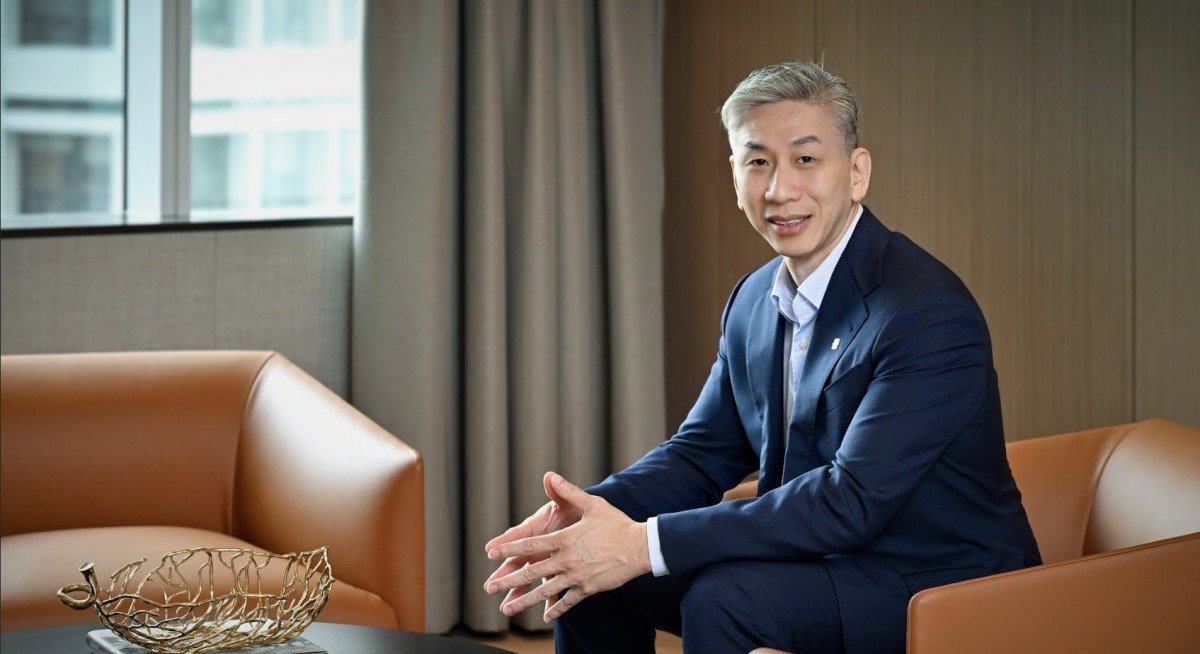


Just before Leong became CFO, US President Donald Trump announced a series of tariffs on trading partners on April 1, 2025. A universal 10% tariff on all imported goods was implemented on April 5, 2025, followed by further tariffs on selected countries. However, the Supreme Court struck down the tariffs on Feb 20.
One of Leong’s first actions as CFO was to implement a pre-emptive “gross allowance to significantly enhance provision coverage” of $615 million, announced on Nov 6, 2025, during UOB’s 3QFY2025 ended Sept 30, 2025 results presentation, which somewhat shocked the market.
“I laid out the facts for the board to look at. There were a few things to put into context. Last year, when I took over in April after the AGM. It was two weeks after Liberation Day. The GDP forecast for every single country was revised down by half. The second thing is that our asset quality issues were indeed creeping up. They were exacerbated in 2Q and 3Q, when prospects for recovery in the US and Greater China looked dismal. Valuations of real estate assets kept recalibrating downwards. There was also the question around buffers that you have in place,” Leong explains.
As he viewed it, this confluence of factors — the tariffs, changing supply chains, and commercial real estate weakness — occurred just as Leong was in his new role and when UOB’s buffers were at the lower end of the range. “If the tariff situation turned out worse than we expected, if we had more asset quality losses and deterioration in US and China [assets], plus asset quality deterioration as a result of tariffs, and if we fell below certain ranges, our investors will not be forgiving,” Leong acknowledges. He emphasises, though, that UOB”s buffers remained well above global standards before the pre-emptive general allowance increase.
See also: Asset-light vs asset-heavy and somewhere in between
“As the new CFO, I was just calling out these facts as they stand. As a steward in the bank, we want to make sure we have a fortress balance sheet that can weather any crisis,” Leong says.
Despite UOB’s conservative coverage and the addition of overlays in 1Q2026, analysts remain circumspect. In a report dated May 28, RHB Research says, “UOB has lagged peers, possibly over a combination of slower earnings momentum and relatively weaker asset quality metrics.”
Leong points out that UOB’s general provisions coverage was raised from 0.8% to 1% and has remained at 1% through 1Q2026. “Our unsecured coverage has actually gone up since then. Our NPA [non-performing asset] coverage has also stayed high at 100% and our NPA formation has come back down. My job is to make sure that we don’t take unnecessary risks and not to be labelled as the guy who came in and decided to kitchen-sink everything,” he adds.
See also: Hongkong Land turns asset-lighter in growth push
The mismatch between analysts and the way UOB is managed arises because group CEO Wee Ee Cheong focuses on the long term. In contrast, analysts assess whether banks’ net profit meets their estimates each quarter.
“A CFO’s role is looking across the entire organisation, looking at all the plumbing behind the scenes and everything that connects the first dollar that comes in through the door to where it exits the bank. It’s a huge eye-opener, but it also gives me a much better feel about how the organisation works,” Leong says.
Customer journey
A bank’s reputation — over and above the various regulatory frameworks and compliance — is its relationship with its customers and employees. The customer journey and employee journey are integral to a bank.
“We need to work through and try to make sure we are optimising the best customer journey as we possibly can so plumbing — technology, operations, processes — is one big family,” Leong says. A customer today expects instantaneous, always-on-demand, 24/7, best-in-class customer service.
“Various banks are designed around optimising customer segmentation. If you are a very high-net-worth individual but don’t need a private bank and want a simple credit card and debit account from a bank, you opt for a mass-market product. It works well most of the time until you decide you need help, call a call centre, or reach out to the bank. As a mass-market customer, your expectation of service may be very different,” Leong cites as an example.
Since the customer journey is closely related to the employee journey, UOB is using AI to improve productivity. During its 1Q2026 results briefing on May 7, Leong had said, “AI for us is not artificial intelligence. It’s actually augmented intelligence. The goal is to support staff, not replace them: the priority is to roll out tools that augment our staff’s capabilities, including productivity, efficiency, customer service and risk management.”
To stay ahead of Singapore and the region’s corporate and economic trends, click here for Latest Section
CEO Wee says, “We are investing in our people, building AI-ready skills and embedding AI across the bank. We have streamlined our processes that cut across the whole region. I also want our staff to be happy and have a work-life balance. As a responsible employer, we ensure our employees have on-the-job exposure.”
Leong, who oversees UOB’s AI push, has segmented UOB employees’ AI journey into AAEPA. The first A stands for assisted, the second for augmented, followed by E for embedded, P for predictive and the final A for automated. “It helps you visualise, when you talk to people, where they are on the AI spectrum.”
Initially, AI is used to assist humans. The second progression is augmentation to help humans make better decisions. “I still have to ask (the AI entity), but the AI offers information that is beyond what you ask,” Leong says.
In the next phase of embedded AI, humans do not need to ask; the extra information is embedded in the day-to-day tools they use. For the last A, AI does it automatically for the user.
“These (customer and employee journeys) are all [part of the] plumbing; I don’t think you can ever be satisfied that you’ve reached the optimal because the yardstick and the comparison keep evolving,” Leong says.
Efficiency frontiers
The other aspect of plumbing concerns the financials, which span balance-sheet optimisation, capital efficiency and risk-weighted asset allocation. Capital efficiency is probably a work in progress for banks, with the right instruments optimised for funding costs, liquidity and risk. How effectively a bank generates net income depends on the risk associated with its assets.
One of the metrics that UOB publishes twice a year is its return on risk-weighted assets (RoRWA). “RoRWA is about allocation of assets. If you deploy assets, are you getting the right returns? It’s about optimising the deployment of your risk-weighted assets, capital and liquidity. There’s a lot of plumbing that goes in there. The phrase I use repeatedly with my team is: We are looking for efficiency frontiers,” Leong says.
As he explains, the concept of an efficiency frontier is not just about guiding to a specific lever, such as RoRWA, return on equity (ROE), or cost-to-income ratio (CIR), because banking is complex, with many interdependencies among capital, asset and liability management.
“The efficiency frontier is trying to find the right mix of different conditions that optimises your DNA. You have a certain structure — maybe it’s your geography, choice of businesses — but there’s a certain mix of businesses, allocation and returns that give you an efficiency frontier. If you adjust certain parameters, you get another efficiency frontier. A different mix will yield a different efficiency frontier. It could be an infinite permutation,” Leong muses.
However, if UOB viewed its business units, geographies and focus areas through the lens of businesses that generate the highest RORWA, it would probably run counter to its own tagline, “Right by you”.
Lending, which is a bank’s core business, soaks up capital because of the different risk weights assigned to different loans and assets that form the denominator in capital adequacy ratio calculations as stipulated by the Basel Accords. However, for a full commercial bank and a domestic systemically important bank (D-SIB), to stop lending to customers and focus solely on fee income is most likely unacceptable.
For instance, during a results briefing, when Wee was asked how UOB’s Indonesian franchise was doing, given that DBS had “de-risked” its customers in the small and medium enterprise (SME) and unsecured consumer businesses, he replied: “We are still growing if you look at the consumers and at mortgages. And in fact, this is a time, especially for the SMEs, when you have to stand by them.”
“If we look at the breakdown of RORWA, which are the business units, which are the countries that are underperforming and focus efforts on the businesses that give you the highest RORWA, we would stop doing mortgages and stop lending money. All you do is charge a fee, because the fee business has, in the extreme case, zero RWA. In practice, that doesn’t work because if you are not lending to me, why would I let you do my investment banking business? Why would I let you do my foreign exchange hedging? Why would I let you drive my wealth if you don’t lend me any money?” Leong points out.
In an echo of CEO Wee’s stance of supporting his SME customers through challenging times, Leong says that without lending, UOB would not be able to be a full-scale, full-service regional bank supporting a customer franchise. “During Covid, if all we cared about was our bottom line and we pulled the lines that we have to SMEs and retreated from certain countries, our claim to having an Asean and connectivity footprint and a customer franchise that stands by our customers and helps them through tough times falls away.”
The highest-quality loans tend to yield the lowest returns, but by making more of them, banks end up with higher-quality assets on their books. “Your chances of default are lower, but then you don’t make enough margin. There are a lot of interdependencies when you’re trying to find the right balance that gives you the optimal performance,” Leong says. “We are discovering where our efficiency frontiers are, and we’ve got to execute through those efficiency frontiers. That’s a big part of what I’m spending my time on.”
Capital adequacy
Interestingly, UOB’s fully loaded common equity tier 1 (CET1) ratio is about 10 basis points (bps) lower than its transitional CET1 ratio of 15.3% as at March 31. Given the new heightened requirements, why has UOB experienced little change between the two? The enhanced Basel III (the finalisation of post-2008 reforms sometimes referred to as Basel III Endgame) and Basel II differ primarily in how banks measure risk and calculate required capital. While Basel II focused on giving banks flexibility to use their own internal formulas, the enhanced Basel III enforces stricter, standardised limits to ensure uniform stability.
The reason was that large banks used complex internal models to calculate risk, which often allowed them to artificially lower their capital requirements by assigning lower risk weights to risky assets, observers have said. The Basel III Endgame introduces a strict “output floor”, mandating that a bank’s calculated RWA using internal models can never fall below 72.5% of the regulator’s standardised approach for risk weights.
Also, in Basel II, banks were allowed to use internal loss data to determine their operational risk. The enhanced Basel III abolishes these models and introduces a uniform Standardised Measurement Approach (SMA) based on a bank’s income and historical losses.
“It shows that we have always been operating on a more stringent level and that’s why you don’t see a huge impact for us. But it also tells you that we were probably not as efficient as we could have been in the past, or it was a choice to be safer and more conservative with these requirements,” Leong says.
Asean and Citi
In 2022, as Asean was still reeling from the impact of Covid, UOB announced it planned to acquire Citigroup’s retail businesses in Malaysia, Thailand, Indonesia and Vietnam for a premium of $913 million. Citigroup’s Consumer Business had an aggregate net asset value of approximately $4.0 billion and a customer base of about 2.4 million as at June 30, 2021. The acquisition price UOB paid translates to 1.2 times book value.
UOB has built on the Citi acquisition, growing its retail customer base to 8.5 million as of 1Q2026 from 5.3 million when the transaction was announced. The Casa penetration of the Citi customer base is 66%. UOB has the highest Casa mix, at 58% of total deposits of $207 billion as at March 31.
“The Asean footprint that we have today was built over a good 70 years in Malaysia and Indonesia, Thailand and Vietnam over 25–30 years. Today, you can’t replicate that anymore, and the regulatory environment doesn’t allow you to. Nobody has a network of the Asean footprint that we have today. What we have today is more local than what the global banks have and none of the local banks in the region are as regional as us,” Leong indicates.
However, the slow pace of Citi’s integration and the resulting increase in earnings have tested the investors’ and analysts’ patience.
The management of UOB is unapologetic. “Over the past three years, our focus has been on integrating the Citi portfolio and bringing everything into a single, unified platform. That work is largely completed and has positioned us as one of the most connected banking franchises in Asean, with strong capabilities across retail, SME and wholesale,” CEO Wee says.
Leong points out that it was vital for UOB to make the acquisition. For one thing, a franchise in which the sector and geographies align with UOB’s ambition is uncommon. Secondly, a crisis such as Covid is rare that “allows you to negotiate price, but also to stress test the portfolio at the same time”, Leong points out.
“What people didn’t appreciate is that before that transaction, we had a certain road map and investment plans to build up our business. Because Citi’s technology platform and the products and services it offered to its customers were more sophisticated than ours at the time, we had to forgo many of our own plans and accelerate the specific build to ensure we didn’t lose that customer base. We moved all the resources to bring our tech stack and services closer to matching the experience Citi customers had. Retention was a super high priority for us. Some attrition happened. But ultimately, that customer base has grown,” he elaborates.
In addition to the 66% current account savings account (casa) penetration, card billings are growing at 6–7% y-o-y. The second phase looks at the customer base and the entire continuum of activities. “We want multiple wallets from the same customer. We have the opportunity to offer the customer a variety of products, and the effort versus reward ratio improves significantly,” Leong reasons.
“We are moving into the next phase now, unlocking the value of our enlarged customer base to reshape the group towards a more diversified, fee-driven mix anchored on connectivity, trade and cash management, along with lifestyle solutions like credit cards and wealth,” CEO Wee confirms during the May 7 results briefing.
Non-flashy, capital-light
On the wholesale front, Leong says it’s a deliberate strategy to beef up trade. After all, trade loans indicate cross-border trade activity. They are high velocity, as trade loans tend to be short-term and self-liquidating despite their low margins. Within a year, a bank can extend multiple trade loans. The bank will also have access to its customers’ supply chains and, eventually, to bank entities along those chains.
“Trade invariably entails cross-border and lends well to a bank that has a regional platform; it lends well to doing the FX component of a trade loan; you can serve them in the region; you might as well do interest rate hedging for them; they might give us their operating account, which explains why our wholesale bank Casa ratio is the highest. We can offer that connectivity,” Leong explains.
Trade, volatility in supply and value chains, and hedging around forex and interest rates also lend themselves to banks’ Treasury & Markets business. UOB’s Global Markets division recorded a 39% q-o-q and 19% y-o-y gain in total treasury income to $658 million in 1Q2026. Of this, non-customer treasury income rose 70% q-o-q and 28% y-o-y to $364 million.
“The green shoots, building treasury, trade, the wholesale cross-selling that we have planted are starting to flower,” Leong says. These businesses, which are the building blocks of a commercial bank, aren’t captured in headline numbers. Analysts and the media are focused on wealth, a more glamorous business.
The RHB report says it has tweaked its FY2026 to FY2028 net profit estimates for DBS and OCBC by 2% and 2.4% per annum, respectively, driven by upward revisions to non-interest income following a robust start to the year, reflecting their wealth management contributions.
Leong says UOB’s private bank has seen an “import of talent” from hires from different banks. “Culture is an important consideration for us, whether they are the right fit for our philosophy and how our CEO wants to drive this business.” The issue with private banks is that, although they operate a capital-light business, their balance sheets must be ready to lend, and their cost-to-income ratio (CIR) tends to be above 60%, compared with UOB’s 44%.
UOB’s portion of invested assets under management (AUM) is about 42% in 1Q2026, up from 40% a year ago. “The fact that we are 42% reflects also a more wealth-preservation conservative stance that we’ve always adopted, but that means giving up on product churning and full-scale profitability on the wealth management platform. Apparently, that’s not what investors want, but that’s what we think our customers want. I would say the wealth platform of UOB has a lot of potential,” Leong says.
CEO Wee says UOB plans to double its wealth management income by 2030, using 2025 as a baseline. In 1Q2026, wealth income was around $342 million, up 6% y-o-y. “The relationship managers and infrastructure are ready. We are focusing on the one-bank approach, in which the wholesale and retail banks work together to generate [more income]. We are also strong at foreign direct investment,” Wee says, referring to UOB’s FDI Advisory, which is used to attract wealth and investment flows into and within Asean.
“What we’re doing now is to make sure the infrastructure is ready from a user-friendly standpoint and also to protect the customer. I don’t want a short-term outlook because if customers aren’t happy, they will leave for another bank. The AUM is from our customer base. We are conservative. We want to protect our customers. You can’t just ask them to take their money [and invest in products] given the current environment’s uncertainty. I would rather they be safe and we earn less fees,” Wee says. Market observers have noted that UOB’s approach is significantly different from DBS’s, which is more aggressive in leveraging wealth-related fee income.
As such, analysts remain lukewarm towards UOB. According to Bloomberg’s analyst poll, UOB has garnered 11 holds, one underweight from JPMorgan, and five “buy” recommendations. Nonetheless, the consensus net profit estimate for FY2026 is $5.616 billion as at June 1, up 10.6% y-o-y.
Leong is unfazed by the market’s reception. “It’s not for us to go and beat our chest and tell the whole world how many awards we have won and in what category. That’s not our priority. What we’re focusing on is how we deliver value to our staff; improve the customer journey, the employee journey, improve fraud detection and improve transaction monitoring.”
At this point, Leong sounds a tad like Piyush Gupta, the former CEO of DBS, who introduced the concept of managing through journeys and discussed his bank’s plumbing. In July 2010, he wrote down $1 billion in goodwill associated with the acquisition of Dao Heng Bank in Hong Kong.
“I like to be my own man,” Leong retorts.




