


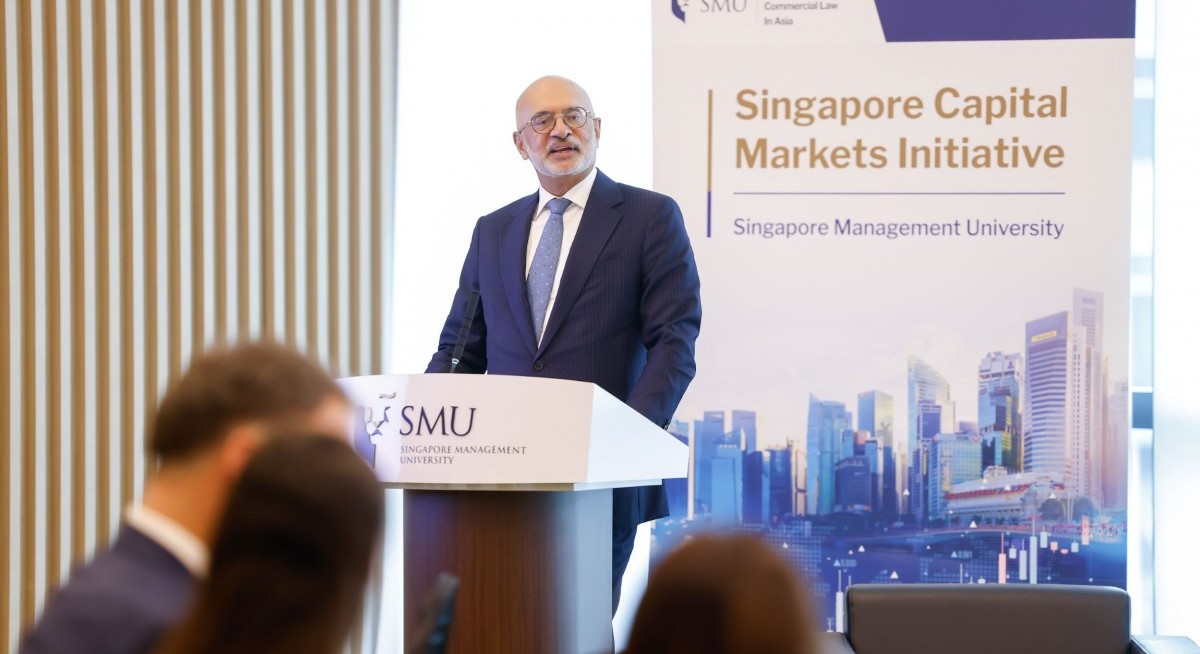


The Singapore Capital Markets Initiative, jointly organised by Singapore Management University (SMU), OECD and ECGI emphasised the critical role of capital markets in fostering innovation, entrepreneurship, and economic growth.
The OECD's Asian Capital Markets Report 2026, launched at the conference held on July 7, underscored the need for institutional investor participation, which is currently only 21% in Asia compared to 47% globally. The discussion also stressed the importance of technology in enhancing market efficiency and resilience, and the need for collaborative efforts to achieve these goals. The Initiative will advance research, policy dialogue and talent development at the intersection of law and finance, with a particular focus on Singapore and Asia.
In his opening address to the conference, Piyush Gupta, chairman of SMU and Keppel and former group CEO of DBS, highlighted the important role that capital markets played in mobilising savings and channeling them towards productive investment. “They connect savers with entrepreneurs, investors with innovators, and capital with opportunity. By doing so, they enable companies to pursue value-creating projects that generate jobs, wealth, and long-term economic growth.”
He adds that capital markets are also engines of innovation, which requires long-term, patient, and risk-tolerant capital. “The companies that develop breakthrough technologies, invest heavily in research and development, and transform industries often possess brilliant ideas long before they possess collateral or stable cash flows. Equity markets provide exactly the type of financing these firms need,” Gupta says.
Capital markets aid businesses by investing in technology, R&D, human capital, and new business models. As such, capital markets support entrepreneurship and help innovative firms grow from promising start-ups into globally competitive enterprises.
According to OECD's Asia Capital Markets Report 2026 Asia is now home to 56% of the world's listed companies and 52% of global venture capital activity.
See also: Strengthening Singapore’s capital markets: A practitioner’s vision for a global equity hub
Singapore has established itself as one of the world's premier financial centres, and its stock market has recently become Southeast Asia's largest by market capitalisation, reinforcing its role as a gateway for global capital into the region.
Following the recommendations of the Equities Market Review Group, the Monetary Authority of Singapore and the Financial Sector Development Fund launched a $5 billion Equity Market Development Programme (EQDP) which was upsized to $6.5 billion. The commitment is expected to draw in additional private capital of around $13 billion over time.
Public market activity has responded in step. Initial public offerings (IPOs) raised over $2 billion in 2025, with net institutional inflows recorded for nine consecutive months following the first set of measures, and turnover in small and mid-cap companies rising sharply.
See also: Oiltek-inspired interest in Koh Brothers persists
However, the OECD Asia Capital Markets Report 2026 points out that Institutional investor participation in Asia is limited, and accounts for only 21% of market capitalisation compared with 47% globally. Institutional investor participation remains underdeveloped in several jurisdictions, limiting the pool of long-term capital that can support market depth, liquidity, stewardship, and sustainable value creation.
To Gupta, this represents untapped potential. “To realise this potential, we need to strengthen institutional investor bases and find new ways to mobilise household savings towards productive investment. We need to encourage broader participation by retail investors while maintaining the highest standards of investor protection and market integrity. The future of economic growth will depend increasingly on our ability to finance innovation. The future of innovation will depend increasingly on our ability to allocate capital effectively. And the future of capital markets will depend increasingly on our ability to build confidence, strengthen trust, and create institutions that are resilient, inclusive, and forward-looking.”




