


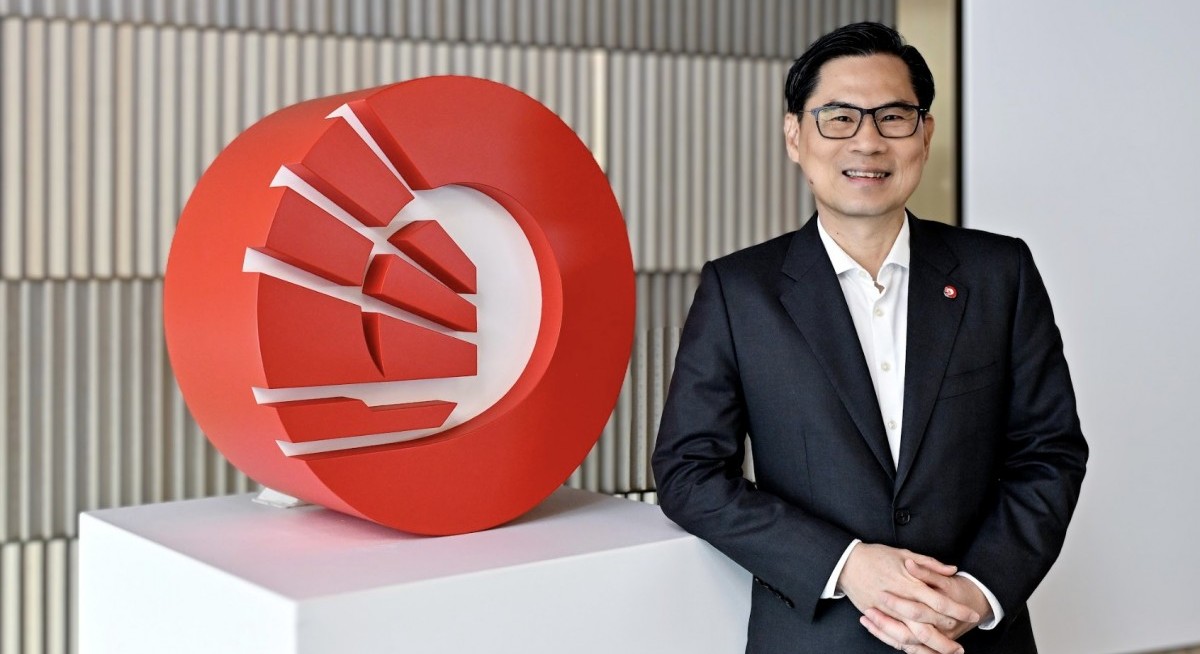


As part of the transition over the last six months, Tan, who has been head of global wholesale banking since joining the bank in March 2022, also assumed the additional role of deputy CEO on July 11, 2025, the day the announcement was made.
Now, officially at the helm, a more noticeable change is Tan’s pivot to Asean, his preference for dividends and special dividends over share buybacks and the expansion of the capital-light, fee-based part of financial services, which could help push return on equity (ROE) towards the mid-teens. Tan has also closed the chapter on Great Eastern (GE) Holdings: “We will not be looking at acquiring more GE shares in the foreseeable future,” Tan said at his first full-year results briefing for FY2025 ended Dec 31, 2025.
OCBC ended FY2025 with an ROE of 12.2%, down 1.1 percentage points y-o-y. FY2025’s net profit was down 2% y-o-y to $7.422 billion, while 4QFY2025’s net profit rose 3% y-o-y to $1.745 billion, but was down 12% q-o-q.
In a new corporate strategy dubbed The Next Frontier, OCBC has identified four “shifts”: Tech shift, Net-zero shift, Asia shift and Franchise shift. The new strategy is an expansion of the group’s focus on banking, wealth and insurance.
See also: ECB asks banks for plans to address AI cybersecurity threats
“We identified five major trends as we grouped our thoughts into four strategic shifts to ride these major trends, with ADD at the centre,” says Tan, where ADD stands for AI, digital and data.

Pivot to Asean
See also: MAS issues consultation paper for new protected cell company corporate structure
As part of its Asia shift strategy, OCBC plans to capture more Asean-Greater China flows by leveraging its “One-Asean” regional network. Here, rising Asian wealth flows are captured through the twin wealth hubs of Singapore and Hong Kong.
The Asean pivot was a trifle surprising, given the focus on North Asia, first, with the acquisition of Wing Hang Bank in Hong Kong in 2015, and the Greater Bay Area strategy articulated in 2023. The focus on Asean is part of OCBC’s Franchise shift and Asia shift.
“Asean is a good place to be in. We see a rising Asia, with rising intra-Asia trade, investments and wealth flows. Asean is projected to become the fourth-largest global economy as a block by 2030. We are very fortunate that these are our core markets, Malaysia, Indonesia and Singapore, which account for 60% of the GDP of Asean. If we include our branches in Vietnam and Thailand, we can cover 85% of the GDP in Asean,” Tan describes.
He plans to use the Tech shift to work on digital solutioning in markets such as Vietnam and Thailand, where OCBC has a limited presence, to enable OCBC to provide a One Asean value proposition to its customers.
In the pivot to Asean, Tan highlights OCBC’s potential in Malaysia. Under its Asean Domestic Market strategy, OCBC plans to tap GE’s Malaysian customer base to expand its own customer base and its product range. “You may not be totally aware, the customer base of GE in Malaysia is almost the size of half of Singapore’s population. So the bank and GE in Malaysia can work together to deliver value propositions to the customer base,” he says.
The Johor-Singapore Special Economic Zone is another opportunity. “We’ve already financed more than RM15 billion [$4.88 billion] worth of projects in Johor. We have four branches in Johor Bahru to serve our customers,” Tan adds. For instance, the RM164 billion in committed investment in data centres in Johor cited by InvestJohor is likely a factor in the ringgit’s strength versus the Singapore dollar. In addition, Malaysia’s FY2025 and 4Q2025 GDP growth exceeded expectations.
In Indonesia, OCBC plans to embark on a “phygital” (physical+digital) journey. “Although we have more than 200 branches in Indonesia, we don’t think it is sufficient cover the marketplace. We aim to extend our OCBC Indonesia services to the wealth customers, to move them to the higher end of the wealth spectrum as part of our whole wealth strategy to help OCBC Indonesia differentiate its value proposition as it moves up to the higher end of the wealth spectrum,” Tan elaborates.
To stay ahead of Singapore and the region’s corporate and economic trends, click here for Latest Section
Singapore and Hong Kong as hubs
Singapore is OCBC’s home market. Greater China is the largest market in terms of presence, assets, and earnings; it provides the second-largest contributions. Within Greater China, by loans, Hong Kong is the largest, followed by “offshore”, with onshore mainland China accounting for 2% of total loans.
The wealth hubs of Singapore and Hong Kong will be used to deliver a “Whole of Wealth” (WoW) solution across banking, wealth and insurance. There are also plans to grow the affluent segment in Hong Kong and scale up the “Global Markets” segment there.
“Hong Kong remains important to us. Hong Kong is a gateway city for Greater China flows, and that positioning has not changed,” Tan adds. “We want to grow the affluent segment in Hong Kong. Last year, OCBC Premier Banking in Hong Kong grew 70% y-o-y, as Hong Kong is a financial hub. We also want to scale up our global market business in Hong Kong. On BAU (business as usual), we managed to keep growing, albeit at a slower pace than the rest of the franchise. But we also managed to grow our loan franchise in Hong Kong; we grew our fee franchise across the wholesale bank and the wealth business. Our fee growth in Greater China, in global markets, is also in double digits,” Tan says.
When Tan and his team crafted The Next Frontier strategy, the initial main focus was to leverage the group’s deep insights in Asean and Greater China to capture new opportunities in the Asia shift and Franchise shift (see chart on Page 8). “Given the challenges in the marketplace, we want to leverage these insights to capture new opportunities,” he says.
Going deep in Asean, including its domestic markets, and crystallising the twin financial hubs of Singapore and Hong Kong to facilitate trade, investment and wealth flows is not a new strategy. Former group CEO Samuel Tsien articulated the “flow business”, followed by Wong, who built on it with the One Group strategy.
The second part of The Next Frontier builds on the flow business with Tech shift, combining OCBC’s physical presence in markets such as Indonesia with a boost to the bank’s digital presence.
Capital for growth
As described by Tan, The Next Frontier strategy appears to focus on capital-light growth. A lot of the new strategy is to link different parts of the group — banking, wealth and insurance — to cross-sell. For instance, in 2026, Tan is aiming for double-digit growth in non-interest income. In FY2025, OCBC recorded 22% growth in fee income to $2.41 billion. “Our wealth management fees surged 33% y-o-y to a new high of $1.23 billion, and contributed to more than half of our group fee income,” notes group CFO Goh Chin Yee.
Tan is reluctant to provide an ROE forecast. “We are at the early stage of implementing the new corporate strategy. I think we are not ready to share the ROE, but directionally, we have planned for it to be an uplifting ROE.”
When asked about OCBC’s excess capital, Tan says The Next Frontier is focused on growth. “We need the capital to support the growth. The loan book remains important, and we have a couple of businesses focused on it, such as financing tech and sustainability. And we intend to continue to grow as much as we can,” Tan says.
“We will use our insights to capture opportunities, but the world is in a challenging environment. The trade tariff levied by the US is also very uncertain; nobody knows how it will turn out. Given this climate, we want to hedge the downside by maintaining a strong capital position. When the downturn happens, we also want to take the opportunity to acquire where it fits our corporate strategy,” Tan describes, adding he is open to considering inorganic opportunities in Asean.
On capital management, Tan says he prefers special dividends to share buybacks (see story on Page 9). “We have long-term shareholders. A special dividend actually rewards our shareholders,” he says, referring to the banking group’s decades-long wealthy shareholder base, including OCBC’s major shareholders. For ordinary dividends, OCBC will stay with a 50% payout ratio.
“For future dividends, it’s still a 50% dividend payout policy, but with a growth strategy, it can translate to higher dividends, even though it’s a 50% dividend payout policy,” Tan says.
In an update, JPMorgan says “the key miss/disappointment was in capital return, and guidance thereof, which was the key reason for our downgrade last in January. Dividend per share (DPS) of 99 cents for the year versus $1.01 in 2024 underscored the point that management is willing to let DPS fluctuate with earnings per share”.
Retaining its neutral rating on OCBC with an overweight on DBS Group Holdings, JPMorgan adds: “Hence, we expect the Street to reduce estimates post these results. The stock is up 26% since the end of October 2025, versus 13% for the Straits Times Index. A combination of DPS decline and likely negative revisions may lead to a partial reversal of some of the performance. The underlying trends at the bank remain good, hence we see a shallow bottom.”
Meanwhile, Maybank Securities has downgraded OCBC to hold because capital return expectations are resetting, amid a decline in yields. “The Next Frontier strategy tilts toward growth over payouts; capital is being retained despite a capital-light narrative by management,” Maybank says.
Macquarie, on the other hand, likes the pivot to Asean and growth. Hence, it is increasing earnings per share estimates for FY2026 and FY2027, forecasting an EPS of $1.76 for this year with DPS of $1.09, and an EPS of $1.81 for 2027. “OCBC delivered the best result amongst peers for 4QFY2025, led by solid revenue generation and contained asset quality trends,” says Macquarie, lifting its price target to $23.82.




