


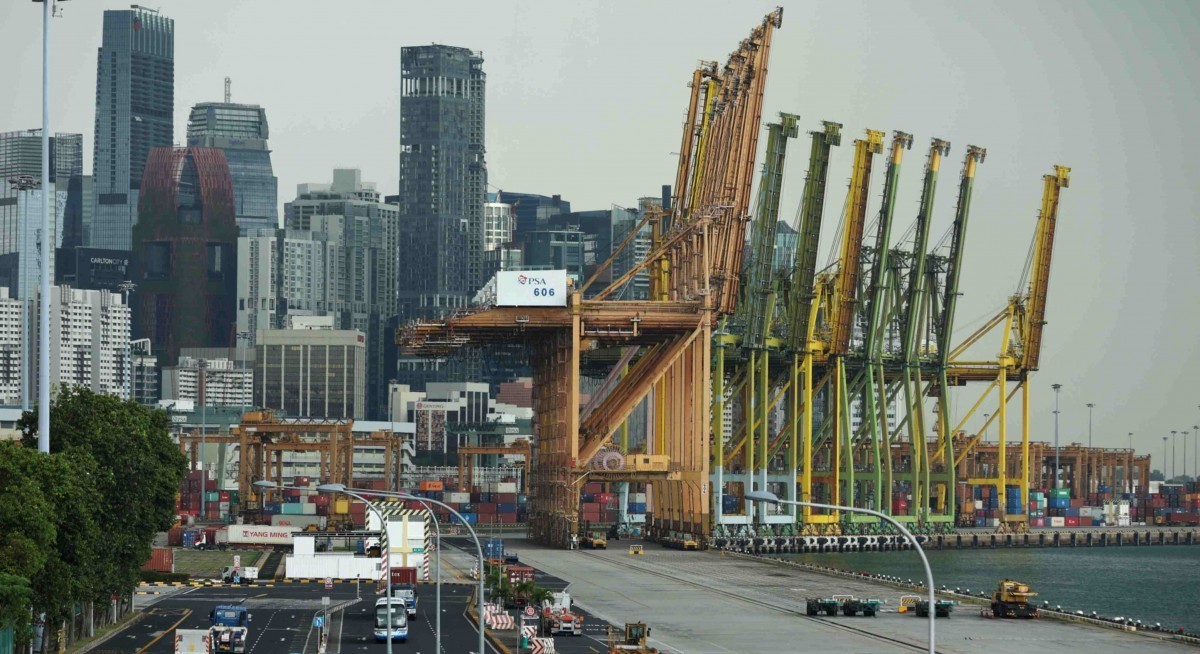


Singapore has unveiled a new maritime technology roadmap, committing more than $100 million to research and development (R&D) over the next five years as the city-state pushes to keep its port ecosystem ahead of mounting challenges to global trade.
The announcements came at the 20th edition of Singapore Maritime Week, where Acting Minister for Transport Jeffrey Siow warned that the open maritime order underpinning global commerce is under growing strain. Cyber threats are outpacing industry defences, and AI is "advancing faster than the industry is adopting it". Meanwhile, the shift to alternative fuels is being held back by fragmented technology, bunkering infrastructure and regulatory frameworks, he says.
Against that backdrop, the Maritime and Port Authority of Singapore (MPA) and the Singapore Maritime Institute launched the 2026 edition of the Singapore Maritime Technology and Research Roadmap, the first update since 2019.
The new roadmap will focus on four areas: autonomous port operations, safe and efficient delivery of alternative energy, smart ships and intelligent port services. Unlike earlier iterations that set broad priorities, the new roadmap is designed to close the gap between laboratory research and live deployment, with industry partners expected to co-develop and pilot solutions alongside research institutions.
The latest funding commitment builds on more than $500 million already invested in maritime R&D over the past two decades. It reflects a shift in how competitiveness in shipping is defined, with software, data and digital capabilities becoming as critical as physical port infrastructure.
Digital infrastructure
See also: Men with a vision
That shift is already taking shape with the launch of OCEANS-X, a data and API (application programming interface) exchange platform that allows shipping companies, port agents and government agencies to connect their internal systems directly to port infrastructure.
Instead of filing documents through web portals, companies can use the platform to automatically transmit data into MPA's systems for port clearance applications, certificate verification, and vessel tracking. With more than 100 APIs and datasets available, OCEANS-X is also open to start-ups and industry players looking to build analytics and AI-driven applications.
In practice, this moves port operations towards machine-to-machine communication. Tasks such as berth scheduling, arrival declarations and clearance documentation can be handled automatically, reducing manual intervention and processing time. The platform is also being used to support electronic exchange of ship certificates with partner ports under Singapore’s Green and Digital Shipping Corridors, cutting reliance on paper-based checks that continue to slow cross-border port clearance.
See also: Marco Polo Marine to spin off shipyards via $139 mil RTO deal with Fuji Offset Plates Manufacturing
AI adoption
Besides that, MPA has signed a memorandum of understanding with the Singapore Shipping Association (SSA) to help companies across ship agency, ship management and chartering, shipping operations and bunkering adopt AI tools.
Twenty-one companies have started initial training runs, with a broader rollout planned for later this year. Firms will be able to benchmark their readiness using AI Singapore's AI Readiness Index, a maturity assessment tool developed from hundreds of company engagements across sectors.
"AI will increasingly shape how maritime operations are planned and executed. Companies that are able to apply AI effectively, whether in improving vessel performance, optimising port operations or enhancing decision-making, will be better positioned to operate efficiently and remain competitive," says Ang Wee Keong, chief executive of MPA.
SSA president TS Teo was more direct about the competitive stakes. "AI is reshaping industries, and our maritime sector must move decisively to forge ahead. By equipping companies and their workforce with the required knowledge, the right tools and the relevant capabilities, we strengthen the competitiveness of Maritime Singapore."
Workforce and training
To ensure the workforce is equipped with the right skills, Singapore Polytechnic (SP) formalised six industry and academic partnerships at the event, spanning cybersecurity training, decarbonisation and talent development. Among them is a collaboration with the Singapore University of Technology and Design's iTrust centre to launch the Advanced Maritime Cybersecurity for Shipboard Operations course, equipping seafarers to identify and respond to threats targeting critical shipboard systems.
Other initiatives include training programmes for electric harbour craft developed with the Singapore Institute of Technology, Pyxis and Sea Forrest, as well as a partnership with VOC Port India to extend training in LNG, methanol and ammonia bunkering.
"The industry is navigating a complex and rapidly evolving landscape across areas such as cybersecurity, decarbonisation, digitalisation and talent development. SP is working to ensure that the capabilities being built today are relevant, connected, and durable enough to serve the sector well into the future,” says Tan Yen Yen, deputy principal for development at Singapore Polytechnic.




