


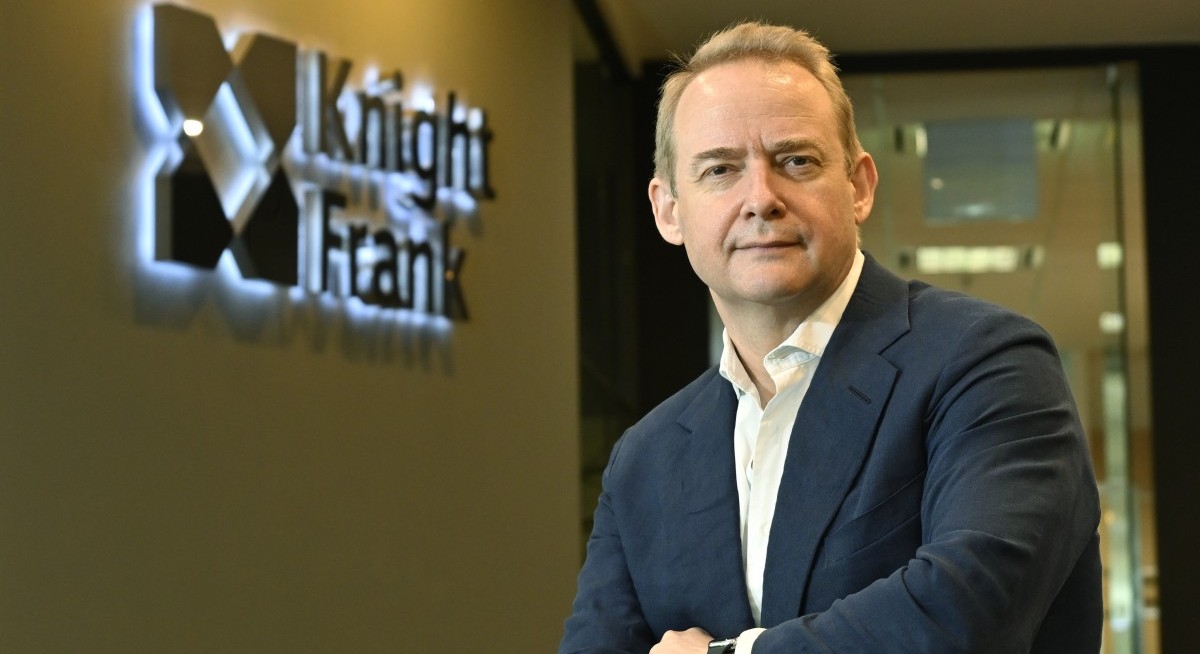


“As soon as the war happened, we had to make tweaks and adjustments to some of the content, but fundamentally, it’s obviously a massive new shock to the global economy, and we still don’t know the long-term ramifications,” says Bailey to City & Country on a recent trip to Singapore. “We can kind of guess that it’s obviously going to have a big impact in terms of energy costs [and] inflation down the road. It’s yet another dislocation in the global economy.”

That said, Bailey does not think the Mideast war is a “radical departure” from the state of the world prior to February. “It’s a big event, but it’s a big event after a series of similar challenges to the global economy… It speaks to the fractured political [and] economic world that developers and investors are operating in.”
Based in London, Bailey has been overseeing Knight Frank’s wealth report since its inception in 2007. In his foreword for the latest edition, released on April 23, he says investors today face a more fractured and complex world than at any point since the publication of the inaugural edition.
See also: World’s rich pocket US$1 bil with big sales of surging stocks
“The commentary around the dislocated, fractured world wasn’t just in relation to this conflict; I think the emergence of two poles between the US and China, that issue is playing out at the moment,” he adds. “I think the way that the US is shifting in terms of foreign policies, its changing relationship with Europe — I think it’s a much more uncertain, unstable environment that we’re in now.
“To be fair, if you go back to the last 10 years, there’s been shock after shock,” says Bailey, “but the pace of those shocks and the potential implications — they’re just getting bigger and bigger.”
Where’s the money?
See also: Four in 10 wealthy Asian boomers lack succession plans, survey shows
Where is the money, where is it being created, where is it moving to and what is the impact of money on property? Knight Frank’s wealth report was founded to answer these four questions, says Bailey.
That annual undertaking has grown over two decades to this year’s 43-page document, complete with sidebars on luxury spending, the world’s shopping districts, art collections and yacht fleets.
“We’re not here to champion wealth or to kind of celebrate wealth; it’s more a question of: ‘There is a phenomenon of private wealth, and it is a growing phenomenon in the global economy. It has a big impact on markets, particularly property markets.’” says Bailey. “What we’re trying to understand is: ‘What does that impact mean in terms of demand and money flows?’”
In order to piece together global fund flows, Knight Frank looks at “disparate” data such as wealth size, the number of wealthy in each country and the prices of their most-sought-after residential property.
The world added 162,000 ultra-high-net-worth individuals (UHNWI) between 2021 and 2026 — the equivalent of 89 new UHNWIs every single day, according to Knight Frank. These well-heeled individuals each have a net worth of US$30 million ($38.19 million) or more.
Of the world’s 3,110 billionaires, Asia Pacific hosts the largest share, at 1,116 billionaires, ahead of North America’s 965. Nearly 31% of that global UHNWI population now sits in this region.

China is “doing a lot of things right” in terms of nurturing wealth creation but the US “has just proved itself to be a machine for wealth creation”, says Bailey. “The American environment just seems to be supercharged compared to any other country in terms of its ability to leverage wealth creation.”
He adds: “The three biggest billionaire populations — the US, China, India — you’ve just got massive internal markets. In all those cases, the ability to create a business and scale it domestically before you go global is just a massive advantage.”
Although India is a “massive player” in terms of billionaire wealth, it is less prominent in the UHNWI space, says Bailey. “There has been big growth, but it’s actually not as dominant at that level yet… But it’s kind of pointing to where India will go in the longer term.”
Closer to home, Singapore’s UHNWI population rose from 4,642 in 2021 to 7,171 in 2026, up 55%. This group is forecast to reach 10,495 in 2031, according to Knight Frank, or a 46% increase between now and then.

The number of billionaires in Singapore rose from 28 in 2021 to 63 in 2026, and Knight Frank forecasts that this elite group will swell further to 85 members in 2031.
Global UHNWI growth over the next five years will “not be led by the usual suspects”, says Knight Frank, but by the “rapidly maturing economies” of Indonesia (whose UHNWI count is projected to grow 82% between 2026 and 2031), Saudi Arabia (63%) and Poland (63%). Placing fourth is Vietnam, whose projected 59% rise in UHNWI numbers over the next five years reflects how new centres of wealth are forming across Southeast Asia, adds Knight Frank.

The world’s priciest homes
Knight Frank’s proprietary Prime International Residential Index (Piri) recorded a 3.2% average rise in global luxury residential prices in 2025, slightly below the 3.6% increase recorded in the previous year.
“The Piri gives us a view on how markets are performing over a period of time; it’s a snapshot of a year,” says Bailey.
Of the 100 markets tracked by Piri, 73 saw prices increase while 24 experienced declines.
The Piri 100 tracks movements in luxury prices across the world’s top residential markets. The index, compiled using data from Knight Frank’s research teams around the world, covers major financial centres, gateway cities and second-home hotspots — both coastal and rural — as well as leading luxury alpine resorts.
Tokyo’s new-build apartment market — boosted by scarcity, low interest rates and strong inward demand from the Asia Pacific — posted a 58.5% spike in price changes over 12 months, far outpacing podium finishers Dubai (25.1%) and Manila (17.5%).

The Tokyo story is “fascinating”, says Bailey. “We’re tracking new-build apartments in Tokyo; it’s a specific market [that’s] in quite short supply at the moment, the ends being weak. It just shows that the growth of Asian wealth is having a big impact on Tokyo. A lot of inward investment has led to prices rising.”
Conversely, Guangzhou placed last on the Piri 100, posting a 12.2% decline in prime home prices over 12 months. Also in the bottom are Toronto (-7.8%), Shenzhen (-7.2%) and Vancouver (-7%).
Beijing (-4.9%) and Hong Kong (-2.1%) also posted 12-month price declines, as “the Greater Chinese mainland regions remain challenging”, says Knight Frank.
Singapore: 13th in prime home prices
Singapore ranked 13th on the Piri 100 in 2025, with a 7.9% rise in prime residential prices. “Singapore is a market that’s massively interesting to global buyers,” says Bailey, “but the stamp duty just makes it — it doesn’t work for most people.”
Foreigners cannot purchase Housing & Development Board (HDB) flats in Singapore. Foreigners buying any private residential property here are subject to 60% additional buyer’s stamp duty (ABSD), up from 30% prior to a round of property cooling measures introduced on April 27, 2023.
“Domestically, you’ve got an unusual marketplace, because for most people, you don’t need to go into the private market, do you? I think Singapore has just got an unusual structure to the market, and that’s maybe why it’s not following the same kind of trajectory [as other markets],” says Bailey.
The more uncertain the world gets, the more attractive Singapore seems to be, says Leonard Tay, Knight Frank Singapore’s head of research.
Speaking at a separate media briefing for the launch of the wealth report, Tay says Singapore “has not been doing well” in the Piri since the outbreak of the pandemic. “We were in 59th place in the year of the pandemic, then we’ve always been above 50th position [since]. In the last two years, we were 49th and 47th. But now, we are in 13th position. So, our prime market only woke up last year, in 2025.”
Knight Frank’s definition of prime, luxury residential property refers to a subset of Singapore’s Core Central Region (CCR), according to Tay.
This includes Districts 1 (Marina Bay, Raffles Place, Boat Quay), 4 (HarbourFront, Telok Blangah, Keppel Bay, Sentosa Island), 9 (Orchard, Somerset, River Valley), 10 (Tanglin, Holland, Bukit Timah) and 11 (Newton, Novena, Thomson, Watten Estate).
Projects must also have “qualifying attributes”, adds Tay. This explains the disparity between Knight Frank’s 7.9% rise in “prime residential prices” and Urban Redevelopment Authority (URA) data.
Non-landed private residential property prices in the CCR rose 1.9% y-o-y for the whole of 2025, moderating from a 4.5% y-o-y increase in 2024. This year, non-landed private residential property prices in the CCR rose 0.6% q-o-q in 1Q2026, following a 3.5% q-o-q fall in 4Q2025, according to URA data released on April 24.
“Before [2025], it was very quiet,” says Tay of CCR price growth. “Regardless of what you read in the headlines every day, all the action was taking place in the fringe and suburban areas, and it was Singaporeans driving it. Yes, ABSD on foreigners is still 60%, but now, the CCR is starting to move — mostly still by Singaporeans, or maybe, in some fashion, contributed by new citizens.”
Prime locations pricier
Spending power also fell “sharply” in many prime locations, according to Knight Frank, with the steepest contractions in Dubai (-66%), Tokyo (-41%), Miami (-40%) and Los Angeles (-28%), reflecting intense prime market appreciation.
The Piri tracker, which calculates how much prime residential space US$1 million can purchase in major cities around the world, places Singapore’s premier homes as the third-most expensive in the world, tied with Geneva.
According to Knight Frank, US$1 million can purchase an average of 28 sqm of prime residential space in Singapore as of 4Q2025, down from 36 sqm back in 4Q2020.

The only major cities with pricier prime homes are Hong Kong (US$1 million can purchase 23 sqm in 4Q2025) and Monaco (16 sqm).
Galven Tan, CEO of Knight Frank Singapore, says Singapore sits at the crossroads of Southeast Asia, China, India and Australia. “Singapore offers the wealthy proximity to opportunity with mitigated exposure to jurisdictional risk, and investment teams can access the growth markets of Indonesia, Vietnam and India while holding assets, structures and governance in a neutral, internationally trusted base.”
AI’s impact on wealth
Knight Frank’s wealth model, which it references for its UHNWI and billionaire projections, “takes a reading” from the wealthy’s equity portfolios, says Bailey. This is one metric alongside household wealth, GDP growth and others.
Could this reading be inaccurate — just paper gains — given how US equities have run up over the past year?
“You’re right, there is a degree of volatility there. Because asset prices have just ballooned kind of everywhere, particularly in the financial sector, so there is a risk to the numbers,” says Bailey.

For Knight Frank’s next wealth report, Bailey’s team will “do more work on the implications of AI”. “Is there increasing evidence of AI adoption and usage actually impacting wealth creation or narrowing the concentration of wealth? I think we will be looking into that… AI is leading to significant creation of high company valuations, which on paper seems to lead to some big wealth creation moments.”
He adds: “The question is: ‘Well, that may be good for that group of people, but actually, what’s the benefit for the rest of the economy?’”
The other story is taxation and government reaction, he adds. “If you have this process of wealth outperformance that we’ve talked about in the report — what [New York City mayor Zohran] Mandani has just done in New York, and in Los Angeles, you’ve got billionaire taxes now on the ballot — these things happen as a kind of reaction, I suppose, to the story of wealth creation… It’s not a linear process; there’s always a counterpoint to the wealth story. That is probably likely to get more supercharged over the next 12 months.”
Included in the latest report is a two-pager on plutonomy — the economic model in which the wealthy command a disproportionate and growing share of global wealth. That idea was on the agenda in a 2007 meeting between Knight Frank and Citi Private Bank, and the inaugural Wealth Report was reportedly borne out of a need to study the emerging phenomenon.
David Poole, former head of Citi Private Bank, the UK and Ireland, says the compounding nature of elite wealth has become “politically charged”. As the top tier captures an ever-larger share of the market, the legitimacy of the system is increasingly questioned. “That line can’t keep going,” he warns, noting that extreme inequality ultimately breeds “a backlash”.
Photos: Albert Chua/The Edge Singapore
Infographics: Knight Frank
For more property trends and breaking news, visit City & Country’s microsite at theedgesingapore.com/cityandcountry




