


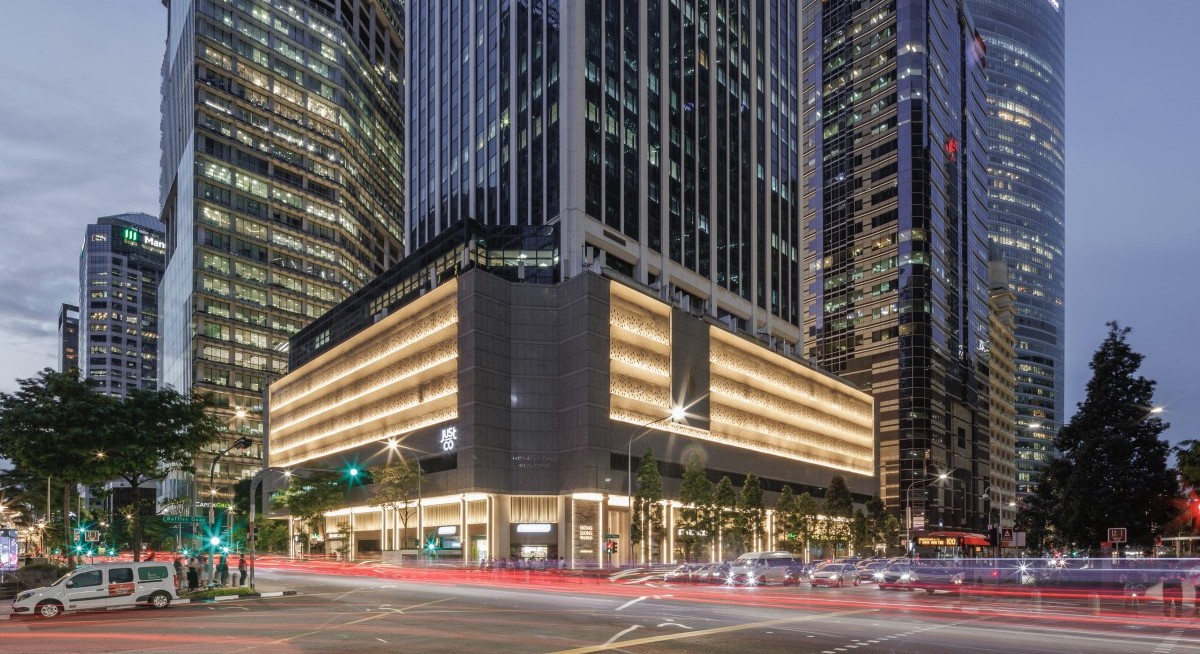


But one building in Singapore’s Central Business District has stood the test of time and continues to stand today — Hong Leong Building. Designed by Singaporean architectural and design firm Swan & Maclaren and completed in 1976, the tower at 16 Raffles Quay was once home to the Stock Exchange of Singapore before it moved to the Overseas Union Bank Centre (now One Raffles Place) in July 1988.
In 2025, Singapore-based architecture firm TA.LE completed its refurbishment works for Hong Leong Building. The works, which comprised a year of planning and two years of construction, helped extend the tower’s lifespan by 20 years while retaining 95% of its structure.

Designed by Swan & Maclaren and completed in 1976, Hong Leong Building was once home to the Stock Exchange of Singapore. Photo: TA.LE
See also: UK apartment owners are getting locked out of money-saving green tech
TA.LE co-founder and principal architect Lionel Leow tells City & Country that the project was one of the largest and most complex refurbishment works the firm has done to date.
Previously, TA.LE completed refurbishment and asset enhancement works for properties like City Square Mall on Farrer Road and the Nordic European Centre in the International Business Park. Refurbishing Hong Leong Building, however, was a completely different challenge for TA.LE.
“Hong Leong Building was constructed during Singapore’s formative nation-building years, and it carries cultural and collective significance beyond its physical structure,” Leow says. “Working on a building from this era required a heightened sensitivity to its architectural identity and its place in Singapore’s urban memory.”
In a way, Leow is uniquely suited for the challenge. He earned his bachelor’s degree in architecture from the National University of Singapore before pursuing a master’s degree in the same field at the Delft University of Technology, located in the Netherlands.
“Studying in the Netherlands exposed me to a strong culture of adaptive reuse and sustainability-driven urban thinking,” Leow says. “This philosophy of working with existing structures — rather than against them — is deeply embedded in European practice and continues to inform our design ethos today.”
When it came to refurbishing Hong Leong Building, Leow drew on his experience restoring shophouses. Often, restorative works are less about finding things to change than about practising restraint and precision, he adds. “From shophouses, we learned to work within constraints, such as existing structures, materials, services and regulations, while still achieving meaningful transformation.”
Mixing old with new
Retaining Hong Leong Building’s granite façade was a non-negotiable for the building’s owner Hong Leong Holdings. That was not a limitation for Leow, who says preserving it not only helped to avoid unnecessary material waste but also retained the building’s original character.
That said, Leow was still able to leave his own mark on Hong Leong Building in the form of the decorative metal screen surrounding the building’s multi-storey carpark. “It allowed us to modernise the building’s expression while retaining its passive ventilation strategy.”
The screen helps improve shading and support the building’s visual identity without compromising its airflow or increasing its energy demand, adds Leow. “It is rather common to enclose the carpark, but we embraced its openness instead.”

The decorative metal screen surrounding the multi-storey carpark bolsters the building’s visual identity without limiting its ventilation. Photo: TA.LE

The interior of Hong Leong Building’s multi-storey carpark and vehicle pick-up point. Photo: TA.LE
Intuitively, demolishing and rebuilding the tower seems straightforward and could be cheaper than undertaking delicate refurbishment work. But that is not the case; refurbishing the building actually cut renovation costs by 20% to 30%. Leow says Hong Leong Holdings saved a lot more than just construction costs by opting for refurbishment.
“Refurbished buildings can maintain rental income during works, shorten time-to-market and increasingly appeal to ESG-conscious tenants and investors,” he says. “In valuation terms, a well-executed refurbishment can reposition an asset competitively without the risks and capital outlay of a full redevelopment.”
In the case of Hong Leong Building, construction works were carried out in phases over a two-year period. This meant the building remained operational and tenants could continue to run their businesses while the renovation work was ongoing. This is “economically positive for both the owner and tenants”, says Leow.
That said, financial costs should not be the only consideration on building owners’ minds when deciding whether to rebuild or refurbish their properties. According to Leow, other factors, such as carbon accounting, regulatory timelines, tenant retention, and urban sustainability goals, are just as important in the decision-making process.
“Beyond economics, refurbishment preserves collective memory and enhances the quality of place. These values are difficult to quantify but deeply important in mature cities like Singapore,” Leow says.




