


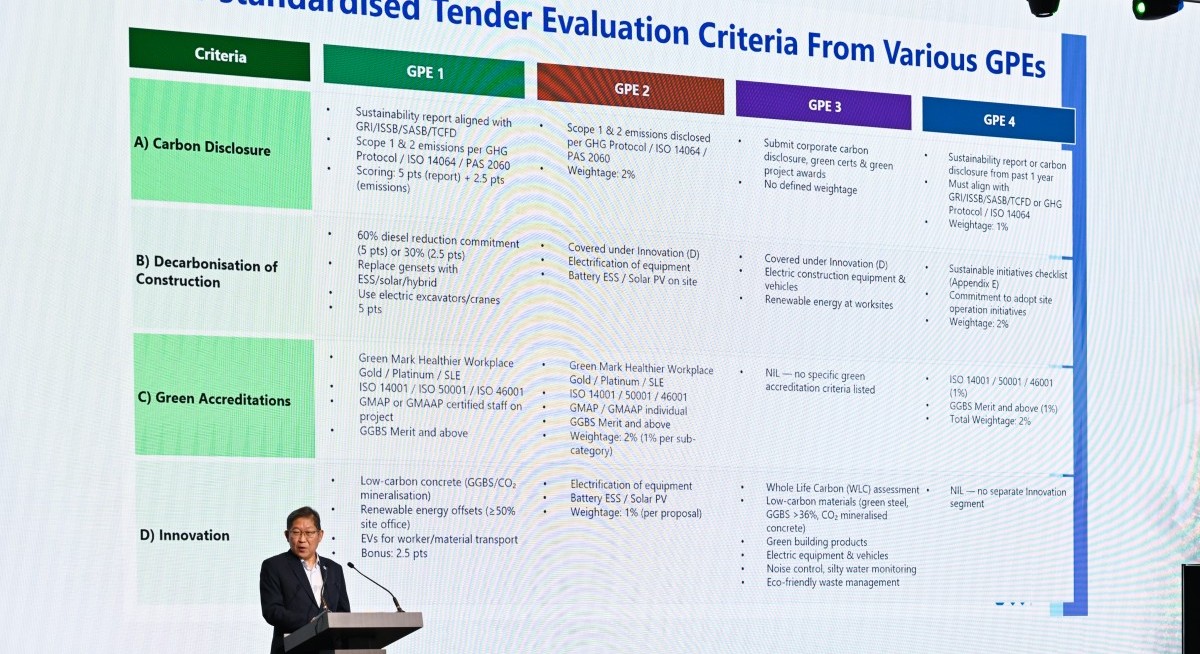


As the global sustainability journey gets going in a big way, various standards and measures are being developed and deployed. While the end goal is roughly similar, there are both overlaps and differences in the metrics. Certain organisations might gravitate to certain sets of standards, while others have their own preferences.
The differences are manifesting in ways that make it challenging for businesses to operate in a changing environment. Singapore’s building contractors, when trying to tender for jobs, are compelled to meet different sustainability requirements even when the nature of the work is largely similar, says Lee Kay Chai, president of the Singapore Contractors Association Limited, or SCAL.
Founded in 1937, SCAL is a not-for-profit organisation representing more than 3,000 construction firms and allied businesses in Singapore. Lee was speaking at The Edge Singapore’s Sustainable Construction Symposium 2026 on April 29, where YTL Cement Group is the event partner.
Business imperative, not compliance exercise
Under the Singapore Green Plan 2030 and the Building and Construction Authority’s (BCA) Green Building Master Plan, clear targets have been drawn. Among the targets: 80% of Singapore’s buildings are to be green by 2030.
With the construction sector contributing about 20% of Singapore’s national carbon emissions, the need to act is urgent. “I trust all of you will agree that 2030 is not very far away,” says Lee, whose day job is executive director of Lian Soon Construction.
See also: More Singapore residents target more than $1 mil and retirement in their 40s: CIMB-NTU study

To put things into a broader context, Lee says that this 2030 target is but a “stepping stone” as Singapore journeys towards the longer-term goal of net-zero emissions in 2050.
The way Lee sees it, the “first and most important” change needed for contractors is to stop treating sustainability as a compliance exercise and to embrace it as a business imperative.
See also: Global fragmentation drives flows to Asean
“The regulatory direction is clear, and it is tightening. Green Mark standards are being refreshed,” says Lee, referring to the various reiterations over the years. “The bar is rising, and contractors and consultants have to work very hard to achieve that,” he adds.
For example, since last January, BCA Green Mark procurement has been given greater weight, with at least 5% of the tender evaluation criteria allocated to sustainability. Contractors have to quantify activities like water and energy use; carbon disclosure is increasingly built into procurement and regulatory frameworks — requirements that many smaller firms find challenging to meet.
Coffee or kopi?
Meanwhile, various government procurement entities — typically the largest project owners — have their own green procurement requirements and initiatives in place. This means that when contractors tender for a job, their submissions have to conform to different definitions of what are actually similar requirements, says Lee.
According to Lee, his fellow contractors, while trying to meet the different requirements, describe the experience as akin to the way different customers order coffee. Is the order “coffee with milk”, “kopi c”, or just plain “coffee”, asks Lee. More confusion arises when variations such as “more sugar” and “less sugar” are added, he says.
Most SME contractors do not have a dedicated team to manage these sustainability-related processes, navigate carbon accounting frameworks and produce sustainability reports. “Reports become very complex and costly,” says Lee, adding to the risks that the smaller firms are left behind in the transformation of the industry.
Lee calls for active alignment of all stakeholders in the ecosystem. Collaboration must begin upstream at the design stage, where consultants, engineers and architects embed a similar set of green requirements from day one, rather than retrofitting at the end of projects or during handover.
It must also extend across the supply chain, so that sustainability requirements do not stop at the main contractor level, but flow all the way down to every sub-contractor and every supplier.
Contractors have to quantify activities like water and energy use; carbon disclosure is increasingly built into procurement and regulatory frameworks — requirements that many smaller firms find challenging to meet.
Sometimes, contractors want to be green, but are held back for other reasons. For example, contractors do not opt for low-carbon concrete or reinforcement bars if they are not specified. Contractors are wary about doing so as they do not want to be priced out of the competition, says Lee.
Thus, perhaps, a “limited incentive” can be introduced to encourage the use; similarly, for prefabrication and other processes that can “fundamentally” transform the industry, he adds. “These requirements need to be embedded earlier in tender specifications or supported by clear mechanisms that incentivise contractors to adopt low-carbon materials and advanced construction methods.”
Lee calls for alignment that is to be strengthened across the industry and with the government, so that policies, procurement frameworks and incentives are coherent, calibrated, fair and forward-looking. “Together, we can build a construction industry that is more sustainable, more resilient and more competitive,” says Lee.

AI, BESS, LED, GPS
According to Lee, some contractors are starting to deploy more efficient battery energy storage systems, or BESS, with support from smaller generators or solar panels. These are best used in projects involving tower cranes requiring high-voltage power. “As a contractor myself, I did the sums; it is true, it is cheaper,” says Lee.
Other ways of using new technologies include GPS technology in vehicle fleets. With real-time data, companies can better plan their movements.
For example, concrete casting can be a delicate process and contractors like to know whether trucks delivering materials will arrive as planned or if there will be any delays. If so, workers originally deployed for casting can then be assigned elsewhere. They may be allowed to take longer breaks while waiting, rather than standing exposed to the elements, Lee explains.

The movement of machines, ranging from excavators to loaders and trucks, can also be better coordinated, says Lee. If machines are left idling, costly diesel is being wasted, he adds.
With rising energy costs due to the fighting in the Middle East, contractors are feeling the strain and becoming more proactive in addressing wastage. For example, some have started converting diesel-run machines or vehicles to electric models. Those who did so before fuel prices began climbing are happy they did, says Lee.
Other similar moves include using solar panels, LED lights and the like — small but meaningful ways to be more efficient. “Contractors can really think out of the box,” he adds.
AI has dominated business headlines for the past couple of years, as companies try to figure out how to adopt AI to improve their business processes. When asked, Lee says AI is being adopted by some parties in the construction industry as well, contrary to the general perception that little IT is involved in this industry.
According to Lee, some tech vendors are working “very closely” with the industry to develop AI tools to improve functions such as tracking carbon emissions. Of course, certain levels of manual input are still required, but in time, this can be reduced. “We are working on it, and yes, there’s lots of potential,” says Lee.
Another aspect is waste management, where contractors need to segregate all waste after demolition, such as timber, concrete, metal and plastic. Even the management and treatment of wastewater are problems — at some sites, surface runoff from rainwater is extensive. Lee is happy to share that some sites have established strong benchmarks in these areas, which other contractors are eager to visit and learn from.
Queen bees
One way Lee hopes the sustainability journey can be more impactful is for the bigger players to serve as “queen bees” and move the industry ecosystem forward — percolating sustainability practices down from the main contractors to the subcontractors.
SCAL, as the industry association, has set an example with its new premises, which are Super Low Energy (SLE) certified, thanks to its use of low-carbon concrete and horizontal solar panels and where temperatures are set at 25°C — causing some members to “make noise” that it is a bit warm, he quips.
Launched by BCA in 2018, the SLE certification is given to buildings with at least 60% energy savings over 2005 levels.
The association also organises regular talks for members. “We want to provide practical resources and guidance to our members at every stage of their journey. We want to facilitate knowledge sharing by leading firms to set good examples in terms of decarbonisation, electrification and sustainability across the industry,” says Lee.
The sustainability journey is not going to be all smooth-sailing and there will be speed bumps or even detractors along the way. Even so, Lee will continue to lead the industry. “We cannot reject, we should not say no and we should continue our effort. If we don’t continue, that’s the end. But if we continue, one day, we will be very successful.”

Tables: SCAL
Read more from The Edge Singapore’s Sustainable Construction Symposium 2026:
- New mindsets and materials for sustainable construction in focus at The Edge Singapore’s symposium
- BCA sharpens focus on Super Low Energy Buildings in decarbonisation push
- Vietnam’s MIA Design Studio showcases projects at the nexus of architecture, climate and landscapes
- Are sustainable building materials better and cheaper?
- Unlocking built environment opportunities in the green transition
Read more in our curtain-raisers prior to the symposium:
- Solving the ‘quadrilateral’ dilemma of cost, deadlines, quality and sustainability in construction
- Concrete, bamboo and clay: How future building materials can be more sustainable
- MIA Design Studio exemplifies Vietnam’s cultural identity and environmental sensitivity
- YTL Cement balances business, sustainability and ecosystem-building
- Transforming Singapore’s construction industry through mindsets, innovation and value creation




