


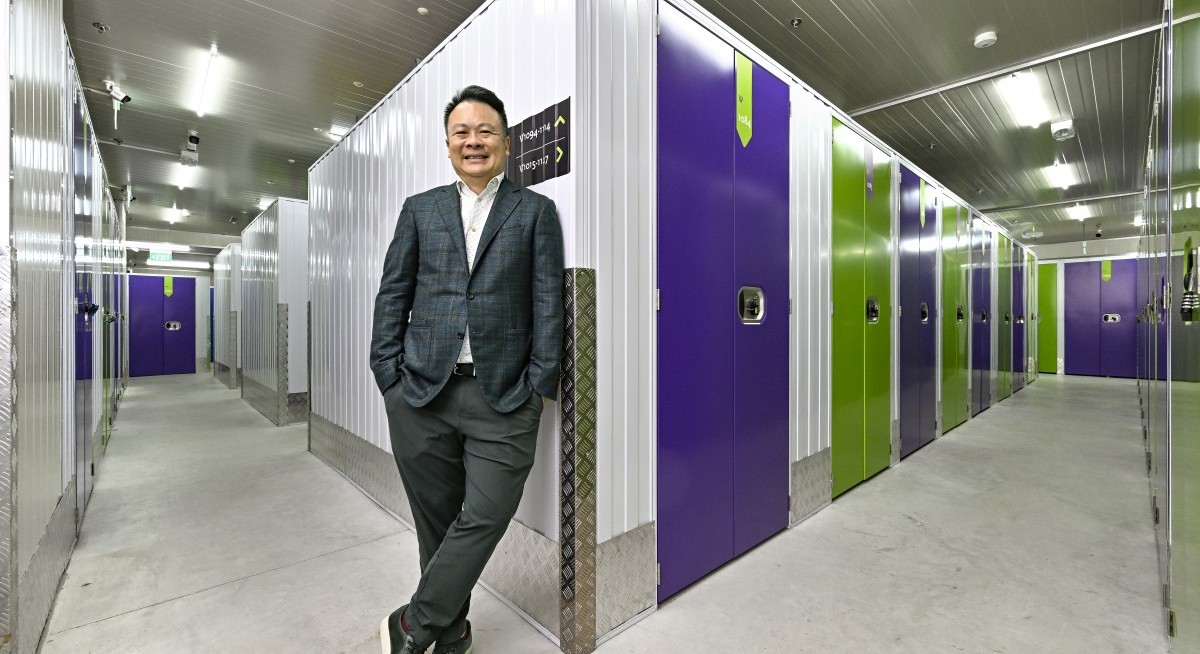


Even as homes get smaller, lifestyles are getting more asset-heavy, and businesses are becoming more fragmented. Singaporeans are no longer only looking for a place to park large furniture during a move or renovation; they are also paying for better environmental control, shorter lease terms and locations that fit how they live and work.
That shift is visible in the rise of more sophisticated storage solutions, such as air-conditioned units and even wine storage. In an interview with City & Country, Danny Wong, CEO of Work+Store, says some users think humidity control is no longer a premium add-on but a necessity — especially for higher-value items such as leather furniture, audiovisual equipment and sensitive inventory.
For others, storage is increasingly tied to lifestyle spending, whether that means preserving wine collections or protecting household goods while homes are being refurbished.

See also: Work+Store faces off with big boys in self-storage and wine storage
For LHN Group’s Work+Store, that shift in customer behaviour is opening up a new leg of growth within the group’s broader space optimisation business.
What started as a response to smaller industrial leasing enquiries has evolved into a business serving e-commerce sellers, SMEs, contractors and households, with a product mix that now spans business storage, basic storage, third-party operator space, air-conditioned storage and wine storage.
As of Dec 31, 2025, Work+Store has seven locations across the island, 2,014 storage units and about 295,000 sq ft of net lettable area for storage units, with occupancy at 93.1%.
The figures are not yet as large as Coliwoo’s co-living portfolio, which remains LHN’s biggest growth story within its space optimisation segment. But Work+Store is increasingly shaping up as another pillar for the group, particularly as LHN looks to deepen recurring income streams across its industrial portfolio and channel capital more selectively after Coliwoo’s spin-off listing in November 2025.
In LHN’s FY2026 strategic roadmap, management says it plans to expand Work+Store’s footprint via acquisitions and add about 10,000 sq ft of air-conditioned storage to lift user experience and margins.

Different users, different uses
Work+Store’s origins lie in the industrial space leasing business, where it offered warehouse spaces for large-scale storage. However, as e-commerce gained popularity, there was an increasing demand for smaller storage spaces.
“We first came up with the idea of Work+Store, not really focusing on self-storage. It was more because of enquiries we received for more industrial spaces of smaller sizes,” says Wong.
In 2015, LHN began seeing a clear shift in the retail landscape as more merchants went online. Enquiries that once centred on units of 800 sq ft to 1,000 sq ft started to skew much smaller, to about 100 sq ft to 200 sq ft.
That product-market fit widened during Covid-19, when both households and small businesses started to use storage differently. On the consumer side, the pandemic accelerated decluttering, home renovation and temporary storage needs. On the business side, it brought a surge in online selling, often from home-based operators who did not want to sign conventional industrial leases.
During the pandemic, especially during the lockdown, people at home started to hone their entrepreneurship skills, says Wong.
“Typically, e-commerce sellers started at home as a one-man show or a very small team,” says Wong. “[As they grow,] they want to find a space to store their inventory, but do not want to commit to traditional industrial leases that are two to three years. They want flexibility.”

Work+Store is offering the solution to that issue, with leases that run from a month to a year — depending on need — along with the flexibility to “move in” as soon as within the week and the option to upgrade or downgrade the size of the space even during the lease term.
That flexibility is a key part of Work+Store’s proposition. Unlike a standard industrial lease, self-storage allows users to quickly adjust their leasing around seasonality, working capital and sales cycles.
Wong says e-commerce demand tends to be volatile and event-driven; sellers stock up ahead of major online sales events or festive periods, then pull back later. “A typical seller on online marketplaces like Lazada and Shopee will store things with us seasonally… depending on sales, like the typical 11.11 or 10.10 sales. They tend to stock up the inventory a bit more leading up to the sale.”
Meanwhile, the user base is also broadening beyond small online merchants. Work+Store is seeing demand from SMEs using storage as a satellite warehouse located nearer to customers or staff, particularly when their main office or warehouse is situated in industrial areas on the far ends of the city.
Contractors are another source of demand. For instance, Wong says air-conditioning contractors and renovation contractors often use self-storage spaces located more centrally to store their tools and materials.
Companies are also using storage to declutter offices as rents rise and employees return from work-from-home arrangements. Instead of leasing larger office premises amid a rise in rents islandwide, some firms are moving documents and spare furniture off-site.
While the demand for space has increased, user preferences have also become more sophisticated, with customers requesting more than just four walls.

Wong says the company has built value-added features around feedback from customers. “It’s not just providing storage,” he says, adding that Work+Store also provides a dedicated space for packing, a photo and video booth for shoots and livestreaming, as well as common holding points for last-mile deliveries for drivers to pick up parcels.

At certain locations, such as the ones in Kallang Bahru and Ang Mo Kio, Work+Store has a thoughtfully designed communal area or a lounge, offering customers a comfortable space for networking and holding meetings.

This ecosystem approach matters for LHN at the group level too. Work+Store can take in customers at an early stage, and keep them within LHN’s broader industrial and commercial property network as they expand.
Wong says: “As they grow bigger, they take up more space. They can slowly transit into our traditional warehouse spaces as well, which helps on the group level.”
That is one reason Work+Store matters to the group strategically — not just as a standalone storage business, but as an on-ramp into LHN’s larger space optimisation platform.
More than just space
Storage demand itself is becoming more nuanced; customers are increasingly asking for purpose-built environments over the cheapest available unit.
Wong says Work+Store expanded its offerings to include air-conditioned storage after seeing more precise customer requirements in the post-pandemic period.
In Singapore’s warm and humid climate, a regular non-air-conditioned space may be susceptible to dust, dampness and mould, which can damage or affect the quality of items, he notes. “We came up with an air-conditioned storage environment for [our customers] to store higher-value items properly, and this took off well. And we also went into wine storage, following increasing demand for a refrigerated storage space.”

Wong says that air-conditioned storage can command a 20% to 30% premium over a regular unit. “People don’t mind paying slightly more, just to preserve their goods,” he adds.

He also points to a wider range of items now being stored in cooled units, including audiovisual equipment, artificial flowers and leather furniture. That suggests demand is not limited to a narrow luxury niche; it is increasingly tied to practical use cases where the value of the stored item justifies higher monthly rent.
For LHN, that translates into better yield. The way Wong sees it, converting former sub-tenant space into air-conditioned storage can lift achievable rental from around $2.60 to $3 psf for a traditional tenant to roughly $5 to $10 psf for air-conditioned self-storage, depending on unit size.
That aligns with the group’s broader playbook. LHN’s core competency has long been space optimisation, taking old or under-utilised assets and redesigning them to improve net lettable area and rental yield per sq ft. In that context, Work+Store is another expression of the same model — slicing industrial space more efficiently, matching layouts to real demand and layering services that raise returns without necessarily requiring ground-up development.
Kelvin Lim, executive chairman and executive director of LHN Group, says the business was incubated within the group’s industrial property portfolio to capture a new market segment.
“The concept was initially implemented within industrial properties managed by LHN, enabling the new concept to test market demand, refine space configurations and streamline operational workflows in a controlled environment,” he says. “This incubation approach also allowed Work+Store to leverage the group’s complementary in-house capabilities — such as facilities management, property management and logistics support — thereby minimising operating costs and execution risks during its early stages.”
That incubation model shows why Work+Store may be better-positioned than a single-line storage operator. LHN can feed Work+Store its properties, facilities management support, tenants and adjacent space products. It also has experience repositioning brownfield assets, which matters in a self-storage market that increasingly depends on converting older buildings rather than building from scratch.
When JTC lifted the moratorium on self-storage expansion in April 2025, it reopened room for growth across the sector, says Wong. The industry generally relies on brownfield sites rather than greenfield industrial land, he adds, meaning operators are often repurposing old buildings rather than competing with advanced manufacturing for new land supply. That also fits LHN’s redevelopment bias and its ESG narrative around adaptive reuse.
Expansion after Coliwoo’s IPO
While Work+Store remains smaller than Coliwoo and smaller than the biggest self-storage names in the city-state, LHN is now signalling that it wants the business to play a larger role in the group’s next phase of growth.
In LHN’s FY2026 business update presentation, management says Work+Store will expand its footprint via acquisitions and convert some existing basic storage units into air-conditioned units, adding about 10,000 sq ft of air-conditioned storage this year.

Wong says demand conditions support that plan, and the company is looking for at least one more facility. “What is most important is: price, location and accessibility.”
The route to expansion does not have to be purely asset-heavy. Wong says Work+Store can grow through property ownership, master leases, sub-leases or even operating models on private non-JTC properties. That gives the business some flexibility in how it scales, even if renewability risk remains a factor for leased assets and higher interest rates affect acquisitions.
What may give Work+Store a better runway now is the group structure after Coliwoo’s listing. Lim says Coliwoo’s listing has made LHN’s capital structure more flexible, allowing each business unit to pursue growth in ways suited to its operating model.

“With Coliwoo now able to access capital independently, LHN can deploy resources more selectively into opportunities that generate recurring income, operational leverage and disciplined returns,” he adds. “For the group, this means additional capital can be strategically channelled across our portfolio, including growth initiatives for Work+Store.”
Those initiatives, Lim says, can include “geographical and operational expansion”, helping the business broaden its footprint and enhance operational capacity.
At the same time, he stops short of promising a similar spin-off for Work+Store. “Any potential spin-off or listing would ultimately depend on factors such as the maturity of the business, market conditions, and whether they would unlock value for both the business and shareholders,” he says.
“For now, our priority is to continue strengthening Work+Store’s operating platform, expanding our footprint, developing new relevant offerings and reinforcing our position in Singapore’s self-storage sector.”
LHN does not need Work+Store to become another Coliwoo overnight — or just yet.
It needs the business to do three things well: deepen recurring industrial income, improve asset yields through smarter space conversion and create another scalable platform within its space optimisation engine.
“We continue to look at how to convert space in existing properties to create better value,” says Wong. “We will also look to add one more facility to our portfolio; the more the merrier.”
See also:
Work+Store faces off with big boys in self-storage and wine storage
Photos: Albert Chua/The Edge Singapore, Work+Store, LHN Group
For more property trends and breaking news, visit City & Country’s microsite at theedgesingapore.com/cityandcountry




