


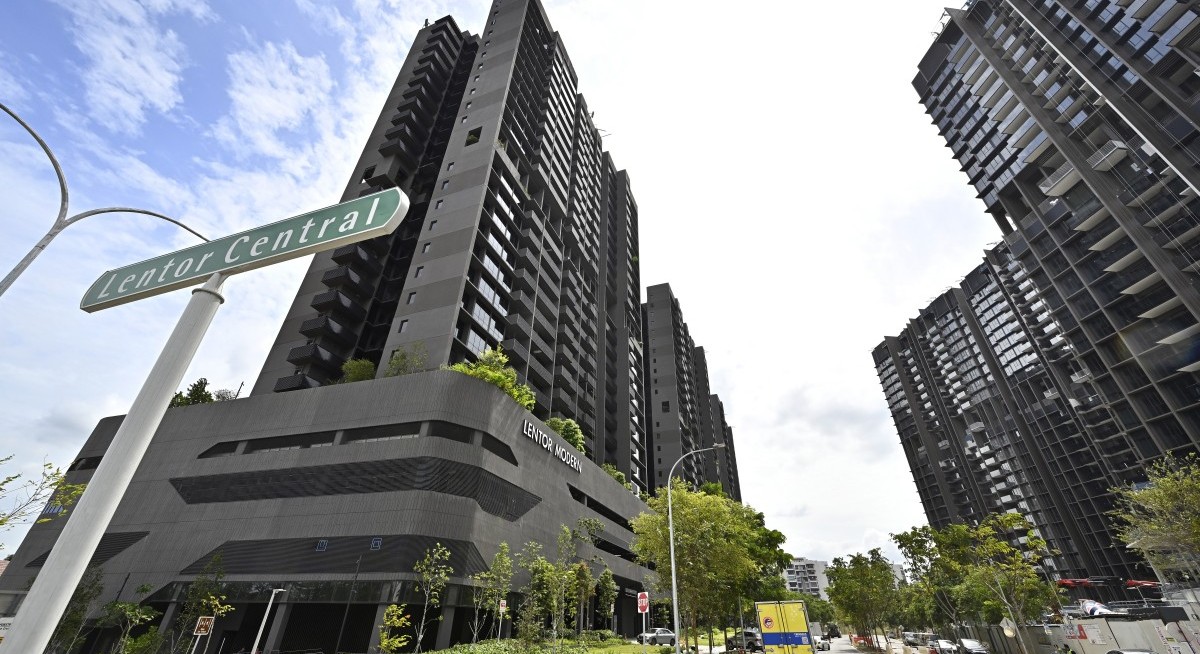


After three decades or more in the area, residents of older developments like Seasons Park, Castle Green and Far Horizon Gardens had become used to travelling between the more established hubs of Yio Chu Kang and Ang Mo Kio.
But Singaporeans — ever eager homebuyers — began taking notice the following year, when the Urban Redevelopment Authority (URA) awarded the second, third and fourth land plots in Lentor Central and Lentor Hills in quick succession.
Mainboard-listed developer GuocoLand had a stake in two of the first four parcels awarded. URA would award three more plots between April 2023 and April 2025, with two of the three going to joint ventures involving GuocoLand.
Developers launched the neighbouring residences about a year after they were each awarded, overlapping with URA’s own announcements on new land parcels.
See also: Freehold five-storey shophouse at 42 South Bridge Road for sale at $33.4 mil
The first plot awarded in the area — the 605-unit Lentor Modern — launched in September 2022 with 84% of its units sold over its launch weekend. The area’s latest debut — the 477-unit Lentor Central Residences — sold 93% of units over its March 2025 launch weekend. GuocoLand is involved in both developments.

Even with six residential developments launched and one retail mall now open to the public, Lentor remains an exciting space to watch.
See also: S’pore property sentiment index plummets into ‘pessimistic territory’
For one, Kingsford Huray Development, a subsidiary of the China-based Kingsford Group, is expected to launch some 500 units in 2Q2026 on the Lentor Gardens site it was awarded in April 2025.
For another, the tender for an eighth plot is set to close on March 3. It is expected to yield some 560 units, according to URA.

Hillock Green (left), Lentor Central Residences (middle) and the Lentor Central
site (right), which has yet to be awarded
The pace of developments in the Lentor Hills Estate has been “deliberate but steady”, allowing for the gradual shaping of a vibrant residential hub, says Mohan Sandrasegeran, head of research and data analytics at Singapore Realtors Inc (SRI).
“Planning, infrastructure and land release strategies were sequenced over several years, allowing Lentor Hills to evolve in a structured and coordinated manner. Lentor Hills is shaping up as a sizeable, master-planned private residential neighbourhood,” adds Sandrasegeran. “The sustained buyer interest across these launches reflects steady market absorption and growing recognition of Lentor as a viable new residential node.”

Lentor Hills Residences, seen in January

Lentoria, seen in January

Hillock Green, seen in January

Lentor Mansion, seen in January
‘The most influential part of Ang Mo Kio’
Streetscapes is inspired by the article series of the same name by our sister publication, City & Country by The Edge Malaysia. In this inaugural edition, we explore Lentor, an emerging precinct with a brand-new retail mall and at least eight upcoming residential developments.
The Lentor Hills private residential precinct was envisioned around the period of the Master Plan 2014. Lentor MRT Station “significantly enhanced accessibility” and “strengthened the feasibility” of higher-density private housing in the area, says Sandrasegeran. “The improved rail connectivity reduced travel times to the city and other employment nodes, making Lentor more attractive to both owner-occupiers and investors.”

With a stake in four of the seven plots awarded so far, why was GuocoLand drawn to Lentor? The group’s experience in developing an office and retail offering at Tanjong Pagar, along with the recent rollout of its Guoco Midtown integrated project in the Beach Road-Bugis district, gave it the “confidence” to “lend influence” to Lentor, says Dora Chng, residential director of GuocoLand.
GuocoLand’s bid for the 186,000 sq ft Lentor Central site (now Lentor Modern and Lentor Modern mall) was above expectations at the time. At $784.1 million or $1,204 per square foot per plot ratio (psf ppr), GuocoLand beat out eight other bids for the 99-year plot.
By winning the bid for the first site in the area, “it gave us a lot of opportunity to define what kind of community we [want to] attract”, says Chng to City & Country. “It is already the most influential part of Ang Mo Kio.”

Lentor was “a clean slate — a blank canvas”, adds Chng. “It was up to us how we wanted to define it, being the first one in the area. So, that was already very attractive to us; we could decide what we wanted [to do]. With the rather affluent community [and] the accessibility of the MRT station, we can bring people from further away to gather at Lentor Modern mall.”

Opening Lentor Modern mall
The 90,000 sq ft Lentor Modern mall officially opened in January, occupying the sloped ground level of Lentor Modern’s three 25-storey residential towers. With direct connectivity to Lentor MRT Station, the mall’s anchor tenants are supermarket Cold Storage Fresh and Mulberry Learning preschool.

There is also a 2,600 sq ft branch of the Anytime Fitness 24-hour gym chain and Merle & Co, a plant-based, pet-friendly cafe.

The mall was crowded on three separate visits by City & Country, particularly on weekends; the heavy foot traffic has also surprised the GuocoLand team. “We knew it would do well, but we didn’t know it would do so well so early. We thought we needed at least two or three more developments in the area to be complete and for [residents] to move in before the crowd would come.”

Latent demand is strong thanks to the number of landed homes in the area. “They don’t have many malls as an option, so it continues to attract people [from the area],” says Chng.

The Lentor Modern mall is 1.2km away from 628 Ang Mo Kio Food Centre, the largest wet market and hawker centre in the area, and 3.4km away from AMK Hub, the mall at Ang Mo Kio MRT Station.
‘Bukit Timah with the lifestyle of Holland Village’
When conceptualising the marketing plan for Lentor, GuocoLand compared the area to Bukit Timah. “The area is entirely landed, all low-rise, entirely private estate, good schools — of course, this is a very small part of Bukit Timah,” says Chng. “This was our literal comparison, just to let people understand the location.”
The spirit of Lentor Modern mall, meanwhile, was modelled after Holland Village. “We wanted this literal ‘kampung spirit’ mall, so it wouldn’t turn [out] too high-end and turn people away. Rather, we want people to gather in the area like a central, community space, for people to feel comfortable having coffee with their neighbours.”
All four GuocoLand projects have achieved 100% sales. About 70% of buyers across GuocoLand’s four projects are HDB upgraders, while the remaining 30% come from private homes.
While the “largest group” of homebuyers in the four developments are currently living in Ang Mo Kio or Serangoon (Districts 19 and 26), “surprisingly, we were able to attract people from all over Singapore”, says Chng. “We have people from Pasir Ris [and] Bukit Batok; it’s quite interesting how much of a draw there is to this TEL [MRT line].”
Environmental impact
The residential developments at Lentor Hills are built on the site of the former 30ha Lentor Forest, which was cleared from late 2016 to 2017. Before the clearing works, URA received a 10-page position paper from the Nature Society (Singapore) proposing that the area be developed in four stages to protect its biodiversity, including endangered species such as the Sunda pangolin.
While URA said the proposal was not feasible, it agreed to work with the National Parks Board (NParks) to salvage and relocate plant species, according to a 2016 Straits Times story.
The authorities also agreed to keep two green plots untouched. URA’s website lists an artist’s impression of the future Hillock Park, with the concept “under development with NParks”. This green area is surrounded by five upcoming developments: Lentor Central Residences, Hillock Green, Lentor Hills Residences, Lentor Mansion and the upcoming development by Kingsford Huray.

Chng says NParks “hasn’t shared much more” about Hillock Park, but it will be “accessible” with “green fingers” between the developments, allowing people to enter and exit the park.

URA’s website lists an artist’s impression of the future Hillock Park, with the
concept ‘under development with NParks’
Chng acknowledges that there were “a lot of concerns in the area” when the forest was removed. To pay tribute to the freshwater stream that once ran through the area, GuocoLand wanted Lentor Modern to reflect its ties to nature. ADDP Architects and landscape architect Ortus Design recreated the stream with a series of “interconnected water bodies” for residents, combining a leisure pool, 25m and 50m lap pools, and spa and jacuzzi pools.
Further sites and en bloc potential
Will they or won’t they? With the tender for the next GLS site in the area slated to close on March 3, is there interest at GuocoLand for a fifth development in Lentor?
“It is our business to keep developing; so, we will explore every opportunity that comes about,” says Chng.

Based on URA’s master plan, at least three more parcels may be released in the area, potentially bringing the total housing count from the current 4,000-odd units to over 5,000.
The eventual total number of units in the area will depend on the timing of future GLS releases, site-specific plot ratios and the unit mix adopted by developers, says Sandrasegeran. “The pace of land supply in Lentor has been deliberate but consistent. This phased approach has allowed developers to assess demand conditions carefully, while ensuring that new supply remains aligned with buyer appetite … As additional parcels are introduced over time, they are likely to build on the existing ecosystem rather than fundamentally alter its trajectory.”
Lentor’s “emergence” will likely “enhance the overall profile of the Upper Thomson to Lentor corridor over time”, adds Sandrasegeran.
Could older developments in the area see a push for en bloc sales? This will “hinge on each development’s individual fundamentals”, says Sandrasegeran. These include land size and configuration, plot ratio and redevelopment headroom, tenure profile, remaining lease “and, importantly, the ability of owners to achieve the required consent threshold”, he adds.
“Lentor may serve more as a catalyst that lifts overall sentiment rather than a direct trigger for en bloc activity,” says Sandrasegeran. “If newer projects in the precinct establish fresh benchmark pricing over time, this could influence land value expectations in the surrounding area. That said, pricing support alone is insufficient without the necessary site attributes and owner alignment.”
Looking north to Springleaf and Tagore
GuocoLand’s plans for the north of Singapore are not focused solely on Lentor; the developer sold 92% of the 941-unit Springleaf Residence at its August 2025 launch — a joint venture with Hong Leong. Located on the site of the former Upper Thomson Secondary School, GuocoLand refurbished the school block into 32 residential units and added five 25-storey towers.
“We did very well in Lentor and that gave us the confidence to bid for the Springleaf land,” says Chng. The GuocoLand-Hong Leong joint venture submitted the sole bid of $779.6 million, or $905 psf ppr.
Compared to the Lentor area, the forested area bordering Springleaf Residence is “much, much bigger”, says Chng. That forest — the Central Catchment Nature Reserve — is also set to stay.

In response to the delicate environment, GuocoLand included 10 sky terraces over the five towers, a window-to-wall ratio of under 50% to prevent bird strikes, a “meadow” concept designed to attract butterflies and warm-toned lighting to minimise light pollution.
Lentor is framed by parks, landed enclaves and low-rise surroundings, while Springleaf sits even closer to nature reserves and heavily forested areas, says Sandrasegeran.
While Chng notes that there are no concrete plans in URA’s master plan for large-scale redevelopment of the Springleaf area, Sandrasegeran thinks it could follow a similar trajectory to Lentor, “albeit at a smaller scale”.
“Its proximity to Lentor also means it may benefit from positive spillover effects. As Lentor approaches full absorption across its various projects, demand may extend further along the Thomson corridor, supporting interest in Springleaf,” he adds.
Springleaf Residence sits on what was once Upper Thomson Road (Parcel B), a two-minute walk from Springleaf MRT Station. In November 2025, Wee Hur and GSC were awarded the Upper Thomson Road (Parcel A) site, which is directly connected underground to Springleaf MRT Station, beating out four other bidders, including a GuocoLand-Hong Leong joint venture.
The 99-year leasehold plot was first launched in December 2023, but the tender closed in June 2024 without any bids. A clause requiring projects to include 100 long-stay serviced apartments was removed and Wee Hur-GSC is expected to build some 595 residential units with commercial space on the first storey.
Lentor and Springleaf are currently adjacent stops on the TEL, but an unopened station sits between them. Tagore MRT Station is a future underground station on the TEL, currently situated in a forested area less than 20m away from the end of Tagore Drive, a light industrial area best known for furniture galleries like Cellini and Royal Gallery.

“At present, Tagore remains a relatively low-intensity area. Its character today is still largely industrial and forested,” says Sandrasegeran. “Any meaningful transformation of Tagore is therefore likely to be gradual and guided by future planning reviews under URA’s Master Plan framework.”
Photos: Albert Chua/The Edge Singapore, SRI, GuocoLand, Google Maps, URA
For more property trends and breaking news, visit City & Country’s microsite at theedgesingapore.com/cityandcountry




