


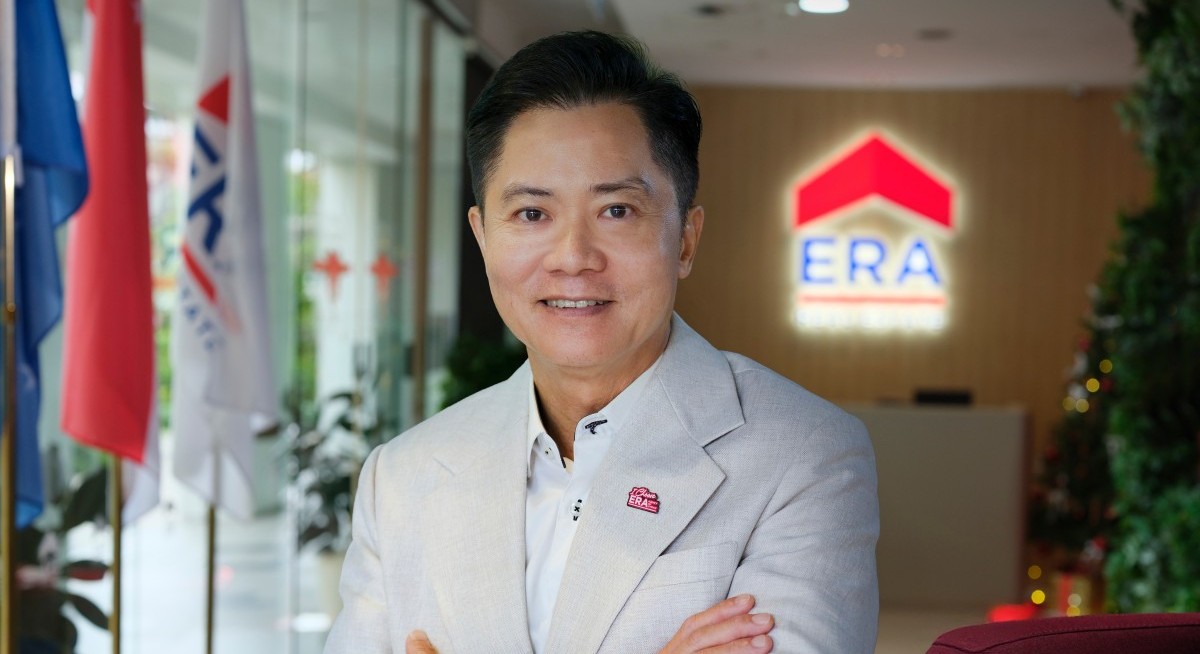


After Covid-19 brought the world to a standstill in mid-2020, a release in pent-up demand propelled ERA parent Apac Realty to earnings of $16.3 million for FY2020 ended Dec 31, 2020, up 17.8% y-o-y. Compared to declining figures in FY2019, Mainboard-listed Apac Realty’s revenue, gross profit, ebit and net profit all rebounded in FY2020.
The profit surge was “a lot stronger than it looks” as 2Q2020 saw “almost close to zero” sales, said Chua, the former CEO of ERA Singapore, in an interview for Issue 974 of The Edge Singapore.

Buyers were also antsy over whispers of coming cooling measures. In January 2021, then-Deputy Prime Minister Heng Swee Keat said the government was paying “close attention” to the stability of the local real estate market.
See also: APAC Realty on the alert for shifting regulations; eyes bigger regional presence
Cooling measures had not made an appearance since July 2018, when the government raised the additional buyer’s stamp duty (ABSD) for Singaporeans from 7% to 12% for second properties, and from 12% to 15% for third properties. Singapore Permanent Residents and foreigners also faced higher ABSD rates.
Chu, then COO, had taken notice, saying buyers are scrambling to avoid the possibility of paying higher stamp duties down the road. His words proved prescient; the authorities have introduced at least four rounds of cooling measures since that interview in early 2021 — there are more if cooling measures for the HDB resale market are also taken into account — starting from December 2021.
Chu himself went through a trial by fire. At 55, he was promoted to lead Apac Realty from July 2021, succeeding Chua, who remains executive chairman of the group.
See also: As both earnings and share price double, APAC Realty sets bigger goals

“Time flies; you can call me the Covid-19 CEO,” says Chu in a recent interview with City & Country.
Property has only gotten hotter since the pandemic era, and only recently have there been signs of moderation. Private residential property prices rose by 3.4% in 2025, marking the lowest rate of increase since 2020, according to flash estimates released by the Urban Redevelopment Authority on Jan 2. Meanwhile, resale prices of public housing stayed flat q-o-q in 4Q2025 — the first time they have not risen since 1Q2020, according to HDB’s flash estimates.
Property agents like ERA have no doubt been doing brisk business. Compared to earnings of $16.3 million for FY2020, Apac Realty posted profit after tax of $11.1 million for 1H2025 alone, more than triple 1HFY2024 earnings. Apac Realty’s full-year 2025 financial results are expected to be released in late February.
Does Chu think another round of cooling measures could be in store this year? He shrugs it off. “Come on — that’s the new norm. Let’s put it this way: the government is always watching [and] we listen to the government when they say they are always watching.”
Looking back, Chu adds: “If there were no cooling measures during Covid-19, the property market could have possibly crashed.”
The property veteran, who has spent more than three decades in the business, says he “admires” how the Singapore government has handled the local property market. “If they had not [introduced] the cooling measures, then it would be like the stock market; it becomes very speculative with people coming in and out — we call them punters. But you don’t have punters in the property market right now.”
See also: Singapore’s property bull run has only just begun: Apac Realty

Bull run incoming
Speaking to The Edge Singapore in a separate interview some months ago, Chu said the local property market is in the “initial years of a bull run”.

This bull run has legs. Chu clarifies that the coming rally is driven by fundamentals and not emotions. “Most of the transactions are closed by locals, not foreigners. So, locals [buy houses] primarily for their own stay, and you cannot buy multiple properties with the new policies unless you are willing to pay the ABSD.”
This bull run will also be steady. Chu tells City & Country that both the volume and quantum of transactions will be “sustainable” in the coming years. Overall, the primary private property market delivered a stellar performance in 2025, says Chu, with 10,611 new units sold, marking the best-performing year since 2021. ERA forecasts between 9,000 and 10,000 new units to be sold this year.
The private resale market should also hold steady y-o-y, at between 13,000 and 14,000 transactions this year, he adds.
The HDB resale market will see more transactions this year, according to Chu, growing from some 23,000 in 2025 to as high as 27,000 in 2026. This is because a total of 13,480 HDB flats will reach their minimum occupation period (MOP) in 2026, nearly double the 6,970 that hit their five-year MOP last year.
Thanks to an “influx” of upcoming Build-To-Order (BTO) flats and policies like the Standard, Plus and Prime housing framework with 10-year MOP, HDB resale flats will see a “sustainable price rise” in the coming years, says Chu. “Prices will not be running as [quickly] as before over a longer period of time.”
Further upmarket, however, “strong demand on the ground” will continue to drive “price escalations” for private residential property, says Chu.
Strong demand from locals who are upgrading from HDB flats is a signal to developers that buyers are willing to accept higher prices, he adds. “Every time you see a Government Land Sales [tender], there will be oversubscription from the developers.”

Chu speaking at the Skye At Holland showflat in October 2025
In November 2025, developer Allgreen Properties topped a whopping 10 bids for the GLS site at Bedok Rise with its $1,330 psf per plot ratio (ppr) submission. It marked the highest number of bidders for a GLS plot since Parcels A and B at Slim Barracks Rise, which closed in September 2021 with 10 bids each.
The strong turnout signals stronger developer confidence, supported by the strong sales performance of recent Outside Central Region (OCR) launches and a more favourable interest rate environment, reads an ERA report following the close of the tender.
“With a small- to mid-sized development accommodating up to 380 units, the site presents Allgreen Properties an attractive entry into the OCR market at a palatable size quantum of less than $465 million, which comes with lower developmental risks,” writes ERA. “Based on the land cost, the future project could be launched at an average price of at least $2,500 psf.”
Developers are “very confident” that they can sell out their upcoming new launches even with a five-year timeframe in mind, says Chu. This timeline takes into consideration a year needed to prepare for the launch and the five-year ABSD remission deadline, which incentivises developers to complete construction and sell all units in a development within five years of acquiring the land.
Using the Bedok Rise GLS site as an example, Chu says developers typically target to market new units at twice the land price. “If you look over the last five to 10 years, the increase is equivalent to about 3% to 4% a year; it compounds, and it’s like this every year. With the current appetite of the developers, I think it will continue.”

Keeping agents up-to-date
ERA is not Singapore’s largest agency by size — that title belongs to rival PropNex. In 2025, Chu ended ERA’s policy of paying the Council for Estate Agencies’ (CEA) annual licence renewal fees for inactive agents. This reduced the agency’s salesforce from 9,200 to 8,600 in early 2025, though this rebounded to nearly 9,000 later in the year.
Chu likens the agent force to the number of drivers on Singapore’s roads. “Perhaps, to curb the number of cars on the road, you don’t issue so many driving licences. Similarly, if there are a lot of driving licences, those who don’t drive [frequently] will probably cause accidents; they are more accident-prone.”
Similarly, there are many real estate agents who hold on to their licence without making any deals, says Chu. “We call them freeloaders — people who have licences but don’t do anything, and someone else is paying for the licence.”
Real estate agencies that are “hard up for numbers” will pay for every agent’s renewal, says Chu. “But let’s come to terms with this: There’s a large number of inactive agents out there. The authorities and the regulator know about this.”
ERA is mirroring itself after Singapore’s financial industry. “We are as professional as the financial industry. In fact, we are dealing with million-dollar deals; [these are] perhaps even bigger than financial industry products like insurance,” says Chu. “If the financial industry requires agents to go through a very stringent continuous development programme, why not the property industry?”

Chu and ERA agents at the ERA Mid-Year Leaders & Achievers Conference 2025 in August 2025
Prior to the start of the year, agents were only expected to attend six hours of training programmes each year. CEA now requires real estate agents to complete 16 training hours annually, comprising 12 hours of structured learning and four hours of self-directed learning.
With more commitment required, the total number of agents in Singapore — now around 36,000 — could shrink by about 10%, says Chu.
“When I say inactive, it does not mean that these agents are no good,” says Chu. “It’s just that they don’t attend our enrichment programmes [and] they don’t upgrade their skills… Imagine using an iPhone 17 with an iOS5 operating system. It’s better that you make a switch to upgrade, or you get out of the market and leave that space to more professional agents.”

Chu and top-performing ERA agents at the agency’s Millionaire Gala 2025 in May 2025
Home and away
ERA’s market share in Singapore is “quite consistent” with its agent count, says Chu. One in every four property agents in Singapore is from ERA, and the agency accounts for about a quarter of all residential property transactions here.
Looking ahead, ERA is “pushing towards” its target of capturing 40% of both new home sales and the resale market, Chu adds.

ERA Asia Pacific holds the exclusive ERA regional master franchise rights for 17 countries and territories in the region. The group currently operates in 14 countries and territories, including Australia, Cambodia, China, Hong Kong, Indonesia, Japan, Korea, Laos, Malaysia, the Philippines, Singapore, Taiwan, Thailand and Vietnam.
According to Chu, Vietnam and Indonesia are two “primary growth markets” for the group. Driven by an active market for new launches, ERA Vietnam’s 4,000-strong team has captured “10% to 15%” market share, reaping some $5.4 million in revenue in 1HFY2025.
In Indonesia, ERA has pivoted from a franchise model — “which is profitable but limited in scale” — to acquiring majority stakes in leading local brokerages in Jakarta, says Chu. “In 2026 and beyond, we will continue to provide value-added support to all these newly bought brokers, which are co-owned with the existing broker. We will still look out for like-minded member brokers to be part of our expansion into Indonesia.”

For more property profiles and breaking news, visit City & Country’s microsite at theedgesingapore.com/cityandcountry




