


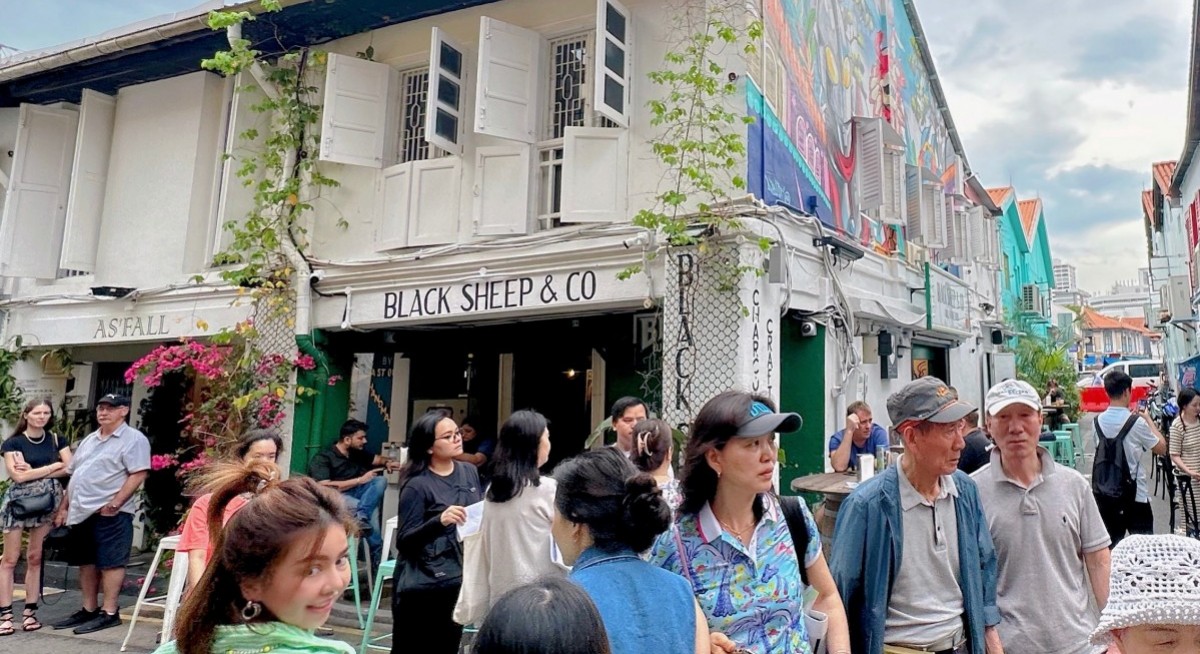


“One concern that people have is that shophouses are speculative [assets],” says Loyalle Chin, co-founder of Steward Asia, an independent team in PropNex. “They think: ‘Oh, the big boys are no longer in the picture.’ There’s half-truth in that.”
Property-minded Singaporeans prefer “safer” assets like residential units, or even “high-performing” investments like equities, he admits. “Of course, there’s space for that [in one’s portfolio].”
When done right, however, Chin believes investing in Singapore’s prime shophouses is far from speculative. Chin’s team at Steward Asia believes maximising returns requires taking into consideration parameters such as rental yield, footfall data, gentrification stories and population growth in the precinct.
“With our acumen in psychographics, tenancy sentiments and placemaking, we believe we can really bring up the yield and the footfall [of precincts],” he adds.
See also: Fund flows from the Mideast into Singapore shophouses more complex than it seems

A new page on Steward Asia’s website showcases a curated list of shophouses and commercial property “across Singapore’s most sought-after districts”. Updated twice daily, the list of properties up for sale is split into five categories: shophouses, hotels, backpacker hostels, commercial buildings and retail strata property.
Visitors to the “Inventory” page of the website can see basic information about the properties available. For example, a three-storey corner shophouse on Amoy Street in District 1 is on the market. The property is permitted for F&B use, has a built-up area of 3,420 sq ft and sits on a 999-year leasehold tenure dating back to 1827.
See also: From maintenance to experience: Rethinking facilities management in commercial real estate

Interested buyers will have to contact Steward Asia for details such as the selling price and exact address.
This “bolsters” the suite of services on offer at Steward Asia as its clients accrue wealth, Jervis Ng, co-founder of Steward Asia and founder of JNA Real Estate, also an independent team in PropNex.
“JNA, by itself, has brought close to 1,500 households into investing in residential [properties]. Steward Asia is built for the ones who have grown into high-net-worth or ultra-high-net-worth — and are now ready for commercial [properties],” adds Ng.
Steward Asia, formerly known as ShophouseHuat, has entered into a partnership with Ng and JNA real estate director of investments Christian Oh to better serve buyers of commercial real estate. The two teams are closely linked and even share an office in Joo Seng Road.
Steward Asia’s new platform “fits in very differently from the rest of the players in the market”, such as Savills, CBRE and Colliers, says Ng. “All of them are actually buy-side and sell-side advisory [firms], but we are not. We have a sell-side team, mainly focusing on divesting the investment assets of our buyers, but Steward Asia by itself is actually a buy-side advisory-cum-investment firm.”
Steward Asia has jointly invested in shophouses with clients. Hence, the company also claims to be a private equity firm, according to Ng. “We hope to [be recognised] as a buy-side advisory that is highly specialised and focused on giving clients the best deals in the market for shophouses, buildings and hotels.”
Buy-side focus
Investors keen on purchasing commercial property often discover they are an underserved segment, says Chin. “No one in the market chooses the buyers first. They usually serve sellers because sellers pay a commission that averages 1.5% to 2% on smaller deals. The commission could be smaller if [the transaction value] crosses hundreds of millions.”
In comparison, the finder’s fee for commercial real estate here is typically lower, adds Chin, at around 1%. “Agents are motivated by commission, and we choose to work on the most objective and financially suitable deals for our clients,” he claims, “even if it means having lower earnings on these listings. But still, we make up for it with the value we add for our repeat customers”.
On behalf of sellers, property agencies here share countless eight-figure listings daily — the likes of which are carried almost immediately on City & Country’s website. But Steward Asia’s focus on serving and representing buyers places the firm in a unique position to meet the needs of various parties.
“We choose to represent buyers not just in their entry, but even in their exit. It prepares the interest of our clients to not just gentrify the property but also to solve sellers’ needs of divesting as well as the community’s needs for placemaking,” says Chin.
Steward Asia’s secret weapon of sorts is the depth of its buy-side analysis and forecasting models for target commercial properties. According to Chin, a select group of “10 to 12 cornerstone investors” will receive Steward Asia’s full suite of services, which extends from simply brokering the acquisition to even presenting recommendations for potential uses and a future exit strategy.

“We calculate your cash flows on your entry price, based on your loan-to-value ratio, how much money you’ve paid and how much return on equity based on your current initial payment. [We also project] costs, including renovation [works], additional alterations and maintenance fees,” he adds.
The firm even goes so far as to analyse the current and future residential catchment in the area based on new housing developments — which directly impacts footfall — and makes introductions with suitable tenants, such as co-living operators.
Co-living players Coliwoo and The Assembly Place — which listed on the Singapore Exchange in November 2025 and January this year, respectively — are aiming to reach 10,000 rooms each by 2030; both are currently at around a third of their targets.
“There is a great demand for co-living operators to find rows of shophouses that would be able to be repositioned into co-living spaces,” says Chin of this particular opportunity. “Adjoining shophouses will [involve] several owners.”
Placemaking over profits
Having brokered more than $1 billion in shophouses, coffeeshops and commercial buildings, Steward Asia believes its services should only be offered to buyers who share its values. “These selected retail investors will have access to our in-depth buy-side analysis. We are not looking to work with everybody because we do not want people to exploit, or worse, take advantage of the neighbourhoods that we serve,” says Chin.
As expected, the firm has worked with clients who were “primarily driven by purely profits”, he adds. “They do not have any intention to gentrify or even add value to consumers. Therefore, we choose to work with clients who not only want capital appreciation and rental yield improvements, but also those who are willing to work with us to bring the most suitable tenants to drive healthy footfall, to even rejuvenate the neighbourhood and attract better-quality tenants.”
Residential property transactions hardly affect anyone other than buyers and sellers. “If you want to actually make a difference to people’s lives, [consider] commercial properties,” says Chin.
With their deep pockets, commercial property buyers have a “huge responsibility to steward their influence”, adds Chin. “Our clients have power to revitalise society or disrupt tenancies… They can actually shape the entire streets of Haji Lane, Amoy Street and even Katong because of their capital influence. We want to make sure that capital breathes life into the streets.”
The gentrification of heritage streets has been blamed for driving up rents and pricing out longtime tenants, but Chin says “the end goal is not just the highest rent per square foot” but to “drive traffic and breathe life” into these precincts. This could mean replacing nightclubs and watering holes with lifestyle- and wellness-focused tenants, he adds.
Upcoming fund
Looking ahead, Steward Asia is “working towards launching a regulated fund” in “less than six months”, says Chin. According to him, the fund is projected to manage “more than $100 million” worth of commercial assets in Singapore, including shophouses and coffeeshops.
Chin’s team is securing cornerstone investors and “big names” on the board to “keep us accountable”. “We are shortlisting partners and structuring our limited partner and general partner framework under a formal partnership charter, designed for aligned long-term capital relationships.”
Chin himself owns 10 shophouses and a commercial office. “I am a practitioner, and I understand the intricate details and challenges of purchasing, managing and divesting shophouses, commercial assets and coffeeshops.”
Combined, Steward Capital Asia’s pool of potential partners — whose identities have yet to be revealed — own “more than a dozen” shophouses and coffeeshops; these could be injected into the fund, according to Chin.
Similar funds already exist here, such as Clifton Partners’ debut real estate fund, Clifton Heritage Partners. Focused on commercial properties in Singapore, it closed in June 2025, reportedly with $258 million in equity.
Running such an operation would require a capital markets services (CMS) licence for fund management from the Monetary Authority of Singapore (MAS). According to Chin, partners with such licences are ready to back Steward Capital Asia. “They see that opportunity — that real estate will stay as a competitive asset in people’s portfolios. They also feel that they can have skin in the game.”
Depending on fund subscription levels, the minimum ticket size could be as low as $50,000, though Chin says this is still unconfirmed. “It is vital that we help the next generation enter into real estate objectively and have a taste of what it means to steward their affluence wisely.”
Circling back to the asset classes available to the retail investor, Chin says “traditional stocks” will also be on the table for them. “We believe that the next generation [of investors] is looking for significance and purpose, and we want to have that purpose-driven success not just for themselves, obviously, but for society.”
Perhaps in a similar vein to the thesis behind sustainable investing, Chin believes there is “no better place” to champion one’s values and advocacy than through purchasing commercial real estate and shaping the tenant mix of a precinct. “They can have a piece of the action by putting their money into what they believe will benefit [society].”
For more property trends and breaking news, visit City & Country’s microsite at theedgesingapore.com/cityandcountry




