




This is achieved via tight cost control, handson asset management and a clear-eyed understanding of how shopping malls function as both income-generating assets and social spaces. As Paradigm REIT prepares to declare its maiden dividend, Chua tells City & Country that delivery, rather than ambition, will be the foundation on which investor confidence is built.

From malls to markets
When Paradigm REIT was listed on June 10, 2025, with a market capitalisation of RM1.6 billion ($507 million), it entered a Malaysian REIT market that offered investors a wide range of established vehicles across retail, office, hospitality and specialised asset classes.
See also: Bangladesh PM met labour tycoon Amin on Malaysia trip — Bloomberg
For a newly listed retail REIT with just three assets at inception, this meant competing not on breadth but on clarity of strategy and consistency of execution. Hence, for Chua, scale was never the defining factor; execution was. “The most important thing for us in the first six months is to ensure that we deliver what was promised in the prospectus, especially in terms of yield,” she says.
A geographically diversified retail portfolio anchors that discipline with a combined appraised value of about RM2.4 billion as at end-2024. The REIT’s assets serve different catchments, operate under different leasing structures and play distinct roles within the portfolio.
Chua’s position within Paradigm REIT is unique as she previously ran the malls now held within the REIT and continues to oversee asset performance, post-listing. “I come from operations, so I don’t just look at the numbers and tell the operator to hit them. I understand how those numbers are achieved, and I supervise what the operators do very closely,” says Chua.
See also: DoubleTree Resort by Hilton Penang for sale at RM250 mil
That background matters because retail assets cannot be managed purely as financial instruments, she asserts. Tenant remixing, downtime during fit-outs and experiential upgrades may temporarily affect income, but are often essential to maintaining long-term relevance.
This creates an inherent tension, Chua openly acknowledges, between a mall operator’s instincts and a fund manager’s obligations. “As a mall operator, you might want to wait for the perfect tenant or the best concept. But as a REIT, a vacancy has a direct impact on returns. Sometimes, you have to make a hard call and prioritise continuity of income,” explains Chua.
New level of accountability
Moving from private asset management to a listed REIT has required a shift in mindset, though not a reinvention of approach. For Chua, the most significant change is accountability. “In the past, I reported along a management line. Now, we have shareholders, analysts, funds and banks to communicate with. The way we plan and pace our decisions has to change.”
Since listing, the management team has been on an active engagement trail, meeting analysts and institutional investors to reinforce the REIT’s delivery trajectory.
This follow-through, Chua notes, is just as crucial as the pre-IPO roadshow. “They need to see that we are on track and doing what we said we would,” she says.
At the same time, operational responsibilities have not taken a back seat. Chua remains hands-on across all three malls, while also laying the groundwork for future acquisitions. “It’s more like an additional portfolio. I still manage the malls, but am also engaging potential asset owners. I understand what needs to be done to strengthen yields before anything comes into the REIT,” says Chua.
Cost discipline has emerged as a defining theme in Paradigm REIT’s first year as a listed entity. Rising electricity tariffs posed a particular challenge, especially for large-format malls where energy consumption is structurally high.
A major breakthrough came following the implementation of Malaysia’s electricity tariff restructuring on July 1, 2025. Prior to the change, Paradigm Mall Petaling Jaya and Paradigm Mall Johor Bahru were billed under the C2 off-peak tariff rider. With the restructuring, Chua notes that both malls converted to a more favourable Medium Voltage (Bulk) Time-of-Use tariff in late November.
“My engineering team was at the offices of the Energy Commission and Tenaga Nasional almost every day. We made sure all the documentation was ready [for the conversion approval],” says Chua.
The approval, backdated to July 1, resulted in material savings that were not factored into the IPO projections. “The revised tariff structure will remain in effect until December 2027, providing cost visibility over the medium term. These savings flowed directly into operating margins and distributable income,” says Chua.
For the period of June 10 to Sept 30, 2025, Paradigm REIT recorded revenue of RM71.4 million and net property income (NPI) of RM50.2 million, translating into an NPI margin of 70.3%.
Distributable income came in at RM36.5 million, exceeding forecast levels (RM35.5 million) for the period. “Many people ask how we achieved that margin. It comes down to disciplined opex (operating expenditure) management, but without compromising the long-term health of the assets,” says Chua.
Asset enhancement and managing trends
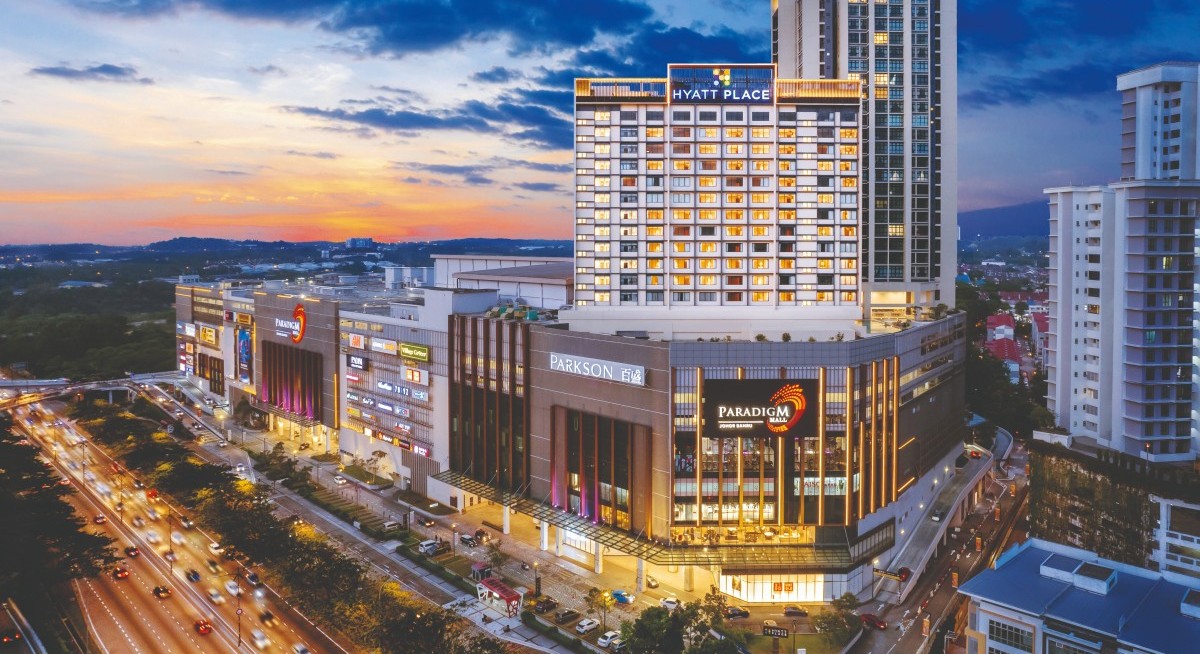
Each of Paradigm REIT’s assets plays a distinct role within the portfolio. Paradigm Mall Johor Bahru is the REIT’s largest asset, with an appraised value of RM1.16 billion and about 1.3 million sq ft of net lettable area (NLA). As at Sept 30, 2025, it was 99.7% occupied with 458 tenants.
Integrated directly with Hyatt Place Johor Bahru Paradigm Mall, the development is positioned as a regional lifestyle and entertainment destination serving both local shoppers and Singaporean visitors.
Paradigm Mall Petaling Jaya, valued at RM600 million, is a mature urban neighbourhood mall integrated with Le Méridien Petaling Jaya, residential towers and an office block.
With about 0.7 million sq ft of NLA and occupancy of 98.3% (as at Sept 30, 2025), the mall continues to generate stable income even as management undertakes active tenant remixing to refresh its offering.
Bukit Tinggi Shopping Centre in Klang, valued at RM680 million, provides a stabilising counterweight to the portfolio.

Fully occupied with an NLA of one million sq ft and anchored by AEON Co (M) under a master lease, the freehold asset carries a weighted average lease expiry of over four years, offering income visibility and defensive characteristics within the REIT structure.
Together, the three assets delivered portfolio occupancy exceeding 98% as at end-September 2025, underpinning stable cash flows in Paradigm’s first year as a listed entity.
At Paradigm Mall Petaling Jaya, recent tenant movements (in late 2025) reflect a deliberate repositioning rather than reactive churn. The exit of Marks & Spencer created an opportunity to refresh the retail mix, with Max Fashion and Nitori introduced to strengthen the affordable fashion and home-lifestyle segments respectively, says Chua.

A mature urban neighbourhood mall, Paradigm Mall Petaling Jaya is integrated with Le Méridien Petaling Jaya, residential towers and an office block
F&B options have also been progressively enhanced, with new tenants such as Tea Garden, Pulau Tikus Market and Oiso added in response to shopper demand for more sit-down dining options.
The mall has further broadened its engagement with senior shoppers, offering free parking (up to three hours) for those aged 60 and above, alongside programmes such as calligraphy, mahjong and exercise sessions.
“A mall isn’t just a place to transact; it’s a community space,” says Chua.
Down south, Paradigm Mall Johor Bahru’s differentiation hinges on scale and entertainment. With attractions ranging from indoor theme parks and skating rinks to cinemas and family-centric activities, the mall positions itself as a one-stop destination — reinforced by its integration with a hotel. “You park once, and everything is there. You don’t need to drive around,” says Chua.
Meanwhile, retail trends, she acknowledges, are increasingly fluid. Celebrity endorsements, viral beverage concepts and fast-rising brands can reshape demand almost overnight, she adds. “There will always be space for what’s trendy. But some shifts like F&B and entertainment are structural and need a longer-term view.”
At Paradigm Mall Johor Bahru, for instance, Chua notes that F&B currently accounts for about 13% of NLA, well below industry norm.
She sees room for growth, but a cautious approach is warranted. “It’s about balance. You expand step by step, watch how tenants perform, and adjust,” says Chua.
In terms of sustainable practices, for Paradigm REIT, corporate vehicles are gradually being converted to electric models. At the same time, petrol motorbikes used for mall operations will be replaced with electric models once they are fully depreciated.
Energy efficiency initiatives, including chiller optimisation, variable-speed drives and solar photovoltaic installations, have already delivered measurable savings across the portfolio. “If you save on opex, your margins improve,” says Chua.
Food waste management is the next focus area, starting with Paradigm Mall Johor Bahru’s large food court, where tenant education and system readiness are critical before wider rollout.
She adds: “It’s better to do it properly, step by step.”
Growth pipeline and the first dividend
Since listing, Paradigm REIT’s units have traded below their IPO price of RM1, often in the 94 to 96 sen range in late 2025, while interim financial statements show net asset value (NAV) per unit at RM1.02 as at Sept 30, 2025.
“It’s not quite where we would like it to be. But we are still the ‘rookie’ in that sense. People don’t know us that well yet,” says Chua.
For her, the focus in the first year is not short-term price performance but credibility. “Once investors receive the dividends and see that we’ve delivered or over-delivered on what we promised, that’s when confidence builds.”
To that end, the management team has intensified engagement with institutional investors, many of whom feature among the REIT’s largest unitholders. “Support from long-term funds helps provide stability,” she says.
Beyond the current portfolio, Paradigm REIT has a pipeline of assets under right-of-first-refusal arrangements with its sponsor, WCT Holdings. These include three hotels — Hyatt Place Johor Bahru Paradigm Mall, Le Méridien Petaling Jaya and Première Hotel Klang — as well as the retail component of KLIA Terminal 2, called gateway@klia2.
However, Chua is clear that any acquisition must be yield-accretive. “We’re already operating at a certain yield level. Anything that comes in has to make financial sense,” she says.
That discipline, she believes, will be increasingly important as the REIT matures.
The immediate milestone is Paradigm REIT’s maiden dividend declaration, with payment expected in early 2026.
Chua is confident it will exceed IPO projections. According to its prospectus, Paradigm REIT is expected to declare a distribution per unit of 7.16 sen for the financial year ended Dec 31, 2025, based on a full payout of 100% of its distributable income. Distributions will be made twice a year thereafter.
For a newly listed REIT still earning market trust, that delivery will be pivotal. “We’re the ‘baby’ of the industry,” she acknowledges. “But once investors see that we walk the talk, that’s when confidence starts to form.”
In a sector often dominated by scale, Paradigm REIT’s origin story is instead about precision, disciplined cost control, operational fluency and a clear understanding of how malls function — both commercially and socially.
For Chua, that grounding may prove to be the trust’s most valuable asset as it grows in its listed life.
This story first appeared in the Jan 12 issue of City & Country in The Edge Malaysia




