




The wholly owned lodging business unit of CapitaLand Investment (CLI) has a legacy dating back more than four decades. Ascott started as an asset-heavy real estate company when it introduced Asia Pacific’s first serviced residence — The Ascott Singapore — in 1984.

The business model was built on ownership and direct operation — one where “we only managed the properties that we owned”, recalls Ascott CEO Kevin Goh.
More than four decades on, that business model has been fundamentally changed. “We have grown from managing 20,000 keys in 2008 — the year Ascott became a wholly owned subsidiary of CapitaLand — to [about] 180,000 keys today,” says Goh at a media briefing at Ascott Tay Ho in Hanoi.
See also: Accor’s Handwritten Collection opens 50th location globally
Yet scale has not come with heavier ownership. “Of those [approximately] 180,000 keys, we only own 0.1%,” says Goh, as he highlights Ascott’s pivot from an asset-heavy owner-operator to an asset-light global lodging business platform.
“Today, growth is delivered through a mix of franchise, management and ‘manchise’ — a hybrid structure that combines the first two,” adds Goh. More than 90% of Ascott’s portfolio is now asset-light, comprising management and franchise contracts, according to a presentation slide shared by Goh.

See also: Hilton Garden Inn to add over 2,000 rooms across China’s business centres and leisure destinations
As at March 31, Ascott operates more than 1,000 properties across its 14 brands, located in over 230 cities in more than 40 countries. As of FY2025, Ascott’s total portfolio stands at 176,400 units across its managed, franchised, leased and owned assets, as well as those held under funds and joint ventures — 4.8% higher y-o-y.
Of the 176,400 units, 63% are operational while the remaining 37% sits in the pipeline. By business model, 79% of the portfolio is under management contracts, 13% franchised, 6% held under REITs and funds, 1% leased and 0.1% owned.
Ascott’s portfolio is concentrated in Southeast Asia, where it operates 359 properties comprising 67,600 keys. This is followed closely by China, Japan and South Korea, with 323 properties, or 66,600 keys, in total. Beyond its core markets, Ascott’s footprint spans Australasia, Europe, South Asia, the Middle East, Africa and Türkiye, the US and Central Asia.
Ascott’s anchor market
Anchored by rising wealth and the middle class, Southeast Asia remains one of the most dynamic hospitality markets, says Ascott’s chief strategy officer Wong Kar Ling.
“There is a huge demand from domestic travel, [underpinned] by the strong connectivity, as well as demand from intra-regional travel [within this region],” adds Wong, who is also Ascott’s managing director for Southeast Asia.
2025 marked a record year of expansion for Ascott, with more than 7,300 units signed across Southeast Asia, a 55% y-o-y increase. The “strongest-ever annual performance” places Ascott among the top three hospitality companies in the region for 2025, according to New York-headquartered hospitality, tourism and leisure consultancy Horwath HTL.
This is “largely driven by the Vietnam market”, says Wong. “We signed very exciting locations such as Citadines Selavia in Phu Quoc, Somerset in Nha Trang and Harris Resort in Cam Ranh.”
Wong says Southeast Asia remains Ascott’s most “diversified growth engine”. “It is the region where we essentially have the full spectrum of the different typologies. Ascott now operates more than 200 properties, with an additional 150 under construction and among these, 25 properties [are slated for opening] in the next 12 months,” says Wong.
Vietnam a ‘dynamic growth market’

Vietnam’s growth trajectory remains robust. David Cumming, Ascott’s regional general manager for Indochina (Vietnam, Cambodia, Myanmar, Thailand and Laos), highlights that Vietnam recorded about 21.2 million international arrivals last year, up 20% y-o-y, becoming the third-most-visited destination in Southeast Asia.
“The government has also set a 25 million target in 2026 and 30 million by 2028”, he adds. “Vietnam is very well-placed to start challenging Thailand in terms of international arrivals.”
Against this backdrop, the “China+1” strategy is further accelerating corporate demand. Responding to City & Country, Goh points to a clear uptick in corporate demand in Vietnam.
“We are getting a lot of corporate contracts from Japanese, Korean and American companies,” Goh says. “As we all know, they have been expanding their businesses to Vietnam and this is likely a manifestation of the ‘China+1’ effect.”
The trend is structural rather than cyclical, he adds. “I do see this as a growing trend, with more businesses continuing to expand their capabilities in Vietnam”.
That said, Goh says the domestic and international demand mix varies significantly by location. “Destinations such as Phu Quoc can see as many as 90% foreign visitors, while others are more evenly split or even dominated by domestic travellers. This is reinforced by improving connectivity and infrastructure, with new airline capacity — including routes introduced by local players such as Sun Group — bringing more international visitors to the country.”
Vietnam, like the rest of Southeast Asia, is also powered by a rising middle class, adds Wong. The middle class in Vietnam is expected to expand to 26% of the population by 2026, up from 13% (97 million) in 2023, according to Enterprise Singapore. Income per capita was reported to be US$3,560 ($4,449) in 2021 and is estimated to grow to US$7,500 by 2030.
Similarly, Cumming points out that the “real anchor” of demand lies in the domestic market. “What is really interesting in Vietnam is the [sheer] size of domestic travel, [with] some 135 million trips taken domestically annually.”
Goh highlights the structural opportunity in the market, driven by the imbalance between branded and unbranded hotel supply. “In Vietnam, the split between branded and unbranded operational and pipeline hotel rooms is [still] roughly 40:60. So there [remains] a lot of opportunity for conversion out there [in Vietnam].”
Conversions a key growth lever
Ascott is leveraging conversions as a key growth lever in this region; about 30% of its Southeast Asia development pipeline is delivered through conversions. This includes three Bayview-branded properties in Penang and Langkawi owned by Oriental Holdings, which will be rebranded as Ascott Batu Ferringhi Penang, Oakwood Georgetown Penang and Fox Hotel Langkawi by 2028.
“We find that conversions are interesting because you already have a property and rebranding it and putting it into the market is much faster,” Lim explains, adding that “markets in this part of the world move very quickly… and emerging markets can rise and become very popular quickly”.
Conversion projects expected to open within approximately one year of signing include Citadines Mitra Bandung, Oakwood Pandanaran Semarang and Fox Hotel Nagoya Batam.
This “dual-track approach” — growing via new developments and conversions — enables faster market entry for Ascott where “opportunities exist, but greenfield supply pipelines are constrained”.
Vietnam’s Mice boom

From left: Tan Bee Leng, chief commercial officer; Serena Lim, chief growth officer; Kevin Goh, CEO; Wong Kar Ling, chief strategy officer and managing director, Southeast Asia, at a media briefing session in Hanoi. Photo: The Ascott
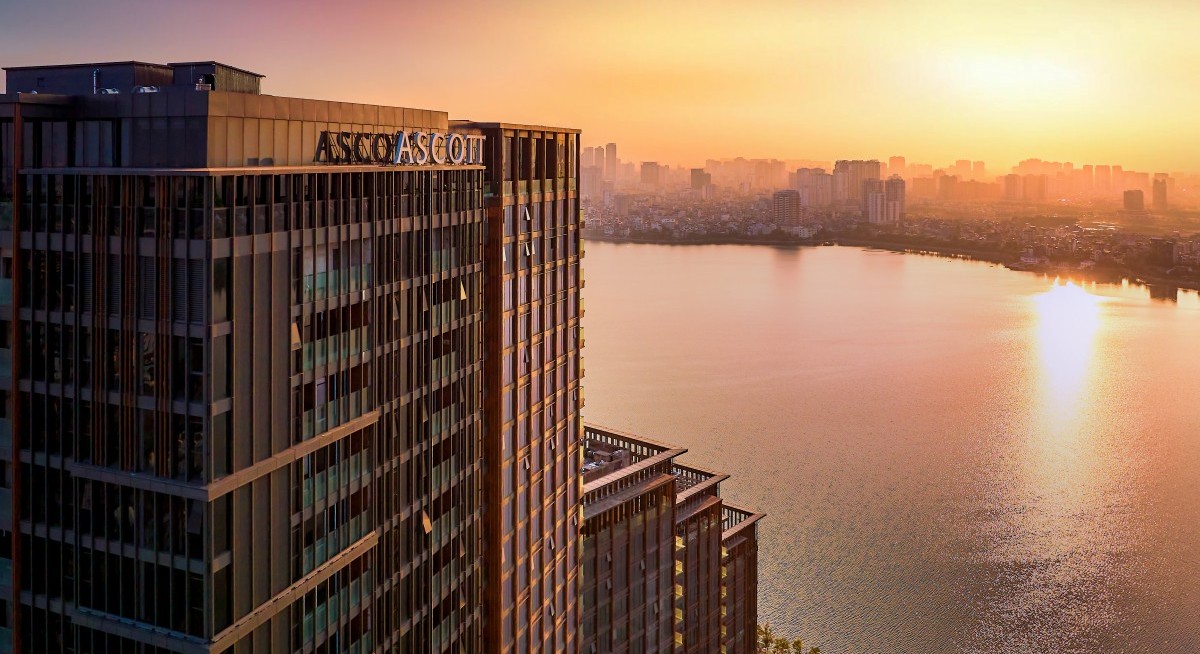
Speaking to the media on a tour of Ascott’s Hanoi properties in mid-April, Goh says Ascott also hopes to attract meetings, incentives, conventions and exhibitions (Mice) to Ascott Tay Ho Hanoi, set to become Ascott’s “largest full-service Mice hotel and a landmark events and hospitality destination in Vietnam’s capital”.

The property features a fully operational convention centre with 13 flexible event spaces, as well as Hanoi’s largest pillarless hotel grand ballroom with capacity for up to 2,000 guests. Photo: The Ascott
Located on the shores of West Lake in Hanoi’s upscale Tay Ho District, the property features a convention centre with 13 flexible event spaces — including Hanoi’s largest pillarless hotel grand ballroom with capacity for up to 2,000 guests.
The convention centre is already operational. When fully open in 2027, the property will also offer 1,165 hotel rooms and serviced apartments as well as premium wellness facilities including a spa, gym, indoor and outdoor swimming pools and yoga rooms, alongside 10 dining concepts and a sky bar overlooking the lake.
Ascott Tay Ho Hanoi combines long-stay living, hotel accommodation and Mice facilities under one roof, establishing Ascott’s credentials in Vietnam’s fast-growing meetings and events market, according to Ascott.
This comes on top of the booming Mice market in Vietnam, along with factors such as rising international arrivals, a rising middle class and the positive effect of “China+1”.

According to a latest report published by market research firm IMARC Group, Vietnam’s Mice market reached US$5.1 billion in 2025 and this number is expected to reach US$7.3 billion by 2034, translating to a cagr of 4.1%.
The growth is underpinned by Vietnam’s exponential economic growth, foreign direct investment (FDI) inflows and government infrastructure investments, which are pushing the Mice industry onto an unprecedented upward trajectory.
In 2025, Vietnam’s GDP grew by 8.02%, reaching approximately US$514 billion, an increase of US$38 billion from 2024. GDP per capita reached approximately US$5,026, up US$326 y-o-y.
FDI inflows into Vietnam remained resilient in 2025, with newly registered capital exceeding US$38.4 billion, up 0.5% y-o-y, according to Vietnam’s National Statistics Office.
Vietnam has also earmarked US$40 million for infrastructure in 2026, according to reports by Vietnamese media in early February. Economists say the scale underscores the government’s determination to use public investment as a key driver of economic growth of at least 10%, according to reports. Infrastructure projects include convention complexes, hotels and transport systems, aimed at attracting international event organisers into the Mice industry and positioning Vietnam as a premier regional hub.
Another factor driving the Mice industry is Vietnam’s rich cultural heritage. Vietnam boasts over 40,000 historical sites, eight Unesco World Heritage sites and 15 intangible heritage elements, which provide “unique and attractive settings for conferences, conventions and exhibitions”, reads IMARC’s report. “The mix of ancient landmarks and natural beauty appeals to both international organisers and attendees, making Vietnam a compelling choice for those seeking an inspiring venue.”
Loyalty and technology

Sharpening Ascott’s growth strategy are two pillars of loyalty and technology, says Goh.
Ascott’s loyalty programme Ascott Star Rewards (ASR) “has become a cornerstone of how Ascott captured leisure travel”, he adds. “ASR has been growing very well and we are seeing double-digit growth every year as we open projects.”
Together with corporate travels, “we are driving over 60% direct distribution into our properties through our own channels”, adds Goh.
Partnership further strengthens this ecosystem. “Getting into partnership, such as with the famous Chelsea football club, is very much a core strategy for us,” says Tan Bee Leng, chief commercial officer of Ascott. “The key is creating a loyalty ecosystem so members enjoy curated experiences.”

Over April 17-18, more than 300 fans and Ascott Star Rewards members met with two-time Premier League Golden Boot winner Jimmy Floyd Hasselbaink across three Ascott properties. Photo: The Ascott
Ascott, the official hotel partner of Chelsea Football Club, held on April 17–18 the fourth run of its fan engagement programme. The two day Hanoi showcase marked the programme’s Vietnam debut and featured Chelsea legend Jimmy Floyd Hasselbaink, a two-time Premier League Golden Boot winner.
“Since the first edition two years ago, our membership has grown from 4.5 million then to 8.3 million today,” says Tan of the ASR programme. “Of course, I will not attribute everything to Chelsea, but they definitely played a key part in creating that desire to be part of the ASR ecosystem.”
On the technology front, Ascott announced on April 23 a “decisive push into AI-ready infrastructure to position itself at the forefront of agentic commerce”.
Three strategic collaborations with Accenture, Amadeus and EHL Hospitality Business School will advance this AI-ready transformation across digital architecture, distribution and people capabilities, says Ascott.
As one of the global hospitality companies frontrunning investment in agentic AI, Ascott seeks to accumulate data, operational experience and process efficiencies that would compound over time.
“In an agent-led travel ecosystem, Ascott properties will have to be visible where the real decisions are made — inside algorithms,” says Tan. “Brand and property information must become machine-readable and optimised for generative engines; that requires smarter recommendations, more precise inventory matching and loyalty experiences that recognise our ASR members at every touchpoint, whether they are searching on their own or through an agent.”
Photos: The Ascott
Chart: IMARC Group




