


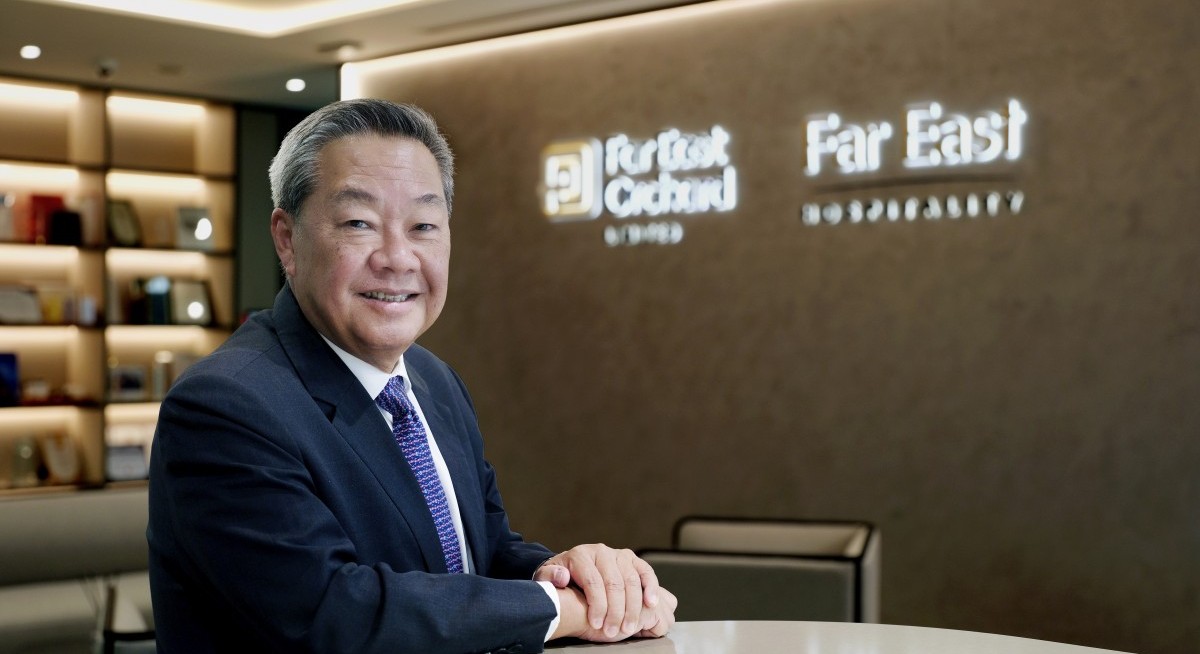


With travel borders still shut, few hoteliers were cutting ribbons then. But Kiong spoke boldly of a “third wave” of tourism — Singapore emulated foreign destinations in the 1960s, then improved the tourist experience in the 1980s; tourists today seek cultural significance in their voyages, said Kiong.
“Covid-19 has changed the game; travel is going to be inconvenient,” he added. “In order for business clients to come here, there must be a convincing purpose.”

The 324-key hotel, themed around the clans that were formed by migrants who arrived in Singapore more than a century ago, offers a fresh perspective on guest hospitality.
“What allowed them to survive [and] thrive was the concept of clanhood or clanship, where we must take care of our own,” says Kiong to City & Country in a recent interview. “They provided a place to live, a job and connections. People saved their money, they built schools, they built infrastructure that enabled businesses to thrive. This whole idea is then brought into the hotel, [which] tells that quintessential Singapore story from the moment guests arrive.”
As the hotel nears its fifth anniversary in March, the shrewd storytelling and guest positioning has paid off. According to Kiong, The Clan Hotel is the “most profitable hotel” in FEH’s global portfolio. “That’s the importance of having a philosophy, a branding strategy, a product and having the service — it all culminates in [saying]: That is Singapore-inspired hospitality.”

See also: Muslim tourists set to drive US$310 mil in annual spend by 2030
‘Take care of our own’
Kiong is generous with his responses despite the multiple interviews his team had arranged towards the end of 2025; he retired from his position as managing director of Singapore-listed Far East Orchard’s hospitality arm on Dec 31. Kiong, 65, is succeeded by FEH’s deputy managing director Mark Rohner, who stepped up as managing director on Jan 1.
In interviews with other outlets, Kiong reflected on his four-decade career in the hospitality sector, which saw him work with renowned brands in Hong Kong and New York before spending 14 years with FEH.
Speaking to City & Country, Kiong instead discussed factors outside the hospitality industry that are driving travel patterns and guest behaviour today. Over an hour, Kiong’s thoughts on Singapore’s hospitality and tourism sector echo the ethos of The Clan Hotel — to “take care of our own”.
Take his comments on “third-wave tourism” at the hotel opening in 2021, for example. A throughline appears in Kiong’s study of our tourism sector — Singapore began replicating other cities’ offerings in a “me too” era, he says, before improving its appeal in a “me better” phase.

The challenge now is for Singapore to define its unique, “me only” proposition in a world filled with “a plethora of innovative tourism concepts”, he adds. “I suppose the best example of a ‘me only’ proposition was the masterstroke of Taylor Swift’s Eras Tour.”
The Singapore Tourism Board (STB) offered grants to the American pop star to stage six nights of her concert tour in Singapore (and nowhere else in Southeast Asia) in March 2024, inspiring inspiring similar moves like Thailand’s deal to bring electronic music festivals Electric Daisy Carnival (EDC) and Tomorrowland to Phuket and Pattaya respectively this year.
“That kind of a masterstroke, unfortunately, is: ‘oh, very clever’ then someone will come and copy it. But at least we led the pack in a new way of looking at how to organise successful MICE [meetings, incentives, conferences and exhibitions] events,” adds Kiong.
The Formula 1 Singapore Grand Prix night race, which began in 2008 and is slated to continue until at least 2028, is another “spark of brilliance”, says Kiong, but “you can only milk it for so long”.
The new Mandai Wildlife Reserve, with several wildlife parks and a resort by Banyan Tree, is “quite a unique proposition” that is “really along the right track”, adds Kiong.
Maximising Sentosa
Sentosa is a “very unique” proposition that should be “leveraged a little more”, says Kiong. “There are very few places in the world where you have the major metropolis — which is the business heart of the city — separated from the leisure hub of the city — like Sentosa — by 11 minutes.”
Major cities like Manhattan, London or Tokyo cannot boast of a resort island situated just 11 minutes away. Hence, Kiong urges the authorities to “work on connectivity” and market the tourist destination for its convenience.
Granted, FEH has vested interest in Sentosa, as it manages and operates four hotels on the resort island. The Barracks Hotel Sentosa offers “bespoke luxury”, Oasia Resort Sentosa promises “pragmatic wellness”, The Outpost Hotel Sentosa is targeted at adults on vacation, while Village Hotel Sentosa is geared towards families.

Three of the hotels opened in 2019, right before the pandemic hit, while Oasia Resort Sentosa opened in September 2021 as FEH’s first wellness-focused resort and spa.
“When we were vying for that plot of land, we thought that we do not want more of the same. 93% of the [hotel] inventory on Sentosa is luxury properties [and] luxury resorts. So, we wanted to do something very different,” he says.
Broadening the target market to “upper-mid-scale” customers ensures long-term sustainability for the island’s hotels, adds Kiong.
“Because of our offering, we were able to make Sentosa more accessible not only to foreign visitors, but to locals as well. It is important that Sentosa doesn’t become a place for foreigners, but is also integrated into the Singaporean psyche.”

With just 40 rooms and suites, The Barracks Hotel Sentosa offers ‘bespoke luxury’ on the resort island
This comes even as FEH’s biggest neighbour in Sentosa pushes ahead with major works to the waterfront facing the mainland, set to be complete by 2030. Resorts World Sentosa unveiled in 2024 plans for two new hotels with 700 rooms, along with more retail, dining and entertainment options, a mountain trail and an 88m-tall light sculpture.
“The upgrade of Sentosa only serves to enhance what we provide, because what we provide is a broadening of the spectrum,” says Kiong. “Sentosa needs to go upmarket, because everything is becoming more expensive… There is always a space for the mid-tier in the budget proposition.”

The Barracks Hotel Sentosa, one of four hotels in Sentosa managed and operated by FEH
Building Singapore’s ‘soul’
According to the STB’s Tourism 2040 road map, Singapore is targeting $50 billion in tourism receipts, with MICE events as a strong driver.
MICE travellers reportedly spend twice as much as leisure travellers; in 2019, Singapore recorded 19.1 million international visitor arrivals and posted $27.7 billion in tourism receipts. In 2024, Singapore received 16.5 million tourists, but they spent more — with receipts totalling $29.8 billion.
MICE is just the “tip of the spear”, says Kiong. “Frameworks simplify and make it easy to understand for the man on the street as to where we are going directionally. But of course, the actual solution is a lot more nuanced than that.”
Buzz-worthy events alone are not Singapore’s answer to changing tourist demands. “If I may use a metaphor — you’ve got very bright, intelligent eyes. How do we make you even more attractive? Let’s have another two sets; let’s make it six eyes! You can’t just [think] because this is successful, let’s have more of it; [the response] has to be a lot more balanced.”
Beyond “functional” improvements to infrastructure and manpower, Singapore must develop “a more important, deeper component”, says Kiong. “The city needs to have soul.”
He adds: “How do we develop the soul of Singapore and the spirit of its attractiveness? That has to do with how you change the complexion of the culture and the people.”

Japan is a prime example of “what makes a place attractive”, says Kiong, thanks to a winning trifecta of superior scenery, infrastructure and culture. In comparison, Singapore does not have Japan’s natural scenery, “but we can build infrastructure”, adds Kiong. “We can solve our manpower problem with technology, but we have to develop soul.”
One example of how Singapore can get ahead by “taking care of its own” is to foster homegrown creative talent.
“We have evolved to a point where we need to really focus on how we can develop our own culture. To develop our own culture means that our arts scene needs to evolve dramatically so that you start having Singapore artists, musicians, actors and actresses [and] movies,” says Kiong.
This is akin to how South Korea has leveraged its film and entertainment sector, using cultural soft power to attract visitors. “Singapore’s influence on the world entertainment scene must stand apart from what is currently available in the West and North Asia,” adds Kiong.
Surrendering control
Although Kiong stepped down at the end of last year, he remains in a consultative role until April 30. Rohner, his successor, joined FEH as COO in July 2024 with over 25 years of experience in the hospitality industry, holding senior positions in real estate investment, asset management and hotel operations.
When one retires, one has to surrender control, says Kiong. He is looking forward to taking care of his health, pursuing his faith and offering his experience to hospitality brands as a consultant.
“I’ve got a number of consulting projects in Singapore and outside Singapore that I’m currently engaged in discussions with, and there are many others that are in the pipeline,” he adds. “So, it appears that I’m going to be rather busy.”
Kiong calls the opportunities on his table an act of “divine orchestration”. “What I’m asking for is actually quite impossible because three things must align. First, the work must be meaningful, something that I enjoy and be able to add value. I have another requirement: it has got to be aligned with my values; so, that eliminates quite a number of other possibilities. Third, it has got to be economically sustainable. So, I’ve been very blessed that these things have come to pass.”
Looking back at the past decades, Kiong genuflects to a higher power. “In everyone’s career, I believe there’s no such thing as [being] the master of our own fate and by sheer talent and diligence, creating our future. I think when people paint these kinds of stories it is missing out on many nuances.”
He adds: “In every life and in every journey, I believe — having gone through it — that there is a spiritual dimension… I believe that one should surrender to that humility — that we will do our best, but we must leave room for the mystery of how we are able to stand on the shoulders of giants, and how circumstances sometimes conspire to give us that window of opportunity — for us to take our shot.”

Photos: Albert Chua/The Edge Singapore, Far East Hospitality
For more property trends and breaking news, visit City & Country’s microsite at theedgesingapore.com/cityandcountry




